Sensit BT
Handheld and wireless dual-channel potentiostat
- Capable of EIS up to 200 kHz
- Built around the EmStat Pico module
- Potential range -1.7 to +2 V
- Current ranges 100 nA – 5 mA (max ±3 mA)
- Can be used without PC or smartphone connection
The Sensit BT is ideal for electrochemical sensor applications. The Sensit BT connects via Bluetooth to your smartphone or tablet and controlled via the Android app PStouch. You can use the USB-C port to charge the Sensit BT or connect to a classic USB port on your PC and control the Sensit BT via our PC software PSTrace.
The Sensit BT supports most common electrochemical techniques, including Cyclic Voltammetry, Square Wave Voltammetry and Impedance Spectroscopy (FRA/EIS).
More information can be found through the link: https://www.palmsens.com/product/sensit-bt/
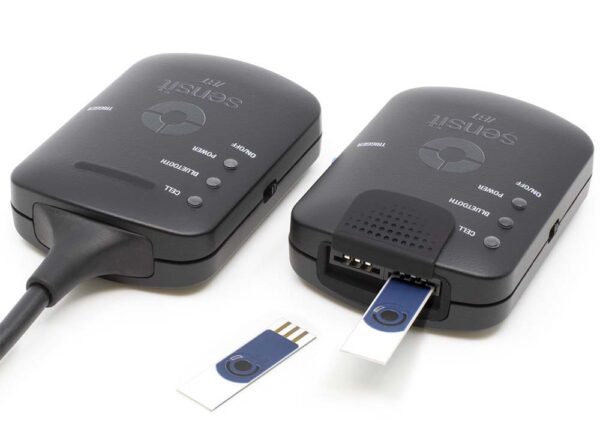
Two versions:
| Sensit BT.SPE | Sensit BT.SNS | ||
 |
 |
||
| Sensor pitch | 2.54 mm | Cable length | 40 cm |
| Electrode connections | RE, WE, CE | Connectors | 2 mm banana |
| Allowed sensor thickness | Between 0.1 mm and 0.8 mm | Electrode connections | RE, WE, WE2, CE |
| Maximum sensor width | 11 mm | ||


Dual-channel and Bipotentiostat
The Sensit BT.SPE can be used for running sequential measurements on two different Screen-Printed Electrodes (SPE’s) each with their own Reference, Counter and Working electrodes.
The second channel can also be used in Bipotentiostat mode, functioning as second Working Electrode versus the Reference and Counter electrode of channel 1. Both working electrodes are recorded simultaneously in the Bipotentiostat mode.
The Sensit BT.SNS has a lead connected to the WE of channel 2 and can be used out-of-the-box for BiPotentiostat measurements.
On-board data storage

The Sensit BT is equipped with 500 MB internal storage memory.
Save measurements on-board as a backup. Or pre-program the device with a script and use the trigger button to run and store measurements: no need to connect a PC or smartphone. Browse and transfer all internally stored measurements back to the PC easily using PSTrace for Windows.
Related products
-
EmStat4S
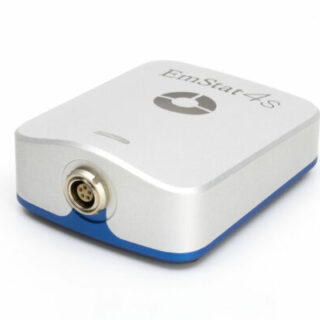
Read moreThe EmStat4S delivers desktop performance in the palm of your hand. The EmStat4S is a portable USB-powered Potentiostat, Galvanostat, and optional a Frequency Response Analyser (FRA) for Electrochemical Impedance Spectroscopy (EIS). The EmStat4S is controlled with PSTrace for Windows, or you can write your own MethodSCRIPT and control it from any platform or operating system.
More information can be found through the link: https://www.palmsens.com/product/emstat4s/
Versions
The EmStat4S comes in two different versions:
- Low Range: for lower currents and potentials
- High Range: for higher currents and potentials
Both versions can be configured with optional EIS/FRA with a maximum frequency of 200 kHz.
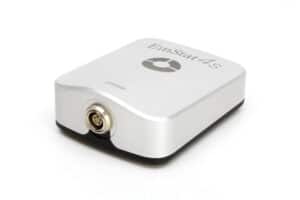
Main differences between the EmStat4S Low and High Range 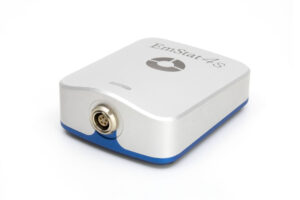


Potential range ±3 V ±6 V Max. compliance voltage
±5 V ±8 V Current ranges 1 nA to 10 mA (8 ranges) 100 nA to 100 mA (7 ranges) Max. current ±30 mA ±200 mA Electrode connections WE, RE, CE and ground,
2 mm banana plugsWE, RE, CE, Sense, and ground,
2 mm banana plugsStandard included
A standard EmStat4S includes a rugged carrying case with:
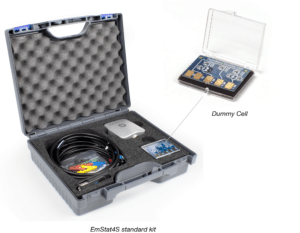
- EmStat4S
- USB-C cable
- Sensor cable: high quality, double-shielded cable with 2 mm banana connectors for Working, Counter, Reference electrode and Ground
- 4 or 5 crocodile clips
- Dummy Cell
- PSTrace software for Windows (on USB drive)
- Manual (hardcopy)
- Quick Start document
- Calibration report
-
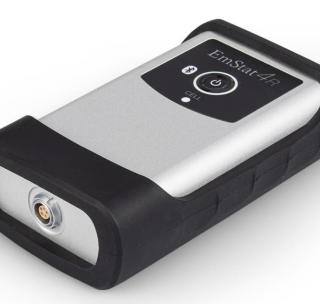
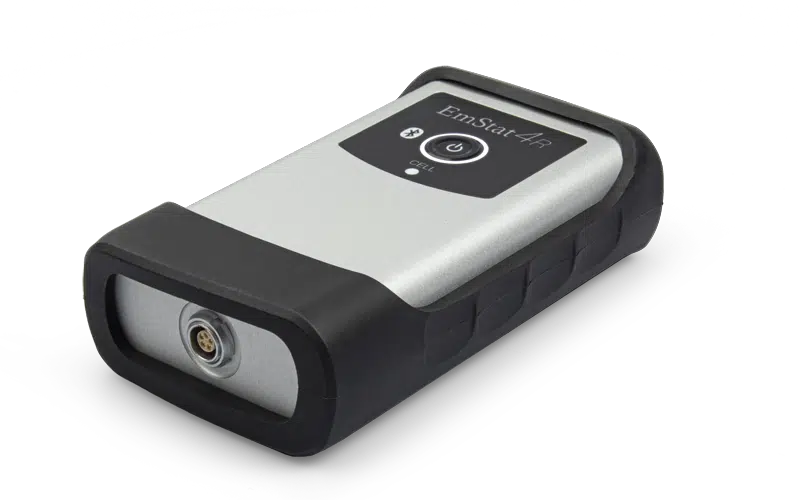
EmStat4R
Read moreThe EmStat4R delivers desktop performance in a rugged enclosure. The EmStat4R is a portable Battery or USB-powered Potentiostat, Galvanostat, and optional a Frequency Response Analyzer (FRA) for Electrochemical Impedance Spectroscopy (EIS).
The EmStat4R is great for applications that require low currents, from 30 mA down to picoamps, such as sensor applications. The EmStat4R is controlled with PSTrace for Windows, the Android app PStouch, or you can write your own MethodSCRIPT and control it from any platform or operating system.
More information can be found through the link: https://www.palmsens.com/product/emstat4r/
- Portable: battery, Bluetooth and rugged housing
- Available with connection module for sensor cable or SPE
- Potential range ±3 V
- Max. current ±30 mA
- Optional impedance analyzer: 10 μHz up to 200 kHz
Two versions
The EmStat4R is available with a cell cable or SPE connection module. Both versions can be configured with optional EIS/FRA with a maximum frequency of 200 kHz. See specifications for more information.
EmStat4R SNS EmStat4R SPE 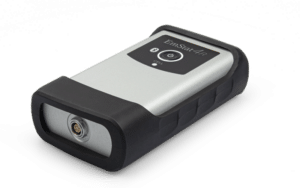
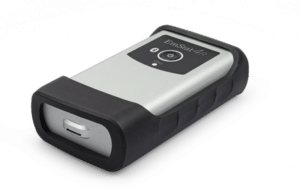
Connection module Cell cable Connection module Screen-printed-electrode Cell cable included Yes Cell cable included No Electrode connections WE, RE, CE and ground Electrode connections RE, WE, CE Connectors 2 mm banana Sensor pitch 2.54 mm Maximum sensor width 11 mm Allowed sensor thickness Between 0.1 mm and 0.8 mm Always a backup
The EmStat4R is equipped with 500 MB internal storage memory for storing your measurements as a backup. All internally stored measurements can be browsed and transferred back to the PC easily using the PSTrace software for Windows. Your data is always with your instrument wherever you take it.
Standard included
A standard EmStat4R includes a rugged carrying case with:

- EmStat4R
- Rugged case
- USB-C cable
- Cell cable: high quality, double-shielded cable with 2 mm banana connectors for Working, Counter, Reference electrode and Ground
- 4 crocodile clips
- Dummy Cell
- PSTrace software for Windows (on USB drive)
- Manual (hardcopy)
- Quick Start document
- Calibration report
- Three year warranty
-
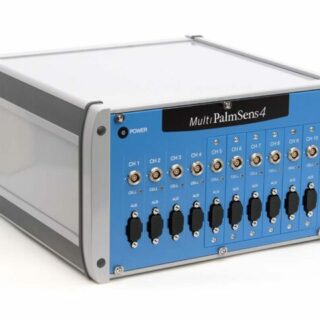
MultiPalmSens4
Read moreMulti-channel Potentiostat / Galvanostat / Impedance Analyzer
- 4 to 10 channels available in different configurations
- FRA / EIS: 10 μHz up to 1 MHz
- 9 current ranges: 100 pA to 10 mA
- potential range: ±5 V or ±10 V
The MultiPalmSens4 is a flexible multi-channel potentiostat, galvanostat and impedance analyzer which you can fully tailor to your requirements and budget. The MultiTrace software allows for using each channel individually or simultaneously or running a sequence of automated tasks on each channel. Each channel provides an additional auxiliary port for controlling peripherals or monitoring temperature or other analog signals.
More information can be found through the link: https://www.palmsens.com/product/multipalmsens4/
Configure your ideal multi-channel potentiostat
Each channel can be configured with:
- ±5 V or ±10 V maximum potential range
- EIS/FRA with maximum frequency of 100 kHz or 1 MHz
- Bipotentiostat module for second WE
- iR-Compensation
- Galvanic isolation
Always a backup
Every channel of the MultiPalmSens4 is equipped with 8 GB storage space. This means all your measurements* can automatically be saved on-board as backup.
Measurements can be browsed and transferred to the PC easily using the MultiTrace software for Windows.Synchronizing channels in Synched mode
By enabling synchronization of channels and adjusting the setup of your cables, you can use the MultiPalmSens4 as a polypotentiostat. This means you can use multiple working electrodes, one counter and one reference electrode in the same cell at the same time. Your working electrodes all perform the same measurement.
-
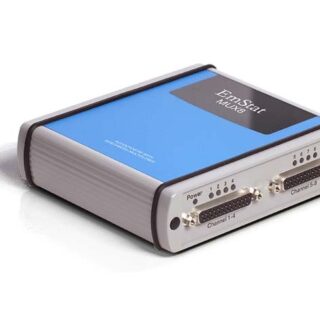
EmStatMUX8-R2
Read moreUSB powered potentiostat with integrated multiplexer
- potentiostat with integrated 8 channel multiplexer
- potential range: ± 3V or ± 4V
- compliance voltage: ± 5V or ± 8V
- current ranges: 1 nA – 100 mA
- maximum current: ± 100 mA
With the EmStat3MUX8-R2 you can connect arrays or other setups made of up to eight working electrodes in two or three electrode cell types. If more channels are required, one or more MUX-R2 can be stacked to the EmStatMUX8-R2 for a total of up to 128 channels.
The potentiostat is controlled as well as powered by USB and is used with PSTrace. The MUX8-R2 can sample different cells at a rate of 25 ms/cell. Usually a method needs to be finished to switch the cell but the fast sampling per cell makes it possible to measure time depending techniques, e.g. chronoamperometry, practically simultaneously. Via the script window of PSTrace it is also possible to perform a different experiment on each of the channels sequentially.
More information can be found through the link: https://www.palmsens.com/product/emstatmux/
Specifications
With EmStat potentiostat version 3 3+ dc-potential range
± 3.000 V ± 4.000 V compliance voltage
± 5 V ± 8 V dc-potential resolution 0.1 mV 0.125 mV dc-potential accuracy 0.2 % 0.3 % current ranges
1 nA to 10 mA (8 ranges) 1 nA to 100 mA (9 ranges) maximum current ± 20 mA typical
and ± 15 mA minimum± 100 mA typical The current is measured using a zero resistance ammeter (ZRA).
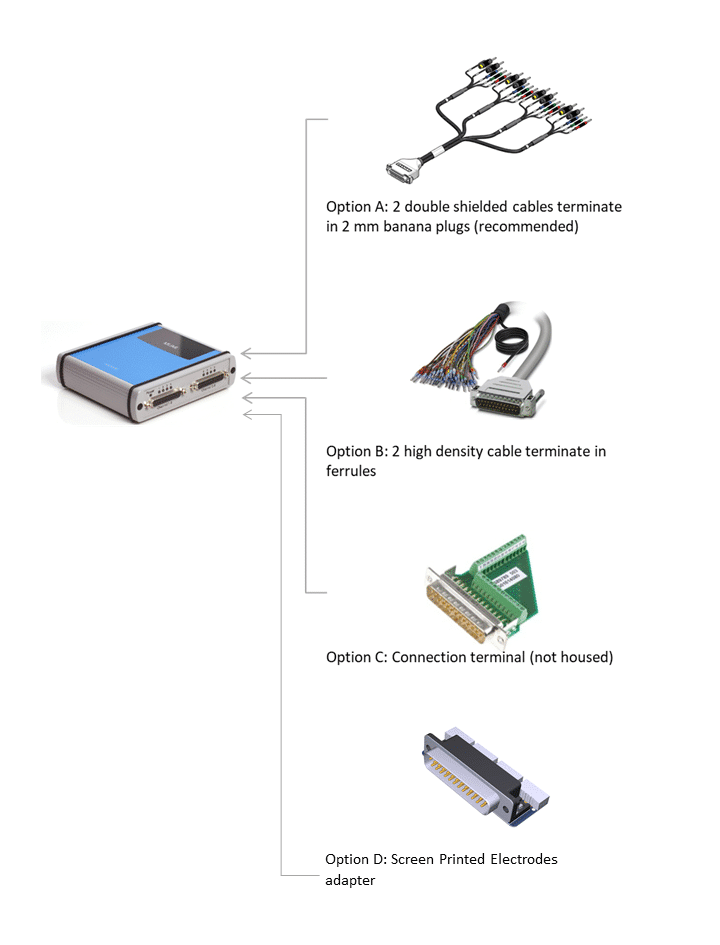
Cell connections
There are four ways to connect your sensor. These sensor connections are quoted separately.
- Option A: Double shielded sensor cables with 2 mm banana connectors. The 2 mm banana connectors are compatible with standard croc clips (they will be included in the quotation as optional).
- Option B: High-density cable that terminates in ferrules
- Option C: Connection (Screw) Terminal to assemble your own wires.
- Option D: Screen Printed Electrode Connector
Each of these connection options can be used to connect 4 channels. When you add the EmStatMUX8 in the quotation basket we will make sure to include two units of the selected connection option so you can connect all 8 channels to the electrochemical cells.