Category
- NEW PRODUCTS
- CUSTOMER SERVICES
- Custom made glass products
- Custom made and Modified Screen Printed Electrodes
- Sensors and electrodes
- Cables and connectors
- Cell
- Spectro, Photo, Raman – electrochemical cells
- Membrane Capacitive Deionization configurable cell
- NREL High-Pressure Low-Temperature Electrolysis Cell
- High-Pressure (25 bar) Single-Compartment Electrochemical Cell
- Stirrers
- Pumps
- Kits & Sets
- Minithermostat
- Modular PEM Electrolyzer Test Station
- Measurements of battery and supercapacitor materials
- Potentiostats
- Manual Screen Printer
- Accessories
- Discounted SPEs (at a reduced price with visual defects/inconsistancies, but fully functional)
Category: Kits & Sets
Kits & Sets
Showing all 12 results
-
Basic electrochemical cell setup (redox.me)
Read moreThis is a stationary solution basic electrochemical cell for measurements of electrodes in a form of:
a) rod/disc (6 mm dia.),
b) thin film deposited on a flat substrate (using a wire clip) and
c) membrane (using a wire clip).
The working, counter, and reference electrodes are mounted in a top casing either in 2-, or 3-electrode setup. The cell elements are constructed with materials that are inert to the sample (glass and PEEK). It well fits aqueous (FKM/EPDM O-Rings) and organic solvent (FFKM O-Rings) electrolyte requirements. The construction is gas-tight and can be used when the removal and exclusion of contaminants such as oxygen and water is required by bubbling of an inert gas through the electrolyte. The cell chamber is available in several material variants here (glass, PTFE, PEEK)
Application note:
The reference electrode tip should be placed at the level of working electrode center. This will ensure a low potential drop throughout the electrolyte solution for low-current experiment. Various auxiliary electrodes are suitable for this cell including metal wire and metal foil electrodes as well as graphite rod. The bubbling of gas through the solution must be stopped prior to experiment.Specification:
maximum electrolyte volume: 50 mL
electrode plug diameter: 6 mm
number of electrode slots: 3Intrastat data:
HS Code: 90309000
Country of Origin: Sweden
NET weight: 200 gSetup includes:
Item Qty B-A-BEC-50 B-O-BEC-50 BEC 50 mL – Basic Electrochemical Cell 1 C-A-BEC-50 C-O-BEC-50 Metal wire auxiliary electrode – 50HX15 0.6/250 mm, platinum (99,9%), 1 mm dia. gold plated pin 1 E-A-50HX15_Pt-1mm E-O-50HX15_Pt-1mm Silver / Silver Chloride Reference Electrode – Ag/AgCl 70 mm 1 E-Ag/AgCl_70 Non-aqueous Silver / Silver Ion Reference Electrode – Ag/Ag+ 70 mm 1 E-Ag/Ag+_70 Working disk electrode – 2 mm dia., PEEK BODY 6 mm dia. – 70 mm, glassy carbon 1 E-A-DISK_GC-70 E-O-DISK_GC-70 10 pcs of Tantalum wire clip with septum plug 0.6 mm dia., 60 mm long 1 E-A-Ta_CLIP-0.6/60-10p E-O-Ta_CLIP-0.6/60-10p -
Basic electrochemical H-cell setup (redox.me)
Read moreThis is a stationary solution double compartment electrochemical H-Cell for measurements of electrodes in a form of:
a) rod/disc (6 mm dia.),
b) thin film deposited on a flat substrate (using a wire clip) and
c) membrane (using a wire clip).
The working, counter and reference electrodes are mounted in a top casing either in 2-, or 3-electrode setup. The counter electrode is placed in a compartment separated from the other electrodes by ion-exchange membrane (19 mm to 25 mm dia.), so the electrochemical products appearing at working and counter electrode do not affect the opposite electrode. The counter electrode compartment is equipped with a separate inlet and outlet for easy filling with an electrolyte and evacuation of gaseous products. It can accommodate standard Metal Wire Auxiliary Electrode as well as square shape electrodes with sizes up to 25 mm x 25 mm. The cell elements are constructed with materials that are inert to the sample (glass and PEEK). It well fits aqueous (FKM/EPDM O-Rings) and organic solvent (FFKM O-Rings) electrolyte requirements. The construction is gas-tight and can be used when the removal and exclusion of contaminants such as oxygen and water is required by bubbling of an inert gas through the electrolyte. After removal of the counter electrode glass compartment, the cell gets the functionality of a Basic Electrochemical Cell – BEC 50 mL.
The cell chamber is available in several material variants here.
Application note:
The reference electrode tip and working disk electrode tip should be placed in the middle of the membrane. This will ensure a low potential drop throughout the electrolyte solution for low-current experiment. Various auxiliary electrodes are suitable for this cell including metal wire and metal foil/mesh/foam electrodes as well as graphite rod. The bubbling of gas through the solution must be stopped prior to experiment.Specification:
minimum electrolyte volume in WE compartment: 22 mL
minimum electrolyte volume in CE compartment: 6 mL
maximum electrolyte volume: 40 mL
minimum membrane diameter: 19 mm
maximum membrane diameter: 25 mm
maximum membrane thickness: 0.5 mm
electrode plug diameter: 6 mm
number of electrode slots: 3Intrastat data:
HS Code: 90309000
Country of Origin: Sweden
NET weight: 200 gSetup includes:
1 x BE H-Cell 50 mL – Basic Electrochemical H-Cell 50 mL
1 x Metal Wire Auxiliary Electrode – 50HX15 0.6/250 mm (Platinum)
1 x Reference electrode (Ag/AgCl, or Ag/Ag+)
1 x Glassy Carbon disk electrode – 2 mm dia.
1 x Plug with silicone rubber septum and set of Tantalum wire clips (set of 10) -
Bottom mount front contact electrochemical cell setup (redox.me)
Read moreThis is a static voltammetry cell with variants for different sample dimensions. The sample is loaded from the bottom via magnetic or screw mount, while counter or/and reference electrodes are mounted in the lid as either 2-, or 3-electrode configuration. The cell is constructed with materials that are inert to the sample environment (glass and PEEK), and it can be used with FKM/EPDM O-rings or FFKM O-rings for aqueous or organic electrolyte requirements, respectively. The construction is gas-tight and inert gas can be bubbled through the electrolyte to remove and exclude contaminants such as air or water.
Application note:
The reference electrode tip should be placed close to the sample surface to ensure a negligible potential drop throughout the electrolyte solution during low-current experiments. In the magnetic variant of the cell, the strength with which the magnets hold the sample is adjusted by adding or removing the washers under the magnets. Thanks to this procedure, the distance between the magnets changes, with it, the force of their attraction. Various auxiliary electrodes are suitable for this cell, including metal wire and metal plate electrodes as well as carbon-based electrodes (graphite or Glassy Carbon). If a purge gas is used, stop the flow during experiments for better results.Specification:
nominal exposure area: 0.07 cm2 for 5x5mm2, 0.2 cm2 for 7x7mm2, 0.5 cm2 for 10x10mm2, and 1.33 cm2 for 15x15mm2
minimum electrolyte volume: 2.5 mL
maximum electrolyte volume: 15 mL
electrode plug diameter: 6 mm
substrate size: 5x5mm2, 7x7mm2, 10x10mm2, and 15x15mm2, other sizes available on request
minimum substrate thickness: 0.4 mm**lower thicknesses are also feasible when using a pad below the sample
Intrastat data:
HS Code: 90309000
Country of Origin: Sweden
NET weight: 200 gSetup includes:
1 x BM FC EC 15mL – Bottom Mount Front Contact Electrochemical Cell, 15mL (or BMM FC EC 15mL – Bottom Magnetic Mount Front Contact Electrochemical Cell, 15mL)
1 x lid
1 x glass chamber
1 x bottom casing
1 x sample mount
1 x tantalum contact
1 x plug
1 x set of Nylon screws (screw variant only)
1 x Reference electrode (Ag/AgCl, or Ag/Ag+), 70mm, 4 mm female banana socket
1 x Metal Wire Auxiliary Electrode – 50HX15 0.6/250 mm, platinum 99.9%, 4 mm female banana socket -
Front contact photo-electrochemical H-Cell setup (redox.me)
Read moreThis is a horizontally mounted, double compartment photo-electrochemical H-Cell used to simultaneously or individually investigate thin film photo-anode and photo-cathode. The cell elements are made of PEEK and Fluoropolymers. It well fits aqueous (FKM O-Rings) and organic solvent (FFKM O-Rings) electrolyte requirements. The construction is gas-tight having two separate chambers, each equipped with gas inlet and outlet. This allows bubbling the solution and evacuating gases. Chambers are separated with an ion-exchange membrane (e.g., DuPont’s Nafion® membrane), so the electrochemical products appearing at photo-anode and (photo-)cathode do not affect the opposite electrode.
Application note:
This cell allows several approaches to perform measurements in 2- or 3-electrode setups. It is designed to investigate performance of a thin film photo-anode or photo-cathode (e.g. nanocrystalline material or conducting polymer) deposited on a rigid or flexible transparent substrate (typically fused quartz glass). The counter electrode is mounted in the second chamber either in a top casing or attached on the side of the cell as a thin film deposited on rigid or flexible substrate. The reference electrode is mounted in a top casing of the same chamber as the studied photo-electrode. Various auxiliary electrodes are suitable for this cell including metal wire, gauze and foil electrodes as well as non-metal electrodes and thin films. Typical applications include: basic photochemistry (photo-catalysis), photolytic water splitting, photoinduced charge separation and photo-corrosion.Specification:
minimum electrolyte volume: 2×10 mL
maximum electrolyte volume: 2×15 mL
electrode plug diameter: 6 mm
maximum substrate thickness: 3 mmIntrastat data:
HS Code: 90309000
Country of Origin: Sweden
NET weight: 600gSetup includes:
1 x Front Contact Photo-Electrochemical H-Cell
2 x lid – 0001CPEMA
2 x chamber
2 x sample mount
2 x Tantalum contacts
1 x micro tripod
4 x plug
1 x set of O-Rings (18 pcs)
1 x Metal Wire Auxiliary Electrode – 50HX15 0.6/250 mm (Platinum)
2 x Reference electrode (Ag/AgCl, or Ag/Ag+), 30 mm -
Membrane Capacitive Deionization configurable cell (redox.me)
Read moreMembrane Capacitive Deionization (MCDI) configurable cell has been designed to conduct research on removal of charged ionic species from aqueous or organic solutions (i.e., Desalination/Demineralization) via electrostatic (i.e., non-Faradaic) or electrochemical (redox) interactions. The MCDI cell contains two graphite current collectors that can serve as polarization electrodes. However, if the electrode material is the subject of research, it should be applied to an additional current collector, such as graphite paper or metal felt (not included in the product). Different electrode materials can be installed on both sides of the cell. If the thickness of these electrodes exceeds 250 micrometers, different gaskets are required. In such a case, please contact us for a solution.
The cell is designed in such a way that replacing the electrodes does not require removing the membranes or flow fields. It is enough to unscrew the plungers on both sides and replace the electrodes. In the standard configuration, the liquid in the main channel and side channels flows through the flow field cut from PEEK. However, these can be replaced with a porous material such as felt or a battery spacer, which will allow fluid flow. If work with materials of dimensions different from those listed in the specification is required, we can supply seals of different thicknesses or customize the cell. The cell allows for the installation of one or two ion-exchange membranes (not included in the setup). Their thickness is not critical, and it is not necessary to adjust the thickness of the membrane gaskets pressing them. The cell elements are constructed with inert materials to the sample (PEEK). It well fits aqueous (FKM gaskets and O-rings) and organic solvent (FFKM gaskets and O-rings) electrolyte requirements. The construction of the cell is gas-tight.
Application note:
MCDI cell can be configured to allow the following cell architectures:- Flow-by CDI consisting of: (i) two porous carbon or metal based current collectors coated with capacitive (e. non-Faradaic) material, and (ii) a main flow field enabling the feed water to be transported between electrodes. In this configuration, side flow fields and membranes are not installed.
- Membrane CDI consisting of: (i) two porous carbon or metal based current collectors coated with capacitive (e. non-Faradaic) material, (ii) two ion-exchange membranes (cation exchange membrane and anion exchange membrane) separating electrodes from the main flow field, and (iii) a main flow field enabling the feed water to be transported between electrodes. In this configuration, side flow fields are typically not installed. However, there are cases where installing both side flow fields is justified. All the graphics included in the product page refer to that configuration.
- Inverted CDI consisting of: (i) two porous carbon or metal based current collectors coated with capacitive (e. non-Faradaic) material where anode is treated for net negative surface charge and a cathode is treated for net positive surface charge, and (ii) a main flow field enabling the feed water to be transported between electrodes. In this configuration, side flow fields and membranes are not installed.
- Flow-electrode CDI consisting of: (i) two porous carbon or metal based current collectors with flowing electrodes made of capacitive (e. non-Faradaic) carbon suspension, (ii) two ion-exchange membranes (cation exchange membrane and anion exchange membrane) separating electrodes from the flow chamber, (iii) a main flow field enabling the feed water to be transported between electrodes, and (iv) two side flow fields for liquid electrodes. All the graphics included in the product page refer to that configuration.
- Hybrid CDI consisting of: (i) a Faradaic (e. battery) electrode for cation adsorption/desorption, (ii) a capacitive (i.e. non-Faradaic) electrode for anion adsorption/desorption, (iii) an anion exchange membrane placed adjacent to the capacitive electrode, and (iv) a main flow field enabling the feed water to be transported between electrodes. In this configuration, side flow fields and a cation-exchange membrane are not installed.
- Cation intercalation desalination consisting of: (i) two porous carbon or metal based current collectors coated with Faradaic cation intercalation materials, (ii) an anion exchange membrane separating electrodes, and (iii) a main flow field enabling the feed water to be transported between electrodes. In this configuration, one side flow field and cation-exchange membrane are not installed.
- Desalination battery consisting of: (i) two porous carbon or metal based current collectors coated with redox (e. Faradaic) material (one for cation adsorption/desorption and the other for anion adsorption/desorption), and (ii) a main flow field enabling the feed water to be transported between electrodes. In this configuration, side flow fields and membranes are not installed.
Specification:
tubing size: 4 mm OD
fitting type: push-in, M5 male
electrode size: 60 mm x 60 mm (36 cm2)
recommended total electrode thickness: 200-250 µm
membrane size: 70 mm x 85 mm
maximum operating pressure: 20 bar
maximum operating temperature 150 ºCIntrastat data:
HS Code: 90278080
Country of Origin: Sweden
NET weight: 1300 gProduct includes:
2 x stand, anodized aluminum
2 x plunger holder, SS 316L
2 x PEEK plunger
2 x tantalum current collector
2 x graphite current collector
1 x threaded end plate, SS 316L
1 x unthreaded end plate, SS 316L
1 x PEEK outer cell body
1 x PEEK inner cell body
1 x set of fittings
2 x female banana connectors, 4 mm dia.
1 x PEEK main flow field, 0.5 mm thick
2 x PEEK side flow field, 0.5 mm thick
1 x set of gaskets (FKM or FFKM) including:1 x main flow gasket, 0.5 mm thick
2 x membrane gasket, 0.25 mm thick
2 x side flow gasket, 0.5 mm thick
2 x electrode gasket, 0.25 mm thick -
Raman Electrochemical Flow Cell, active area: 3.5 cm2, volume: 4.5 mL (redox.me)
Read moreThis cell combines two classical analytical techniques such as electrochemistry and Raman spectroscopy, to obtain in-situ chemical information about the reactions taking place during an electrochemical experiment. It consists mainly of three elements: (i) sample holder with Tantalum (formerly Copper) foil serving as an electric contact to working electrode surface, (ii) chamber in which reference and counter electrodes are installed together with electrolyte inlet and outlet and (iii) lid which seals the cell and holds the Sapphire window. The sample consisting of a thin film of electrochemically active material deposited on a rigid or flexible substrate (working electrode) is loaded from the bottom via magnetic or screw mount. The counter or/and reference electrodes are mounted in a top casing (either 2-, or 3-electrode setup. The oval counter electrode made of e.g. Platinum wire assures uniform distribution of the field lines along the path to working electrode. During an experiment Raman laser is focused onto the surface of a thin film working electrode through a transparent Sapphire window and thin layer of electrolyte (total optical path of 3.25 mm). The electrolyte thickness of 2.25 mm ensures free diffusion of ions (e.g. protons) and its counter ions.
The electrode adapter for installing 6 mm dia. electrodes inside Raman ECFC is available here. It enables using disk electrode, plug with clip or any other rod-shape electrode (e.g. graphite rod) or current collector (e.g. metal mesh, graphite coated metal mesh, metal foil, graphite coated metal foil, metal foam, carbon woven and non-woven fabrics, carbon paper, etc.) as working electrode instead of a flat electrode in default Raman ECFC configuration.
The screw mount variant of Raman ECFC can be converted into GDE Raman ECFC by using Gas Compartment. This conversion allows installation of Gas Diffusion Electrodes as working electrode.
The cell elements are constructed with materials that are inert to the sample (PEEK, Fluorocarbons). It well fits aqueous (FKM O-Rings) and organic solvent (FFKM O-Rings) electrolyte requirements. The construction is gas-tight and can be used when the removal and exclusion of contaminants such as oxygen and water is required by bubbling of an inert gas through the electrolyte (in an external reservoir).
Application note:
This cell can be used to track kinetic phenomena such as the near-surface proton concentration changes during oxidation and reduction reaction at working electrode. It can be also used to identify materials such as carbon, metal oxides, polymers and electrolytes, and to determine their structure and distribution. Various metals are suitable for this cell as auxiliary electrode including Platinum, Gold and Silver.Specification:
nominal exposure area: 3.5 cm2
electrolyte volume: 4.5 mL
optical path (including Sapphire window): 3.25 mm
electrode plug diameter: 6 mmIntrastat data:
HS Code: 90275000
Country of Origin: Sweden
NET weight: 200 gProduct includes:
1 x chamber
1 x Reference electrode (Ag/AgCl, or Ag/Ag+), 30mm
1 x Metal wire auxiliary electrode – ST 0.6/150 mm, Platinum
1 x Sapphire window – 0054PSPCM
1 x lid
1 x WE Tantalum contact
1 x sample holder
1 x plug – 0005CPEMA -
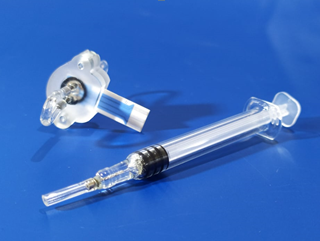
SIRE Sensor Cell Set (Sensor with Injectable Recognition Element)
Read moreThe SIRE Sensor Cell Set consists of a sensor with an integrated non-removable specialised chamber.
The set also contains a syringe which will allow the injection of the recognition element (Enzyme).
The SIRE Sensor Cell uses the concept of soluble enzymes into a reaction chamber separated from the sample by a semi permeable dialysis membrane. The analyte (for example maltose), enters into the reaction chamber by diffusion. The analyte reacts with the recognition enzymes creating H2O2 which is oxidized on a screen printed Pt electrode. The current corresponds to the amount of analyte.* For this product, we recommend our customers use the Training Service from BVT.
(https://bvt.cz/produkt/offer-of-long-term-automated-measurements-on-bvt-apparatus/)
-
Spectro-electrochemical flow cell setup (redox.me)
Read moreThis is a horizontally mounted, multi-purpose spectroelectrochemical cell designed to be used with standard UV-Vis or IR spectrometers. It enables obtaining electrochemical and spectroscopic information from liquid sample or thin films in systems where variations in applied potential induce changes in observed spectra. It consists of a polyether ether ketone (PEEK) flow chamber equipped with a magnetic or screw mount sample holder, screw mount quartz window holder and two different mini tripods. It well fits aqueous (FKM O-Rings) and organic solvent (FFKM O-Rings) electrolyte requirements.
The cell is meant to be used with a standard reference electrode having 6 mm in diameter and a counter electrode either in the form of a rod or helix with 6 mm in diameter and 15 mm active length.
Application note:
The spectroelectrochemical cell is used to study the relation between absorbance/transmittance and electrochemical potential. It enables real-time monitoring of optical change in electrochromic materials. It also enables in-situ spectral acquisition for detection, identification and characterization of short-lived electrochemically-generated species/intermediates, resulting in a detailed investigation of the mechanistic pathways of redox processes.Specification:
nominal exposure area: 1 cm2 (other values on request)
optical path length (electrolyte thickness): 12 mm
flow chamber volume: 1.75 mL
maximum substrate thickness: 4 mm
electrode plug diameter: 6 mm
minimum substrate size: 17 mm x 25 mm
recommended substrate size: 25 mm x 25 mmIntrastat data:
HS Code: 90275000
Country of Origin: Sweden
NET weight: 300 gSetup includes:
1 x Magnetic Mount Spectro-Electrochemical Flow Cell – MM spectro-EFC 1.75 mL (or Spectro-Electrochemical Flow Cell – spectro-EFC 1.75 mL)
1 x Metal Wire Auxiliary Electrode – 35HX15 0.6/235 mm (Platinum)
1 x Reference electrode (Ag/AgCl, or Ag/Ag+) -
Standard electrochemical cell setup (redox.me)
Read moreThis is a stationary solution standard electrochemical (electrolytic) cell for measurements of electrodes in a form of:
a) rod/disc (6 mm dia.),
b) thin film deposited on a flat substrate (using a sample holder) and
c) free-standing membrane (using the basic sample holder).
The working, counter, and reference electrodes are mounted in a top casing either in 2-, or 3-electrode setup. The cell has two spare ports for connection of e.g. thermometer, Clark electrode, pH meter electrode, or other 6 mm dia. electrode/probe.
The cell elements are constructed with materials that are inert to the sample (glass and PEEK). It well fits aqueous (EPDM O-Rings) and organic solvent (FFKM O-Rings) electrolyte requirements. The construction is gas-tight and can be used when the removal and exclusion of contaminants such as oxygen and water is required by bubbling of an inert gas through the electrolyte. The jacketed model is available here.
Application note
The reference electrode tip should be placed close to a working electrode center. This will ensure a low potential drop throughout the electrolyte solution for low-current experiment. Various auxiliary electrodes are suitable for this cell including metal wire and metal foil electrodes as well as graphite rod. The bubbling of gas through the solution must be stopped prior to experiment.Specification:
maximum electrolyte volume: 100, 150, 200, 250, 350, 500 or 1000 mL
electrode plug diameter: 6 mm
number of electrode ports: 5
vial material: borosilicate 3.3 glassIntrastat data:
HS Code: 90309000
Country of Origin: Sweden
NET weight: 200 g (100, 150 mL), 300 g (200, 250, 350 mL), 400 g (500 mL), 600 g (1000 mL) -
STK Starting kit
Read moreStarting kit STK.S
Set of twenty electrochemical sensors with a simple connector to find the best one to fit your application.
Starting kit is the set of twenty different electrochemical sensors to find the best one to fit your application. Starting kit contains 10 types of electrochemical sensors (2 sensors of each type), simple sensors connector and sensors box with numbered positions and silica gel.
-
STK-C Customer Starting kit
Read moreStarting Kit STK.S-C
The customer starter kit is a set of twenty different electrochemical sensors to find the best one that suits your application.
The starter set contains at least 5 pcs of sensors type AC1.W*.R* from the given type of sensors with a working electrode diameter (Dw) 1 or 2 mm stored in a box with numbered positions and silica gel.
The exact choice of the given types of sensors in the kit is at the request of the customer.
-
Three Electrode Battery Test Cell – compression controlled (redox.me)
Read moreThis cell is designed as high-quality alternative to Swagelok-type constructions for reproducible electrochemical measurements of battery and supercapacitor materials.
The cell consists of two main elements:
(i) the cell base with micrometre screw and compression spring, which allows precise control of pressure applied to the electrode sandwich; and
(ii) electrode cartridge where the anode, cathode and reference electrode are located.
The (default) electrode cartridge and plungers are designed for planar electrodes with diameter of 18 mm and total sandwich thickness of 2.5 mm. The diameter of separator shall be at least 2 mm larger than electrode diameter (max. 22 mm). The lock ring secures the separator in the electrode cartridge allowing easy and safe electrodes insertion, while ensuring accurate alignment. The upper and lower electrode plungers are available in various materials: 316L Stainless Steel (default), copper, aluminum, nickel etc. The pin-type reference electrode is installed from the side of the electrode cartridge. Thanks to sharp edged hole at the end of the pin the reference electrode (Li/Na/K etc.) can be easily punched from the metal foil and directly loaded into cell. The magnetic mount facilitates rapid assembly of the cartridge in the cell base. The force applied to the electrodes can reach up to 90N and is adjusted with the micrometer control knob. For 2-electrode measurements, the reference electrode feedthrough hole can be closed with the reference electrode punch.
The cell elements are constructed with materials that are inert to the sample (Stainless steel and PEEK). It well fits aqueous (FKM and EPDM O-Rings) and organic solvent (FFKM O-Rings) electrolyte requirements. Good electrical contact is ensured by gold plated pins. The construction is gas-tight and can be effortlessly assembled in the glove box, reducing possible human error to minimum.
Application note:
This cell can be used for all common battery measurements, such as galvanostatic cycling, cyclic voltammetry or electrochemical impedance spectroscopy. Both liquid and solid-state or gel-polymer electrolytes can be studied. Additionally, properties and performance of supercapacitor materials can be investigated. Various materials can be examined, including typical Li-ion electrodes (graphite, NMC, LTO etc.) and other chemistries – sodium, magnesium, potassium etc. It can also be applied to measure the ionic conductivity of separators and electrolytes. Owing to the micrometer control knob, the relationship between the initial pressure applied to the cell and the performance of solid-state electrolytes or metal plating process (anode-free systems) can be studied.The above graph shows relation of pressure applied to electrode stack and distance travelled from the point of contact. The point of contact can be determined by checking OCV (see manual video) or by calculation. To calculate the point of contact, subtract electrode stack thickness from 4 mm. For example, for the 0.9 mm stack, the point of contact (i.e. reading on micrometer screw) will be 4 mm – 0.9 mm = 3.1 mm. Therefore, you should set micrometer screw to 3.1 mm and measure distance/pressure relation from this point.
Specification:
recommended electrode diameter: 18 mm (other options: 12 mm, 15 mm, 16 mm)
recommended minimum separator diameter: electrode diameter + 2 mm (max. 22 mm)
maximum electrode sandwich thickness: 2.5 mm
spring rate: 10.86 N/mm
maximum spring load: 90 N
operating temperature: -40°C – 80°C (default)Intrastat data:
HS Code: 90309000
Country of Origin: Sweden
NET weight: 400gProduct includes:
1 x cell base
1 x compression control unit
1 x Three-Electrode Cartridge
1 x reference electrode punch
1 x upper plunger (Stainless Steel)
1 x lower plunger (Stainless Steel)
1 x separator locking ring
1 x gold plated piston
1 x compression spring
2 x gold plated pin contact
1 x set of O-rings
1 x set of 3 cable adapters 1mm to 4mm banana plug
1 x electrode plunger removal tool