


Sample Holder 25 mm x 25 mm (redox.me)
The sample holder (known also as flat specimen holder) is used for holding flat, circular or square/rectangular samples. It enables contacting the sample from the front (e.g. ITO/FTO glass, Monolayer Graphene on SiC, or Boron-Doped Diamond thin film on various substrates) and from the back (e.g. metal specimen, Glassy Carbon plate, Boron-Doped Diamond plate). The default nominal aperture is 1cm2, but other value can be provided on request. The large electrical contact with Tantalum (formerly Copper) foil surface (not being in contact with an electrolyte) ensures optimal current collection by minimizing electrical resistance and unifying current distribution. The rod with electrical connection has a diameter of 6 mm, which makes the sample holder compatible with our voltammetry cells and jacketed cells, as long as it fits in. We may also provide an adapter to install this sample holder in openings larger than 6 mm dia.
The sample holder elements are constructed with materials that are inert to the electrochemical system (PEEK, Fluorocarbons). It well fits aqueous (FKM/EPDM O-Rings) and organic solvent (FFKM O-Rings) electrolyte requirements. The construction is well sealed which prevents the electrolyte to leak inside.
Application note
The sample holder is used largely for corrosion studies. It can be installed in a beaker type cell as well as in testing environments such as open water reservoirs, cans, tanks etc. It can also be used wherever it is necessary to make an electrode using a thin layer of an active material deposited on a flat substrate (conducting or insulating).
Specification
nominal aperture range: 0.008 cm2 (1 mm dia.) – 4.155 cm2 (23 mm dia.)
minimum aperture: 0.008 cm2 (1 mm dia.)
maximum aperture: 4.9 cm2 (23 mm dia.)
electrical connection diameter (rod): 6 mm
minimum substrate size:
| nominal aperture | minimum substrate size |
| 0.008 cm2 (1 mm dia.) | 10 x 10 mm2 (square) or 12 mm dia. (circular). |
| 0.196 cm2 (5 mm dia.) | 7 x 7 mm2 (square) or 10 mm dia. (circular). |
| 0.283 cm2 (6 mm dia.) | 8 x 8 mm2 (square) or 11 mm dia. (circular). |
| 0.385 cm2 (7 mm dia.) | 9 x 9 mm2 (square) or 12 mm dia. (circular). |
| 1 cm2 (11.3 mm dia.) | 13 x 13 mm2 (square) or 16 mm dia. (circular). |
| 1.76 cm2 (15 mm dia.) | 17 x 17 mm2 (square) or 20 mm dia. (circular). |
| 3 cm2 (19.5 mm dia.) | 22 x 22 mm2 (square) or 24 mm dia. (circular). |
| 3.5 cm2 (21 mm dia.) | 23 x 23 mm2 (square) or 25 mm dia. (circular). |
| 4.155 cm2 (23 mm dia.) | 25 x 25 mm2 (square only) |
maximum substrate size: 25 x 25 mm2
maximum sample thickness: 4 mm
contact type: front or back
Intrastat data
HS Code: 90309000
Country of Origin: Sweden
NET weight: 100 g
Product includes
1 x chamber
1 x lid
1 x contact (Tantalum foil)
1 x rod with electrical connection
Select configuration
Operating Video Manual:
Related products
-

Standard electrochemical cell setup (redox.me)
Read moreThis is a stationary solution standard electrochemical (electrolytic) cell for measurements of electrodes in a form of:
a) rod/disc (6 mm dia.),
b) thin film deposited on a flat substrate (using a sample holder) and
c) free-standing membrane (using the basic sample holder).
The working, counter, and reference electrodes are mounted in a top casing either in 2-, or 3-electrode setup. The cell has two spare ports for connection of e.g. thermometer, Clark electrode, pH meter electrode, or other 6 mm dia. electrode/probe.
The cell elements are constructed with materials that are inert to the sample (glass and PEEK). It well fits aqueous (EPDM O-Rings) and organic solvent (FFKM O-Rings) electrolyte requirements. The construction is gas-tight and can be used when the removal and exclusion of contaminants such as oxygen and water is required by bubbling of an inert gas through the electrolyte. The jacketed model is available here.
Application note
The reference electrode tip should be placed close to a working electrode center. This will ensure a low potential drop throughout the electrolyte solution for low-current experiment. Various auxiliary electrodes are suitable for this cell including metal wire and metal foil electrodes as well as graphite rod. The bubbling of gas through the solution must be stopped prior to experiment.Specification:
maximum electrolyte volume: 100, 150, 200, 250, 350, 500 or 1000 mL
electrode plug diameter: 6 mm
number of electrode ports: 5
vial material: borosilicate 3.3 glassIntrastat data:
HS Code: 90309000
Country of Origin: Sweden
NET weight: 200 g (100, 150 mL), 300 g (200, 250, 350 mL), 400 g (500 mL), 600 g (1000 mL) -

EmStat4T (Tailored electrochemistry through touch-controlled apps)
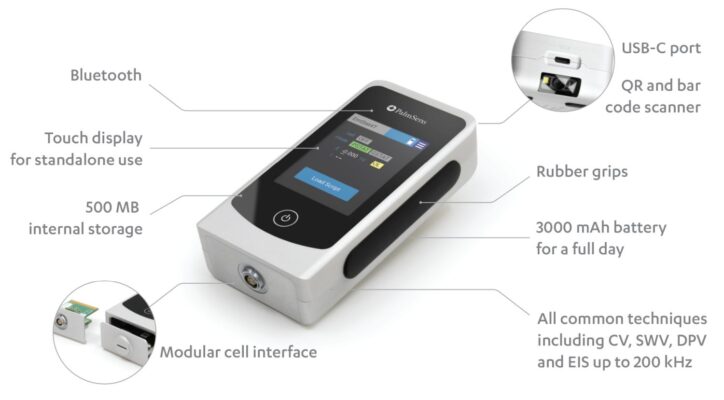
Read moreThe EmStat4T is a programmable handheld potentiostat with a touchscreen, which is ideal for sensor research and sensor-based applications. It offers two main modes of operation:
- Remote Control: where it functions as a conventional potentiostat, controlled directly by our PSTrace software for Windows or PStouch app for Android. These applications allow you to run measurements, view results, and perform data analysis.
- Standalone: where the instrument is controlled via its touch interface to run a wizard‑style app for electrochemical analysis. Compose custom apps easily using the Visual MethodSCRIPT Editor included in PSTrace for Windows. Apps eliminate the need for a computer, tablet, or smartphone. This makes the EmStat4T an ideal solution for point-of-care applications and field research such as environmental analysis or corrosion monitoring.
More information could be found tought link:
https://www.palmsens.com/emstat4t/
Tailored electrochemistry through touch-controlled apps
- Potential range ±3 V
- Max. current ±30 mA
- Supports common electrochemical techniques
- Standalone operation with MethodSCRIPT
- or remotely controlled by laptop or phone
- Bar/QR-code scanner
- Customizable cell interface with drop-detection for SPEs
Main Features
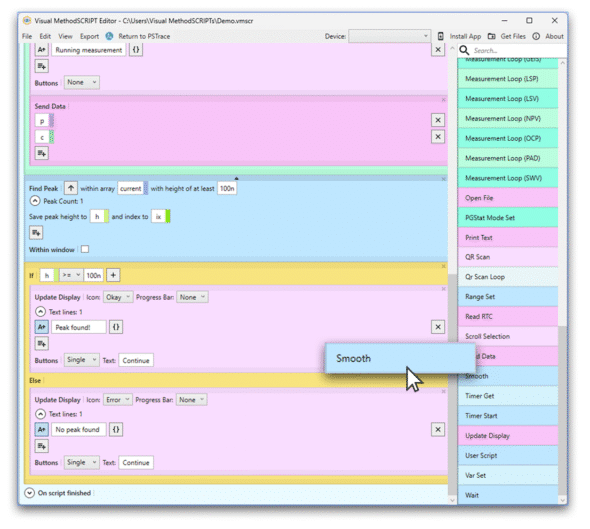 Visual MethodSCRIPT Editor
Create your EmStat4T apps
The powerful MethodSCRIPT™ language allows for easily creating your own applications to run on the EmStat4T. Compose apps using our Visual MethodSCRIPT Editor which generates the MethodSCRIPT for you.
Your measurements are safely stored

Internal Storage
The EmStat4T is equipped with 500 MB internal storage memory for storing your measurements. All internally stored measurements can be browsed and transferred back to the PC easily using the PSTrace software for Windows. Your data is always with your instrument wherever you take it.
-

Nexus
Read moreBuilding on PalmSens’ legacy of providing top-tier solutions for accurate low-current measurements, Nexus delivers an ultra-low-noise performance that exceeds even our existing portable devices, while also supporting measurements up to 1 Ampere.
More information could be found trough link:
https://www.palmsens.com/product/nexus/
- Bi)Potentiostat/ Galvanostat/ Impedance analyzer
- FRA / EIS: 10 μHz up to 1 MHz
- 11 current ranges: 100 pA to 1 A
- Dual EIS with second sense electrode
- Script your experiments using MethodSCRIPT
- Use with PSTrace software for Windows
Versatile
Our high-end instrument, the Nexus, is a Potentiostat, Galvanostat, and optional a Frequency Response Analyser (FRA) for Electrochemical Impedance Spectroscopy (EIS). The Nexus has a large potential range (-12V to +12V) and current range (100 pA to 1 A) with a high resolution and low noise.
The research software PSTrace makes using the Nexus a breeze. The scripting language MethodSCRIPT gives a user full control when needed. Looking for a multi-channel instrument? Just stack multiple instruments on top of each other.
Configurable
Nexus comes in different configurations:
- optional EIS/FRA module with maximum frequency of 1 MHz
- optional BiPotentiostat module for second WE
Standard included
Carrying padded bag containing:
- High quality, double shielded cell cable with
2 mm banana connectors for Working, Sense, Counter, Reference electrode and Ground - Chassis ground cable with croc clip (4 mm)
- Hardware Sync Link cable
- Crocodile clips
- Calibration report
- Dummy cell
- USB cable and Ethernet cable
- Manual and Quick Start document
- PSTrace software for Windows
- iR-compensation (ohmic drop compensation) module
- Second Sense lead cable
S2 and BiPot
Nexus includes a Second Sense lead (S2) and an optional BiPotentiostat (BiPot) module.
S2 – Additional voltage (potential) measurement point
BiPot – Independent second working electrode for simultaneous current measurement
These two features are independent and serve distinct purposes:
- S2 (Second Sense Lead)
S2 acts as an additional voltage-sensing input, with the same specifications as the main reference electrode. It measures the potential at a specific point in the cell and, because the current at that point is known, it can also be used to calculate impedance. - BiPot (BiPotentiostat Module)
The BiPot module introduces a second working electrode (WE2), operating versus the same reference and counter electrodes as the main channel. In BiPotentiostat mode, both working electrodes (WE1 and WE2) are recorded simultaneously. WE2 operates in potentiostatic mode, meaning it can independently control its potential and measure its current.
Why choose the Nexus?

-

Basic electrochemical cell setup (redox.me)
Read moreThis is a stationary solution basic electrochemical cell for measurements of electrodes in a form of:
a) rod/disc (6 mm dia.),
b) thin film deposited on a flat substrate (using a wire clip) and
c) membrane (using a wire clip).
The working, counter, and reference electrodes are mounted in a top casing either in 2-, or 3-electrode setup. The cell elements are constructed with materials that are inert to the sample (glass and PEEK). It well fits aqueous (FKM/EPDM O-Rings) and organic solvent (FFKM O-Rings) electrolyte requirements. The construction is gas-tight and can be used when the removal and exclusion of contaminants such as oxygen and water is required by bubbling of an inert gas through the electrolyte. The cell chamber is available in several material variants here (glass, PTFE, PEEK)
Application note:
The reference electrode tip should be placed at the level of working electrode center. This will ensure a low potential drop throughout the electrolyte solution for low-current experiment. Various auxiliary electrodes are suitable for this cell including metal wire and metal foil electrodes as well as graphite rod. The bubbling of gas through the solution must be stopped prior to experiment.Specification:
maximum electrolyte volume: 50 mL
electrode plug diameter: 6 mm
number of electrode slots: 3Intrastat data:
HS Code: 90309000
Country of Origin: Sweden
NET weight: 200 gSetup includes:
Item Qty B-A-BEC-50 B-O-BEC-50 BEC 50 mL – Basic Electrochemical Cell 1 C-A-BEC-50 C-O-BEC-50 Metal wire auxiliary electrode – 50HX15 0.6/250 mm, platinum (99,9%), 1 mm dia. gold plated pin 1 E-A-50HX15_Pt-1mm E-O-50HX15_Pt-1mm Silver / Silver Chloride Reference Electrode – Ag/AgCl 70 mm 1 E-Ag/AgCl_70 Non-aqueous Silver / Silver Ion Reference Electrode – Ag/Ag+ 70 mm 1 E-Ag/Ag+_70 Working disk electrode – 2 mm dia., PEEK BODY 6 mm dia. – 70 mm, glassy carbon 1 E-A-DISK_GC-70 E-O-DISK_GC-70 10 pcs of Tantalum wire clip with septum plug 0.6 mm dia., 60 mm long 1 E-A-Ta_CLIP-0.6/60-10p E-O-Ta_CLIP-0.6/60-10p