


Three Electrode Battery Test Cell – compression controlled (redox.me)
This cell is designed as high-quality alternative to Swagelok-type constructions for reproducible electrochemical measurements of battery and supercapacitor materials.
The cell consists of two main elements:
(i) the cell base with micrometre screw and compression spring, which allows precise control of pressure applied to the electrode sandwich; and
(ii) electrode cartridge where the anode, cathode and reference electrode are located.
The (default) electrode cartridge and plungers are designed for planar electrodes with diameter of 18 mm and total sandwich thickness of 2.5 mm. The diameter of separator shall be at least 2 mm larger than electrode diameter (max. 22 mm). The lock ring secures the separator in the electrode cartridge allowing easy and safe electrodes insertion, while ensuring accurate alignment. The upper and lower electrode plungers are available in various materials: 316L Stainless Steel (default), copper, aluminum, nickel etc. The pin-type reference electrode is installed from the side of the electrode cartridge. Thanks to sharp edged hole at the end of the pin the reference electrode (Li/Na/K etc.) can be easily punched from the metal foil and directly loaded into cell. The magnetic mount facilitates rapid assembly of the cartridge in the cell base. The force applied to the electrodes can reach up to 90N and is adjusted with the micrometer control knob. For 2-electrode measurements, the reference electrode feedthrough hole can be closed with the reference electrode punch.
The cell elements are constructed with materials that are inert to the sample (Stainless steel and PEEK). It well fits aqueous (FKM and EPDM O-Rings) and organic solvent (FFKM O-Rings) electrolyte requirements. Good electrical contact is ensured by gold plated pins. The construction is gas-tight and can be effortlessly assembled in the glove box, reducing possible human error to minimum.
Application note:
This cell can be used for all common battery measurements, such as galvanostatic cycling, cyclic voltammetry or electrochemical impedance spectroscopy. Both liquid and solid-state or gel-polymer electrolytes can be studied. Additionally, properties and performance of supercapacitor materials can be investigated. Various materials can be examined, including typical Li-ion electrodes (graphite, NMC, LTO etc.) and other chemistries – sodium, magnesium, potassium etc. It can also be applied to measure the ionic conductivity of separators and electrolytes. Owing to the micrometer control knob, the relationship between the initial pressure applied to the cell and the performance of solid-state electrolytes or metal plating process (anode-free systems) can be studied.
The above graph shows relation of pressure applied to electrode stack and distance travelled from the point of contact. The point of contact can be determined by checking OCV (see manual video) or by calculation. To calculate the point of contact, subtract electrode stack thickness from 4 mm. For example, for the 0.9 mm stack, the point of contact (i.e. reading on micrometer screw) will be 4 mm – 0.9 mm = 3.1 mm. Therefore, you should set micrometer screw to 3.1 mm and measure distance/pressure relation from this point.
Specification:
recommended electrode diameter: 18 mm (other options: 12 mm, 15 mm, 16 mm)
recommended minimum separator diameter: electrode diameter + 2 mm (max. 22 mm)
maximum electrode sandwich thickness: 2.5 mm
spring rate: 10.86 N/mm
maximum spring load: 90 N
operating temperature: -40°C – 80°C (default)
Intrastat data:
HS Code: 90309000
Country of Origin: Sweden
NET weight: 400g
Product includes:
1 x cell base
1 x compression control unit
1 x Three-Electrode Cartridge
1 x reference electrode punch
1 x upper plunger (Stainless Steel)
1 x lower plunger (Stainless Steel)
1 x separator locking ring
1 x gold plated piston
1 x compression spring
2 x gold plated pin contact
1 x set of O-rings
1 x set of 3 cable adapters 1mm to 4mm banana plug
1 x electrode plunger removal tool
Select configuration
Variant: water based / organic electrolyte
Related products
-
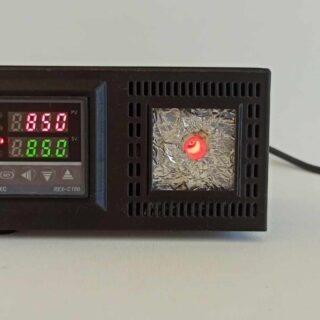
Activation furnance for electrochemical sensors
Read moreThe activation furnance is a device used for curing individual sensors of the AC1 type. At a defined temperature (up to 1000 °C) depending on the electrode and sensor materials. When the sensor is cured, the surface of the electrodes is cleaned from surface oxides and organic impurities, which results in regeneration of the sensor or its activation. In this way, for example, old sensors with immobilized enzyme layers can be cured for reuse – see example at the end ot the document.
-

EmStat4T (Tailored electrochemistry through touch-controlled apps)
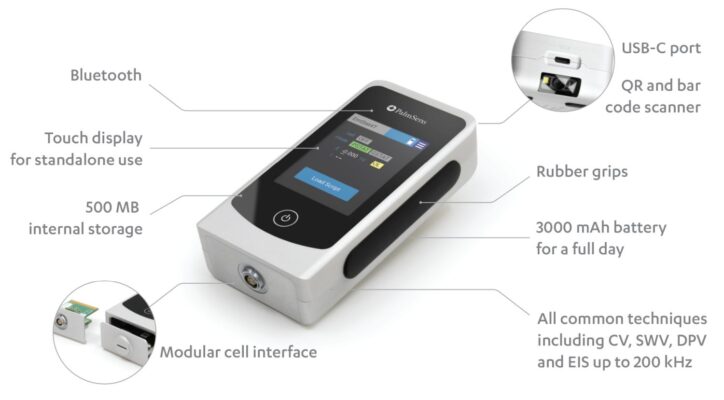
Read moreThe EmStat4T is a programmable handheld potentiostat with a touchscreen, which is ideal for sensor research and sensor-based applications. It offers two main modes of operation:
- Remote Control: where it functions as a conventional potentiostat, controlled directly by our PSTrace software for Windows or PStouch app for Android. These applications allow you to run measurements, view results, and perform data analysis.
- Standalone: where the instrument is controlled via its touch interface to run a wizard‑style app for electrochemical analysis. Compose custom apps easily using the Visual MethodSCRIPT Editor included in PSTrace for Windows. Apps eliminate the need for a computer, tablet, or smartphone. This makes the EmStat4T an ideal solution for point-of-care applications and field research such as environmental analysis or corrosion monitoring.
More information could be found tought link:
https://www.palmsens.com/emstat4t/
Tailored electrochemistry through touch-controlled apps
- Potential range ±3 V
- Max. current ±30 mA
- Supports common electrochemical techniques
- Standalone operation with MethodSCRIPT
- or remotely controlled by laptop or phone
- Bar/QR-code scanner
- Customizable cell interface with drop-detection for SPEs
Main Features
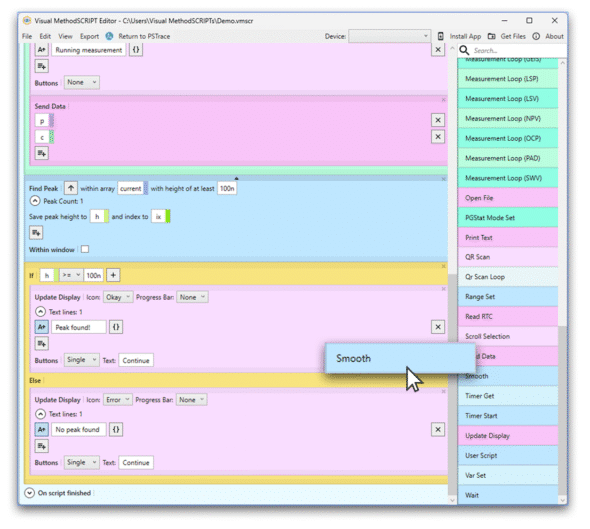 Visual MethodSCRIPT Editor
Create your EmStat4T apps
The powerful MethodSCRIPT™ language allows for easily creating your own applications to run on the EmStat4T. Compose apps using our Visual MethodSCRIPT Editor which generates the MethodSCRIPT for you.
Your measurements are safely stored

Internal Storage
The EmStat4T is equipped with 500 MB internal storage memory for storing your measurements. All internally stored measurements can be browsed and transferred back to the PC easily using the PSTrace software for Windows. Your data is always with your instrument wherever you take it.
-

AC1.GP. Electrochemical sensor with a working electrode of guaranteed purity
Read moreBasic amperometric three-electrode sensor with patented structure made by thick film technology.
Dimensions: 25.40 mm x 7.26 mm x 0.63 mm
WE material: gold, platinum, silver, copper, iron, nickel, cobalt, chromium, tantalum, irridium, rhenium, magnesium, palladium, zirconium and others
*Selection of sensor electrode materials other than those listed above is possible upon agreement with the customer.
The sensor is made on a corundum ceramic base. Working, reference and auxiliary electrodes are applied to this surface. Working, reference and auxiliary electrodes are made of different materials. At the end of the sensor there is a contact field that is connected to the active part by silver conductive paths that are covered with a dielectric protective layer. The working electrode of the sensor with a diameter of 2 mm is made of a material of guaranteed purity of up to 99.99 % depending on the selected material– standard layer thickness 0.0125 mm.
We also offer a working electrode made of polished gold AC1P.W*.R*, with homogenous surface with roughness less than 1 µm.
We also offer activated graphite sensors on customer request.
-
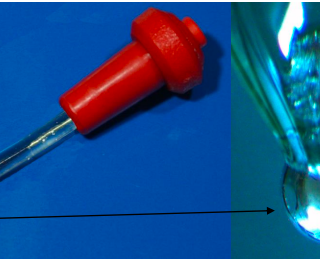
Hanging Platinum Drop Electrode
Read moreThe Hanging Platinum Drop Electrode (HPDE) is solid phase alanogy of HMDE.
The drop of liquid Pt at 2000 °C forms a drop of Pt. The surface of HPDE has nearly ideal surface which is impossible to obtain using polishing. HPDE has also spherical symmetry which enables mathematical treatment of its response.
The material is not toxic and it is chemically stable. The only disadvantage is HPDE cleaning, which can be, however, in some cases solved by carefull insertion of the electrode tip to the flame of an alcohol burner.
Thus HPDE can be used as reference electrode for complicated electrochemical studies, where it is necessary to distinguish the analytical signal from the signal generated by surface inhomogenities.Hanging platinum drop electrode (HPDE) is designed for measurements with thermostated cell TC4, TC5, TC6 and TC9.