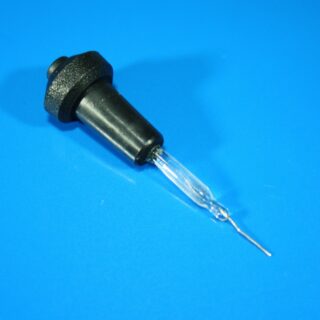
Hanging Platinum Drop Electrode
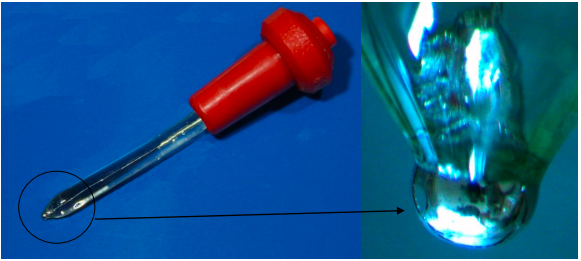
The Hanging Platinum Drop Electrode (HPDE) is solid phase alanogy of HMDE.
The drop of liquid Pt at 2000 °C forms a drop of Pt. The surface of HPDE has nearly ideal surface which is impossible to obtain using polishing. HPDE has also spherical symmetry which enables mathematical treatment of its response.
The material is not toxic and it is chemically stable. The only disadvantage is HPDE cleaning, which can be, however, in some cases solved by carefull insertion of the electrode tip to the flame of an alcohol burner.
Thus HPDE can be used as reference electrode for complicated electrochemical studies, where it is necessary to distinguish the analytical signal from the signal generated by surface inhomogenities.
Hanging platinum drop electrode (HPDE) is designed for measurements with thermostated cell TC4, TC5, TC6 and TC9.
Useful Documents
You may also like…
-
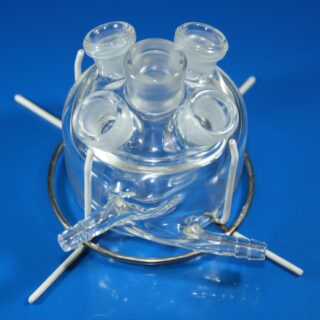
TC5 Electrochemical Glass Cell
Read moreBorosilicate glass cell serves for electrochemical measurements. The cell is jacketed.
The analyzed solution can be thermostated by external thermostat.
Cell openings are designed for electrochemical sensors connector KA1.C, classical electrodes WCEc, ACEc, RCEc and stirrer ST1, ST3 separately.
-
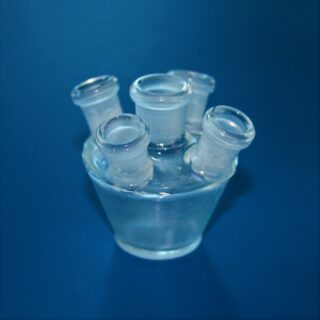
TC4 Electrochemical Glass Cell
Read moreSimple borosilicate glass cell serves for electrochemical measurements.
The temperature of the analyzed solution can be controlled when placing the cell in MT1-1 minithermostat.
Cell openings are designed for electrochemical sensors connector KA1.C, classical electrodes WCEc, ACEc, RCEc and stirrer ST1, ST3 separately.
-
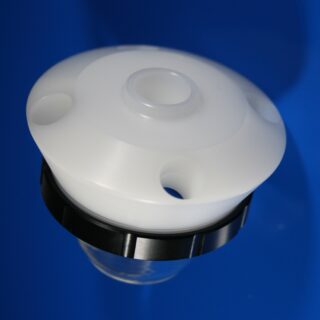
TC6 Electrochemical Glass Cell
Read moreBorosilicate glass cell serves for electrochemical measurements.
The analyzed solution can be thermostated by minithermostat MT1-1.
Cell openings are designed for electrochemical sensors connector KA1.C, classical electrodes WCEc, ACEc, RCEc and stirrer ST1, ST3 separately.
The device enables the measurement with inserted samples.
-
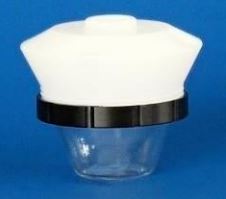
TC9 Electrochemical Glass Cell
Read moreBorosilicate glass cell serves for electrochemical measurements.
The analyzed solution can be thermostated by external thermostat MT1-1.
Cell openings are designed for stirrer ST9 or mini RDE and connector KA9.s with folder for electrochemical sensor AC9C, classical electrodes WCEc, ACEc and RCEc. The device enables the measurement with inserted samples.
Related products
-

AC1.GP. Electrochemical sensor with a working electrode of guaranteed purity
Read moreBasic amperometric three-electrode sensor with patented structure made by thick film technology.
Dimensions: 25.40 mm x 7.26 mm x 0.63 mm
WE material: gold, platinum, silver, copper, iron, nickel, cobalt, chromium, tantalum, irridium, rhenium, magnesium, palladium, zirconium and others
*Selection of sensor electrode materials other than those listed above is possible upon agreement with the customer.
The sensor is made on a corundum ceramic base. Working, reference and auxiliary electrodes are applied to this surface. Working, reference and auxiliary electrodes are made of different materials. At the end of the sensor there is a contact field that is connected to the active part by silver conductive paths that are covered with a dielectric protective layer. The working electrode of the sensor with a diameter of 2 mm is made of a material of guaranteed purity of up to 99.99 % depending on the selected material– standard layer thickness 0.0125 mm.
We also offer a working electrode made of polished gold AC1P.W*.R*, with homogenous surface with roughness less than 1 µm.
We also offer activated graphite sensors on customer request.
-

ZIVE SP1 – potentiostat/galvanostat/ZRA
Read more- Potentiostat/galvanostat/ZRA at affordable price
- Control voltage range: ±10V
- Control current range:9 ranges, 10nA~1A (10nA with gain)
Application - Battery
- Super capacitor
- Fuel cell
- Corrosion
- Sensor
- Solar cell
- Other Echem experiments
Features
- economical high quality potentiostat/galvanostat/impedance analyzer
- compact size with full functions
- ±10V@1Amp control range
- wide current ranges(1A to 10nA) for various applications
- built-in FRA : enables EIS tests by using software
- 14 EIS techniques capability including multisine
- capable of multitude of applications
– corrosion, general electrochemistry, sensor, battery, fuel cell,
supercapacitor, solar cell, etc. - bipolar pulse capability
- voltage pulse or current pulse charge/discharge test(GSM,CDMA etc.),
sine wave function for ripple simulation withenergysoftwarepackage
& pulse plating available - high speed data sampling time
– 2usec or 3usec depending on data point number - iR compensation and measurement
- 3 measurement/control voltage ranges &
9 measurement/control current ranges - internal 542,000 data point storage & continuing experiment regardless
of PC failure. - multichannel configuration available
- free software upgrade
Experimental Techniques
Basic techniques
- Potentiostatic
- Galvanostatic
- Double step potentiostatic
- Double step galvanostatic
- OCP measurement
- Potential sweep
- Current sweep
- Cyclic voltammetry
- Fast potential sweep
- Potentiostatic Ru measurement
- Galvanostatic Ru measurement
Advanced Software Package(Included)
- EIS software package(EISe)
– Potentiostat EIS
– Galvanostatic EIS
– Pseudo galvanostatic EIS
– OCP* EIS
– Potentiodynamic PEIS
– Galvanodynamic GEIS
– Poteniodynamic HFR
– Galvanodynamic HFR
– Potentiostatic HFR monitor
– Galvanostatic HFR monitor
– Multisine potentiostatic EIS
– Multisine galvanostatic EIS
– Intermittent potentiostatic EIS
– Intermittent galvanostatic EIS
(*) The system measures open circuit potential before each frequency
change and applies AC sine wave on this potential. - Corrosion software package(CORe)
– Tafel(Tafel experiment)
– Rp(Polarization resistance)
– RpEc trend
– PDYN(Potentiodynamic)
– CYPOL(Cyclic polarization resistance)
– GDYN(GalvanoDynamic)
– Reactivation
– Galvanic corrosion
– Potentiostatic ECN
– Galvanostatic ECN
– ZRA mode ECN - Energy software package(BATe)
a) Battery test technique
– CC/CV testforcycle life test of lithium battery
– CC/CC tet forcyclelifetestofNiCd or NiMH battery
– Discharging test
– EVS(electrochemical voltage spectroscopy)
– Variable scan rate CV
– Potentiostatic IV curve
– Galvanostatic IV curve
– Steady state CV
– PITT(Potentiostatic intermittent titration technique) test
– GITT(Galvanostatic intermittent titration technique) test
– Pulse mode is available for GSM & CDMA profile.
Pulse shape profile can be measured by user’s demand.
b) Control mode
– Charge : CC, CC-CV, pulse, sine wave
– Discharge : CC, CP, CR, pulse, sine wave
c) Cut-off condition
– Time, voltage, current, power, auxV etc.
– Various battery charge/discharge test is available including
pulse discharge for GSM, CDMA application - Electrochemical analysis software package(EASe)
a) Step techniques
– CA(Chronoamperometry)
– CC(Chronocoulometry)
– CP(Chronopotentiometry)
b) Sweep techniques
– LSV(Linear sweep voltammetry)
– SDV(Sampled DC voltammetry)
– Fast CV
– Fast LSV
c) Pulsed techniques
– DPV(Differential pulse voltammetry)
– SWV(Square wave voltammetry)
– DPA(Diff.pulse amperometry)
– NPV(Normal pulse voltammetry)
– RNPV(Reverse normal pulse voltammetry)
– DNPV(Differential normal pulse voltammetry)
-

Modular PEM Electrolyzer Test Station up to 3 kW (redox.me)
Read moreThe Modular PEM Electrolyzer Test Station is a versatile and flexible solution designed for the testing and evaluation of proton exchange membrane (PEM) electrolyzers. Unlike fully automated, integrated systems, this platform features modular components that can be easily swapped by the end user, allowing for customized setups and adaptability to different testing needs. The platform is engineered to provide precise control and measurement of electrochemical performance while offering the convenience of easily replaceable parts.
This design enables users to test various configurations, integrate new modules, and adapt the system to specific research or development objectives without the need for specialized equipment or extensive downtime. Ideal for research labs and development environments, this platform supports the advancement of PEM electrolyzer technology through hands-on, flexible experimentation.
Application note:
Ideal for researchers investigating new PEM materials, flow field designs, and cell configurations. The system is an excellent tool for academic institutions and training centers, providing students and researchers with a hands-on understanding of PEM electrolysis processes and system operation. PEM Electrolyzer Test Station with power up to 3 kW is suitable for testing lab-scale or small to medium-scale electrolyzers, typically up to 60 cm². If the power requirements for a given electrolyzer are less than 2 A/cm², larger electrolyzers up to 100 cm² or more can also be tested.
The entire system, as well as its component parts, are CE certified, which signifies that a product meets European Union (EU) health, safety, and environmental protection standards. Other certificates are available upon request.The Modular PEM Electrolyzer Test Station is continuously being improved, so the photos may not fully represent the current version of the device.
Specification:
weight: 150 kg
height: 129 cm (25U)
width: 135 cm (85 cm with folded monitors)
depth: 90 cm
maximum input power: 3 kW
maximum input current: 120 A
maximum input volatge: 60 V
power connection: 230V, 3 kW, single phaseIntrastat data:
HS Code: 85433000
Country of Origin: Sweden
NET weight: 150 kgSetup includes:
1 x Modular PEM Electrolyzer Test Station or selected module(s)