


ZIVE SP3 – potentiostat/galvanostat/impedance analyzer
- Research grade potentiostat/galvanostat/impedance analyzer
- Control voltage range: ±10V, ±1V, ±100mV
- Control current range: 2nA ~ 2A (2nA with gain, 10 ranges)
Application
- Battery/Super capacitor
- Fuel cell
- Coating
- Corrosion
- Sensor
- Solar cell
- Other Echem experiments
Features
- high compliance voltage potentiostat/galvanostat/impedance analyzer
- ±10V@2Amp control range
- current range (10 ranges)
– 2A to 20nA
– 2nA with gain - frequency range : 10uHz ~ 1MHz
- 14 EIS techniques capability including multisine
- Electrical isolation floating potentiostat can be used with autoclaves, mechanical stress apparatus, or pipeline probes.
- suitable for typical corrosion applications
– pitting, crevice corrosion, and passivation behavior
– corrosion rate (Tafel Plot) determination
– active/passive characteristics
– passivation rates
– anodic and cathodic protection - high speed data sampling time
– 2usec or 3usec depending on data point number - fast sweep mode (5000V/sec with 10mV data sampling)
- iR compensation & measurement
- 3 measurement/control voltage ranges &
10 measurement/control current ranges - internal 542,000 data point storage & continuing experiment regardless of PC failure
- LCD display
- software package
– Corrosion software package(COR3)
– EIS software package
– Electrochemical analysis software package
– Energy software package - multichannel configuration available by connecting multiple SP3 or other ZIVE products
- included basic software, Energy(battery)/Impedance/Corrosion/Echem analysis software packages
- free software upgrade
Experimental Techniques
Basic techniques
- Potentiostatic
- Galvanostatic
- Double step potentiostatic
- Double step galvanostatic
- OCP measurement
- Potential sweep
- Current sweep
- Cyclic voltammetry
- Fast potential sweep
- Potentiostatic Ru measurement
- Galvanostatic Ru measurement
Advanced software techniques (Included)
Options
- Power booster
| Power amplifier (CE) | |
| Power | 40Watt(20V@2A) |
| Compliance voltage | ±20V |
| Max. current | ±2A |
| Control speed selection | 4ea |
| Bandwidth | 1MHz |
| Slew rate | 8V/usec |
| Potentiostat mode(voltage control) | |
| Voltage control | |
| – Control voltage range | ±10, ±1V, ±100mV |
| – Voltage resolution | 16 bit per each range |
| – Voltage accuracy | ±0.02% fs (gain x1) |
| – Max. scan range | ±10V vs. ref. E |
| Current measurements | |
| – Current range | 10 ranges (auto/manual setting) 2nA~2A (2nA with gain) |
| – Current resolution | 16 bit 60uA, 6uA, 600nA, 60nA, 6nA, 600pA 60pA, 6pA, 600fA, 60fA |
| – Current accuracy | ±0.03% f.s.(gain x1)>200nA |
| Galvanostat mode(current control) | |
| Current control | |
| – Control current range | max. ±2A ± full sacle depending on selected range |
| – Current resolution | 16 bit 60uA, 6uA, 600nA, 60nA, 6nA, 600pA 60pA, 6pA, 600fA, 60fA |
| – Current accuracy | ±0.03% f.s.(gain x1)>200nA |
| Voltage measurements | |
| – Voltage range | ±10V, ±1V, ±100mV |
| – Voltage resolution | 16 bit; 0.3mV, 30uV, 3uV |
| – Voltage accuracy | ±0.02% fs(gain x1) |
| Electrometer | |
| Max. input voltage | ±10V |
| Input impedance | >2×10¹³Ω||4.5pF |
| Bandwidth | >22MHz |
| CMRR | >114dB |
| EIS Measurement for system | |
| Frequency range | 10uHz ~ 1MHz |
| Frequency accuracy | <0.01%> |
| Frequency resolution | 5000/decade |
| Amplitude | 0.5mV ~ 5Vrms(potentiostatic) 0.1 ~ 70% f.s.(galvanostatic) |
| Mode | Static EIS: potentiostatic, galvanostatic, pseudo-galvanostatic, OCP Dynamic EIS: potentiodynamic, galvanodynamic Fixed frequency impedance: potentiostatic, galvanostatic, potentiodynamic, galvanodynamic Multisine EIS: potentiostatic, galvanostatic Intermittent PEIS/GEIS |
| Main system | |
| PC communication | USB2.0 high speed |
| Line voltage | 100~240VAC, 50/60Hz |
| Size/weight | 195x313x105mm(WxDxH) |
| LED indicator | Run, Comm |
| Max. output power | 40Watt |
| Software | |
| Max. steps per experiments | 1,000 |
| Shutdown safety limits | voltage, current, temperature etc. |
| Max. sampling rate | 2usec or 3usec depending on data point number |
| Min. sampling time | unlimited |
| Sampling condition | time, dv/dt, dI/dt, temp. etc. |
| Interface for system | |
| Auxiliary port | |
| – Digital output | 3 (open collector) |
| – Digital input | 1 (photo coupler) |
| – Auxiliary voltage inputs | 3 analog input: ±10V for measurement of WE vs. CE CE vs. RE or other signal |
| – Analog output | 1 analog output : ±10V for stirrer, MFC, RDE etc. |
| Misc.port | |
| – Peripheralcommunication | I2C to control exte al devices |
| – Temperature measurement | 1 K-type thermocouple input |
| – Zero resistance ammeter | 20nA ~ 2A ranges |
| System | |
| Cell cable | 1 meter shielded type (standard) working, reference, counter, working sense |
| Calibration | Automatic |
| Control DAC |
DSP with FPGA 2x16bit DAC(50MHz) for bias & scan 1x16bit DAC(1MHz) for analog output |
| Dataacquisition ADC |
2x16bit ADCs(500kHz) for voltage & current 4x16bit ADCs(250kHz) for auxiliary voltage and temperature reading |
| Calibration | Automatic |
| Filter selection | 4ea(5Hz, 1kHz, 500kHz, 5MHz) |
| Scan rate | 0 ~ 200V/sec in common mode 0 ~ 5000V/sec in fast mode |
| Inte al data memory | 542,000 points |
| LCD display | DC & EIS mode automatically |
| PC requirement | |
| Operating system | Windows 7/8/10(32bit/64bit OS) |
| PC specification(minimum) | Pentium4, RAM 1GB or higher |
| Display | 1600×900 high color or higher |
| USB | high speed 2.0 |
| General | |
| Dummy cell | One exte al dummy cell included |
| Thermocouple | 1.5meter K-type (option) |
| Auxiliary cable | Option |
| Misc. cable | Option |
| Impedance data analysis software | ZMANTM software |
| DC data analysis software | IVMANTM software |
The specifications are subject to change without notice.
Related products
-
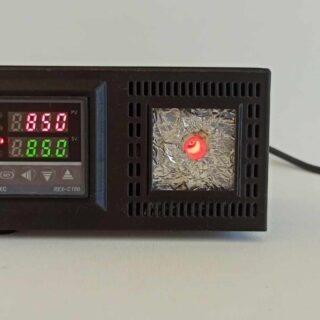
Activation furnance for electrochemical sensors
Read moreThe activation furnance is a device used for curing individual sensors of the AC1 type. At a defined temperature (up to 1000 °C) depending on the electrode and sensor materials. When the sensor is cured, the surface of the electrodes is cleaned from surface oxides and organic impurities, which results in regeneration of the sensor or its activation. In this way, for example, old sensors with immobilized enzyme layers can be cured for reuse – see example at the end ot the document.
-

Nexus
Read moreBuilding on PalmSens’ legacy of providing top-tier solutions for accurate low-current measurements, Nexus delivers an ultra-low-noise performance that exceeds even our existing portable devices, while also supporting measurements up to 1 Ampere.
More information could be found trough link:
https://www.palmsens.com/product/nexus/
- Bi)Potentiostat/ Galvanostat/ Impedance analyzer
- FRA / EIS: 10 μHz up to 1 MHz
- 11 current ranges: 100 pA to 1 A
- Dual EIS with second sense electrode
- Script your experiments using MethodSCRIPT
- Use with PSTrace software for Windows
Versatile
Our high-end instrument, the Nexus, is a Potentiostat, Galvanostat, and optional a Frequency Response Analyser (FRA) for Electrochemical Impedance Spectroscopy (EIS). The Nexus has a large potential range (-12V to +12V) and current range (100 pA to 1 A) with a high resolution and low noise.
The research software PSTrace makes using the Nexus a breeze. The scripting language MethodSCRIPT gives a user full control when needed. Looking for a multi-channel instrument? Just stack multiple instruments on top of each other.
Configurable
Nexus comes in different configurations:
- optional EIS/FRA module with maximum frequency of 1 MHz
- optional BiPotentiostat module for second WE
Standard included
Carrying padded bag containing:
- High quality, double shielded cell cable with
2 mm banana connectors for Working, Sense, Counter, Reference electrode and Ground - Chassis ground cable with croc clip (4 mm)
- Hardware Sync Link cable
- Crocodile clips
- Calibration report
- Dummy cell
- USB cable and Ethernet cable
- Manual and Quick Start document
- PSTrace software for Windows
- iR-compensation (ohmic drop compensation) module
- Second Sense lead cable
S2 and BiPot
Nexus includes a Second Sense lead (S2) and an optional BiPotentiostat (BiPot) module.
S2 – Additional voltage (potential) measurement point
BiPot – Independent second working electrode for simultaneous current measurement
These two features are independent and serve distinct purposes:
- S2 (Second Sense Lead)
S2 acts as an additional voltage-sensing input, with the same specifications as the main reference electrode. It measures the potential at a specific point in the cell and, because the current at that point is known, it can also be used to calculate impedance. - BiPot (BiPotentiostat Module)
The BiPot module introduces a second working electrode (WE2), operating versus the same reference and counter electrodes as the main channel. In BiPotentiostat mode, both working electrodes (WE1 and WE2) are recorded simultaneously. WE2 operates in potentiostatic mode, meaning it can independently control its potential and measure its current.
Why choose the Nexus?

-

Silver / Silver Chloride Refillable Reference Electrode – 6 mm dia. (redox.me)
Read moreIt is a compact refillable Ag/AgCl reference electrode equipped with ceramic frit molten into the glass body. This electrode outperforms competing products in terms of mechanical stability, voltage stability and lifetime. In general, the reference electrode is composed of a system of phases, which retain an essentially constant composition, and therefore provides a stable potential by which the working electrode potential can be monitored. The phases present in reference electrodes undergo reversible redox processes at a very high rate, enabling them to rapidly adjust to changes in the solution’s ionic activity, but leaving them sensitive to the passage of large current densities.
Application note
This electrode is commonly used with aqueous acidic electrolytes, but due to the low resistance of the frit it can be used with standard non-aqueous electrolytes, as well. The reference electrode should be stored with the rubber plug applied on the tip. Please see the full instruction here. Keeping in the solution may shorten its lifetime (the electrode operates well as long as there is at least ¼ of the solution in the electrode tube). Before use rinse it with deionized water. If air bubbles are present around the porous frit, flick the tip several times to remove them. For cleaning use detergent (dish washing detergent with water), alcohols or acetone and rinse it with deionized water at the end. To re-fill the electrode please follow this article.Specification
effective length: 30 mm or 70 mm
tube diameter: 6 mm
filling solution: 3M KCl
potential stability: <5 mV
frit resistance: 2-10 kohm at RT
operating temperature: 0-100 deg C
potential vs SHE at 25 °C: 0.207 VIntrastat data
HS Code: 90278930
Country of Origin: Sweden
NET weight: 100gProduct includes
1 Ag/AgCl refillable reference electrode
1 O-Ring
1 glass tube for storing purposes -

Working Disk Electrode – PEEK body 6 mm dia., 70 mm long (redox.me)
Read moreThis is a Standard Working Electrode in which a disk of electrode material (glassy carbon, gold, platinum, silver, boron-doped diamond, palladium, titanium, and copper) is embedded into the PEEK body by a compressed PTFE or PEEK sleeve. It well fits aqueous and organic solvent electrolyte requirements. If you need a different disk material, please contact us.
Application note
The disk electrode is immersed in the ion-conducting solution as a working electrode. An electric current is passed between the working electrode and the counter electrode for a certain amount of time. After the experiment, the electrode should be washed several times with ethanol or isopropanol. If the disk electrode was used as a current collector with other electrode material, or when there are visible traces of material absorption, it should be polished down to the mirror surface after the experiment is completed. Store the working disk electrode in the glass tube sealed with an O-ring (all included in the package). Instruction on maintenance is provided on the Electrode Polishing Kit product page.Specification
disk diameter: 2, 3, 4 or 5 mm
disk length: 1.5 mm for BDD, 3 mm for the rest
body material: PEEK with PTFE or PEEK sleeve
body diameter: 6 mm
body length: 70 mmIntrastat data
HS Code: 85451900
Country of Origin: Sweden
NET weight: 100 gProduct includes
1x working disk electrode
1x O-ring
1x glass tube