


Silver / Silver Chloride Refillable Reference Electrode – 6 mm dia. (redox.me)
It is a compact refillable Ag/AgCl reference electrode equipped with ceramic frit molten into the glass body. This electrode outperforms competing products in terms of mechanical stability, voltage stability and lifetime. In general, the reference electrode is composed of a system of phases, which retain an essentially constant composition, and therefore provides a stable potential by which the working electrode potential can be monitored. The phases present in reference electrodes undergo reversible redox processes at a very high rate, enabling them to rapidly adjust to changes in the solution’s ionic activity, but leaving them sensitive to the passage of large current densities.
Application note
This electrode is commonly used with aqueous acidic electrolytes, but due to the low resistance of the frit it can be used with standard non-aqueous electrolytes, as well. The reference electrode should be stored with the rubber plug applied on the tip. Please see the full instruction here. Keeping in the solution may shorten its lifetime (the electrode operates well as long as there is at least ¼ of the solution in the electrode tube). Before use rinse it with deionized water. If air bubbles are present around the porous frit, flick the tip several times to remove them. For cleaning use detergent (dish washing detergent with water), alcohols or acetone and rinse it with deionized water at the end. To re-fill the electrode please follow this article.
Specification
effective length: 30 mm or 70 mm
tube diameter: 6 mm
filling solution: 3M KCl
potential stability: <5 mV
frit resistance: 2-10 kohm at RT
operating temperature: 0-100 deg C
potential vs SHE at 25 °C: 0.207 V
Intrastat data
HS Code: 90278930
Country of Origin: Sweden
NET weight: 100g
Product includes
1 Ag/AgCl refillable reference electrode
1 O-Ring
1 glass tube for storing purposes
Select configuration
Electrode length: 30 mm / 70 mm
Related products
-
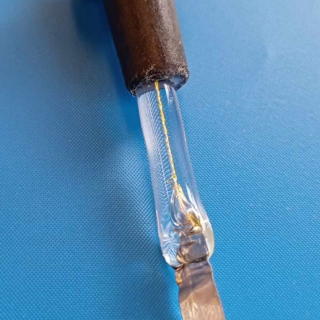
ACEc.Pt plate Auxiliary Classic Electrode Conic with platinum plate
Read moreACEc.Pt plate is a glass tube with platinum plate of guaranteed purity 99.99 %. Standard connection is with a 2 mm banana plug. Auxiliary classic electrode with platinum plate (ACEc.Pt plate) is designed for electrochemical measurements.
Dimensions of Pt plate: 15 x 5 mm Pt
(Pt thickness approx. 0.21 mm)The size of the platinum sheet can be adjusted at the customer’s request.
-
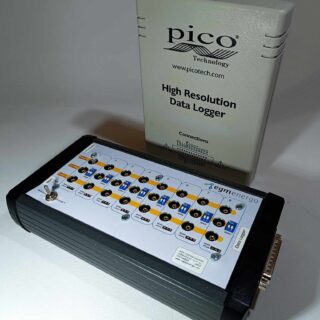
8/16-Channel Potentiostat for High Resolution Data Logger
Read moreThe device consists of a combination of an multi-channel potentiostat/converter (BVT Technologies) and an external USB Pico ADC high resolution data logger (Pico Technology).
The data logger can be supplied in two versions: ADC-20 (20 bits, 8 channels) or ADC-24 (24 bits, 16 channels). For detailed specifications, see the attachment at the end of the document. The device allows measurements from up to 8 or from up to 16 independent channels. The basic output signal is a voltage in the range of -2.5 to 2.5 V. All channels are programmable (the output can be concentration, temperature, pressure…).
After connecting the device to a PC with Pico Technology’s Picolog 6 measurement program installed, the voltage [V] can be processed using math channels and directly recorded in real time as temperature, current, resistance, frequency, % and pressure, see measurement example at the end of the document.
For temperature measurement, the device is compatible with resistance thermometers (Ni 1000, Ni 5000, Pt 1000. Power is provided via USB-B, the maximum electrical consumption of the device is 500 mA.
Device Usage
- Temperature measurement with different temperature sensor (resistance thermometers Ni 1000, ni 5000, Pt 1000)
- Voltage measurement
- Conductivity and resistance measurement
- Amperometry measurement
* For this product, we recommend our customers use the Training Service from BVT.
(https://bvt.cz/produkt/offer-of-long-term-automated-measurements-on-bvt-apparatus/)
-
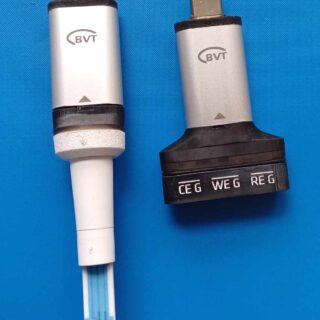
USB Potentiostat Galvanoplot
Read moreUSB Potentiostat Galvanoplot is a super small, low-cost and affordable device suitable for dedicated volume applications, which is optimized for screen-printed sensor and biosensor applications. It can be used in many other research areas and with other electrochemical sensors, for corrosion measurement, battery and super-capacitors or fuel cells.
It is capable of performing all common Amperometric and Voltammetric electrochemistry protocols (CA, LSV, CV, DPV, NPV, SVW, GAL) and can be used with three electrode (WE/RE/CE) and two electrode (WE/RE-CE) setups. Plug the device directly into an Android mobile device through OTG port for a true on-site analysis experience. It is possible to choose from two types of interfaces allowing direct insertion of the BVT SPE sensors or the use of 3 classical electrodes with 2 mm banana plugs (WE, RE, CE).
- Dimensions: 39x17x8 mm
- Weight: 5 g without sensor interface
- Voltage scan range: +-3V @1mV resolution
- Max current: 2000 nA (*at the request of the customer, it is possible to change the range, but this will change the resolution, noise and other parameters)
- Current resolution: 300pA@1KSPS/ 100pA@100SPS/ 30pA/10 SPS resolution
- Noise around: 50nA@1KSPS/ 7nA@100SPS/ 400pA/10 SPS
- Protocols: CA, LSV, CV, DPV, NPV, SVW, GAL
- Cell type: WE/RE/CE and WE/RE-CE
Connectivity: USB-C (Plug the device directly into an Android mobile device through OTG port for a true on-site analysis experience)
- Operating system compatibility: Windows 8, 10+
- Advanced analysis – filtering and auto peaks
Device Usage
- Electrochemical measurements
- Measurements with biosensors and electrochemical sensors
- Measurement of biochemical activity of a sample
- Corrosion measurement
-

EmStat4 MUX (2-in-1: Potentiostat with integrated multiplexer)
Read moreGone are the days with too many cables. With the EmStat4 MUX you have a potentiostat and a multiplexer in one! The EmStat4 MUX is a powerful potentiostat, galvanostat and impedance analyzer and supports all popular electrochemical techniques. Its 8 channels allow for sequential measurements, for example eight Screen-printed electrodes, or eight working electrodes in eight different cells. The instrument’s measurements can be highly customized using MethodSCRIPT. The 4 different cell connections available allow for many different setups. When the measurements are finished, you can easily save your results in PSTrace, or export your results to Excel.
More information could be found tought link:
https://www.palmsens.com/product/emstat4-mux/
- Integrated 8-channel multiplexer
- Supports 2-, 3- and 4-electrode setup using Sense Lead
- Potential range: ± 3V
- Compliance voltage: ± 5V
- Current ranges: 1 nA – 10 mA
- Maximum current: ± 30 mA
- FRA / EIS up to 200 kHz
Two modes of operation
- Consecutive mode: this mode switches channel when a complete measurement has finished
- Alternate mode: this mode switches all activated channels within the specified time interval of a measurement.
In both modes the unselected Working Electrodes can either be left floating or switched to Ground to keep the specified voltage.
Supports a 2-, 3- or 4-electrode setup
- Connect four electrodes per channel by using the Sense Leads.
- Or connect only three electrodes per channel by internally connecting all Sense electrodes to the Working Electodes in software.
- Do you need to connect only two electrodes per channel? Combine the reference and counter electrode physically on the cable, or with a single click on the PSTrace software.

8 to 128 channels
Is 8 channels not enough? If more channels are required, one or more MUX-R2 can be stacked to the EmStat4 MUX for a total of up to 128 channels.
Script your experiments!
Via the script window of PSTrace it is possible to perform a different experiment on each of the channels sequentially. Alternatively, you can use MethodSCRIPT to fully customize your measurements per channel.
Multichannel or Multiplexer?
To make it easier for you to decide, if a multiplexer or a multichannel device is more suitable for your application, we have created a short explanation of multiplexers and multichannels.
See: https://www.palmsens.com/app/uploads/2016/12/Multiplexer-Polypotentiostat-or-Multichannel.pdf