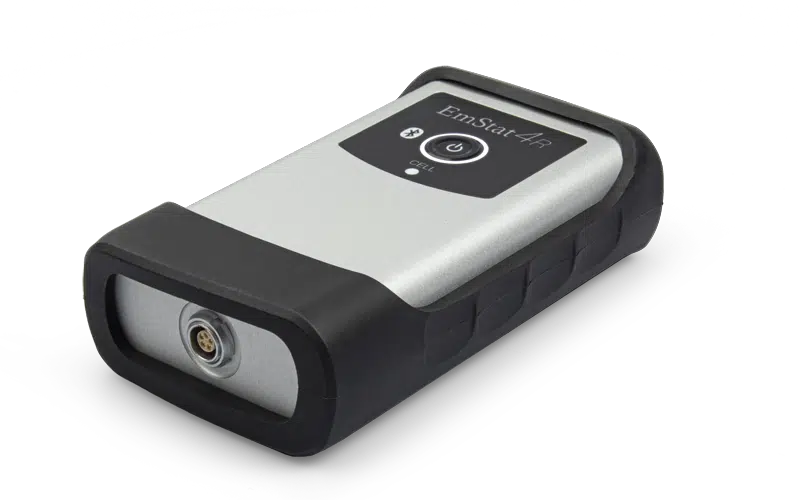


EmStat4 MUX (2-in-1: Potentiostat with integrated multiplexer)
Gone are the days with too many cables. With the EmStat4 MUX you have a potentiostat and a multiplexer in one! The EmStat4 MUX is a powerful potentiostat, galvanostat and impedance analyzer and supports all popular electrochemical techniques. Its 8 channels allow for sequential measurements, for example eight Screen-printed electrodes, or eight working electrodes in eight different cells. The instrument’s measurements can be highly customized using MethodSCRIPT. The 4 different cell connections available allow for many different setups. When the measurements are finished, you can easily save your results in PSTrace, or export your results to Excel.
More information could be found tought link:
https://www.palmsens.com/product/emstat4-mux/
- Integrated 8-channel multiplexer
- Supports 2-, 3- and 4-electrode setup using Sense Lead
- Potential range: ± 3V
- Compliance voltage: ± 5V
- Current ranges: 1 nA – 10 mA
- Maximum current: ± 30 mA
- FRA / EIS up to 200 kHz
Two modes of operation
- Consecutive mode: this mode switches channel when a complete measurement has finished
- Alternate mode: this mode switches all activated channels within the specified time interval of a measurement.
In both modes the unselected Working Electrodes can either be left floating or switched to Ground to keep the specified voltage.
Supports a 2-, 3- or 4-electrode setup
- Connect four electrodes per channel by using the Sense Leads.
- Or connect only three electrodes per channel by internally connecting all Sense electrodes to the Working Electodes in software.
- Do you need to connect only two electrodes per channel? Combine the reference and counter electrode physically on the cable, or with a single click on the PSTrace software.

8 to 128 channels
Is 8 channels not enough? If more channels are required, one or more MUX-R2 can be stacked to the EmStat4 MUX for a total of up to 128 channels.
Script your experiments!
Via the script window of PSTrace it is possible to perform a different experiment on each of the channels sequentially. Alternatively, you can use MethodSCRIPT to fully customize your measurements per channel.
Multichannel or Multiplexer?
To make it easier for you to decide, if a multiplexer or a multichannel device is more suitable for your application, we have created a short explanation of multiplexers and multichannels.
See: https://www.palmsens.com/app/uploads/2016/12/Multiplexer-Polypotentiostat-or-Multichannel.pdf
Related products
-
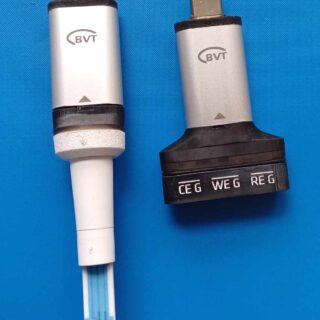
USB Potentiostat Galvanoplot
Read moreUSB Potentiostat Galvanoplot is a super small, low-cost and affordable device suitable for dedicated volume applications, which is optimized for screen-printed sensor and biosensor applications. It can be used in many other research areas and with other electrochemical sensors, for corrosion measurement, battery and super-capacitors or fuel cells.
It is capable of performing all common Amperometric and Voltammetric electrochemistry protocols (CA, LSV, CV, DPV, NPV, SVW, GAL) and can be used with three electrode (WE/RE/CE) and two electrode (WE/RE-CE) setups. Plug the device directly into an Android mobile device through OTG port for a true on-site analysis experience. It is possible to choose from two types of interfaces allowing direct insertion of the BVT SPE sensors or the use of 3 classical electrodes with 2 mm banana plugs (WE, RE, CE).
- Dimensions: 39x17x8 mm
- Weight: 5 g without sensor interface
- Voltage scan range: +-3V @1mV resolution
- Max current: 2000 nA (*at the request of the customer, it is possible to change the range, but this will change the resolution, noise and other parameters)
- Current resolution: 300pA@1KSPS/ 100pA@100SPS/ 30pA/10 SPS resolution
- Noise around: 50nA@1KSPS/ 7nA@100SPS/ 400pA/10 SPS
- Protocols: CA, LSV, CV, DPV, NPV, SVW, GAL
- Cell type: WE/RE/CE and WE/RE-CE
Connectivity: USB-C (Plug the device directly into an Android mobile device through OTG port for a true on-site analysis experience)
- Operating system compatibility: Windows 8, 10+
- Advanced analysis – filtering and auto peaks
Device Usage
- Electrochemical measurements
- Measurements with biosensors and electrochemical sensors
- Measurement of biochemical activity of a sample
- Corrosion measurement
-
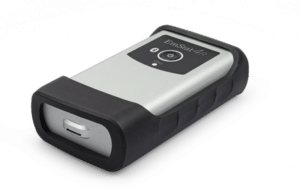
EmStat4R
Read moreThe EmStat4R delivers desktop performance in a rugged enclosure. The EmStat4R is a portable Battery or USB-powered Potentiostat, Galvanostat, and optional a Frequency Response Analyzer (FRA) for Electrochemical Impedance Spectroscopy (EIS).
The EmStat4R is great for applications that require low currents, from 30 mA down to picoamps, such as sensor applications. The EmStat4R is controlled with PSTrace for Windows, the Android app PStouch, or you can write your own MethodSCRIPT and control it from any platform or operating system.
More information can be found through the link: https://www.palmsens.com/product/emstat4r/
- Portable: battery, Bluetooth and rugged housing
- Available with connection module for sensor cable or SPE
- Potential range ±3 V
- Max. current ±30 mA
- Optional impedance analyzer: 10 μHz up to 200 kHz
Two versions
The EmStat4R is available with a cell cable or SPE connection module. Both versions can be configured with optional EIS/FRA with a maximum frequency of 200 kHz. See specifications for more information.
EmStat4R SNS EmStat4R SPE 
Connection module Cell cable Connection module Screen-printed-electrode Cell cable included Yes Cell cable included No Electrode connections WE, RE, CE and ground Electrode connections RE, WE, CE Connectors 2 mm banana Sensor pitch 2.54 mm Maximum sensor width 11 mm Allowed sensor thickness Between 0.1 mm and 0.8 mm Always a backup
The EmStat4R is equipped with 500 MB internal storage memory for storing your measurements as a backup. All internally stored measurements can be browsed and transferred back to the PC easily using the PSTrace software for Windows. Your data is always with your instrument wherever you take it.
Standard included
A standard EmStat4R includes a rugged carrying case with:

- EmStat4R
- Rugged case
- USB-C cable
- Cell cable: high quality, double-shielded cable with 2 mm banana connectors for Working, Counter, Reference electrode and Ground
- 4 crocodile clips
- Dummy Cell
- PSTrace software for Windows (on USB drive)
- Manual (hardcopy)
- Quick Start document
- Calibration report
- Three year warranty
-
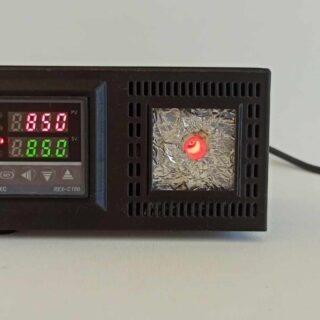
Activation furnance for electrochemical sensors
Read moreThe activation furnance is a device used for curing individual sensors of the AC1 type. At a defined temperature (up to 1000 °C) depending on the electrode and sensor materials. When the sensor is cured, the surface of the electrodes is cleaned from surface oxides and organic impurities, which results in regeneration of the sensor or its activation. In this way, for example, old sensors with immobilized enzyme layers can be cured for reuse – see example at the end ot the document.
-
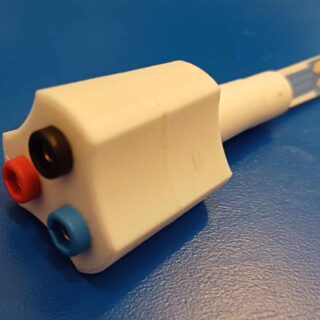
SPE Connector.GC.1 for measurements in glass
Read moreThe connector enables the use of the biosensor or electrochemical sensor based on the substrates AC1, AC4 and TS1 in glass cell TC4, TC5, TC6 or TC7.
The connector enables measurement with screen printed electrodes with width 7.26 mm and standard contact pads pitch (2.54 mm).
It is compatible with other SPE´s that use the same distance between the contact pads (2.54 mm). The cone at the connector sensor side is NJ 8/10 which enables to use the connector with any standard chemical vessels.Termination: 2 mm Banana plugs