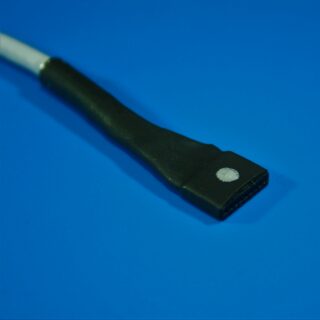
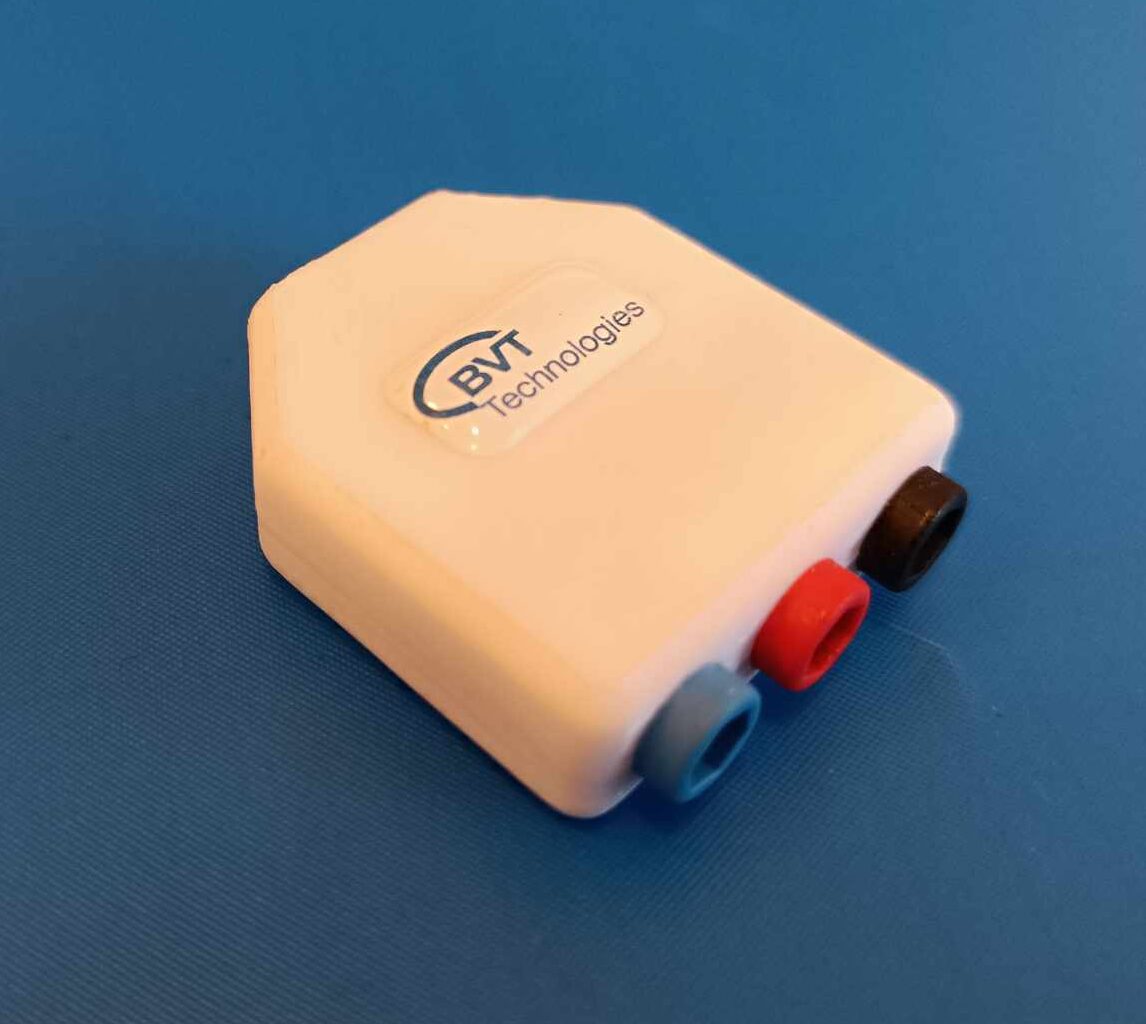
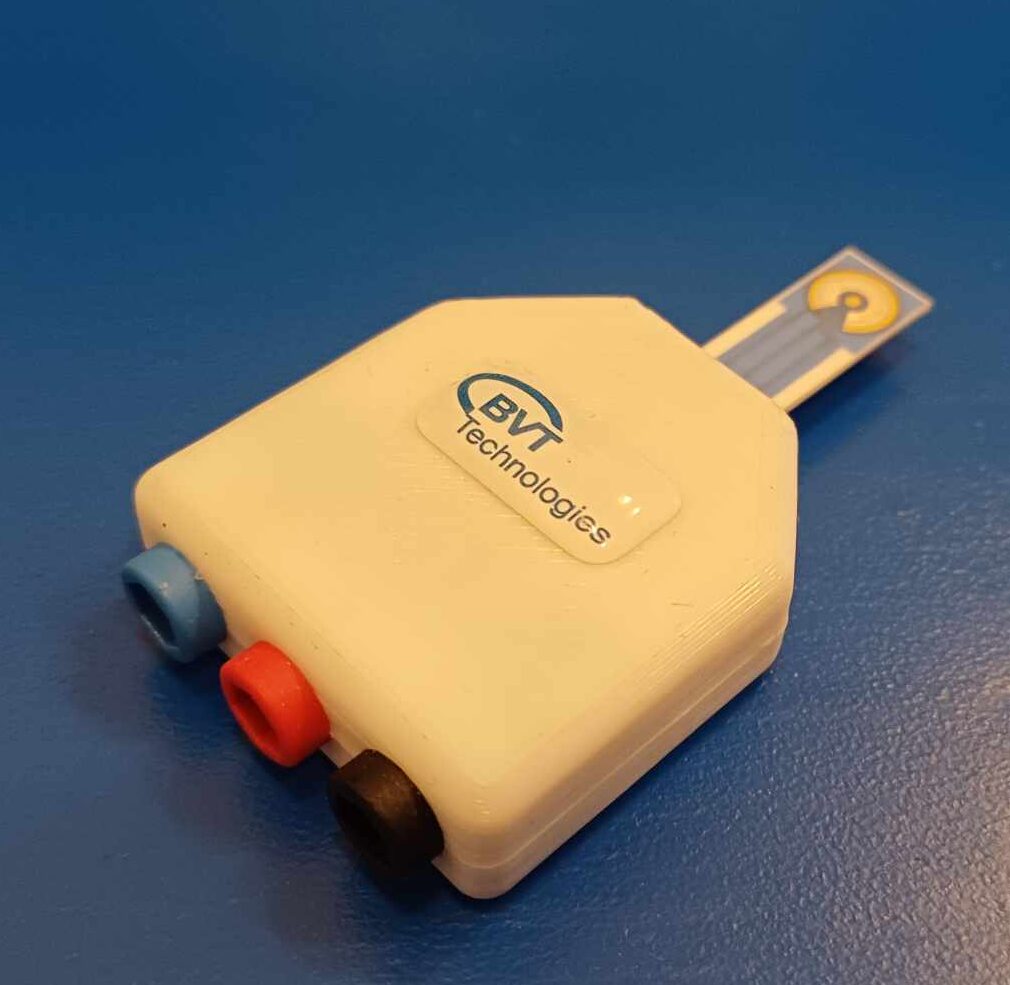
SPE Connector.1 for electrochemical sensors type AC1, AC4, CC1, CC2, TS1
The connector enables the use of the biosensor or electrochemical sensor based on the substrates AC1, AC4, CC1, CC2 and TS1 1 in classical electrochemical arrangement.
The connector enables measurement with screen printed electrodes with width 7.26 mm and standard contact pads pitch (2.54 mm).
It is compatible with other SPE´s that use the same distance between the contact pads (2.54 mm).
Termination: 2 mm Banana plugs
You may also like…
-
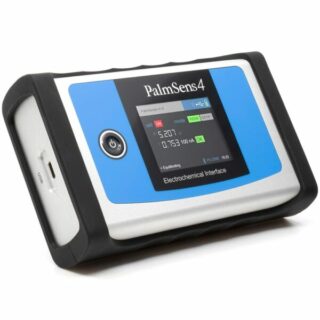
PalmSens4
Read moreThe PalmSens4, is a USB and battery powered Potentiostat, Galvanostat, and optional a Frequency Response Analyser (FRA) for Electrochemical Impedance Spectroscopy (EIS).
Compact, versatile and powerful
- (Bi)Potentiostat / Galvanostat / Impedance Analyzer
- FRA / EIS: 10 μHz up to 1 MHz
- 9 current ranges: 100 pA to 10 mA
- 18-bit resolution
- Bluetooth or USB connection
The PalmSens4 has a large potential range (-5V to 5V or -10V to 10V) and current range (100 pA to 10 mA) with a high resolution and low noise. The economical PalmSens4 is a complete laboratory instrument but its compact and rugged design makes it also ideal for field work.
Connecting via Bluetooth guarantees a perfectly floating measurement.
More information can be found through the link: https://www.palmsens.com/product/palmsens4/
Configurable
PalmSens4 comes in different configurations:
- ±5 V or ±10 V potential range
- EIS/FRA with maximum frequency of 100 kHz or 1 MHz
- optional BiPotentiostat module for second WE
- optional iR-Compensation
Standard included
- Rugged carrying case
- High quality, double shielded cell cable with
2 mm banana connectors for Working, Counter, Reference electrode and Ground - Crocodile clips
- Dummy cell
- USB cable
- Manual and Quick Start document
- PSTrace software for Windows
-
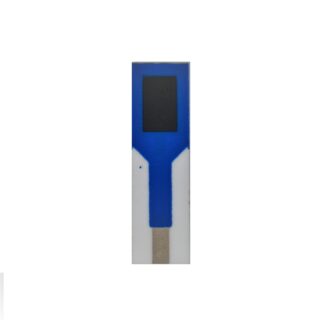
AC4 Electrochemical sensor
Read moreAmperometric single working electrode sensor with a extremely big working electrode made by thick film technology
Dimensions: 25.4 x 7.26 x 0.63 mm
WE material: Au/Pt, Au, Pt, Ag, C
The sensor is formed on a corundum ceramic base. On to this surface working electrode is applied. The working electrode is made of variety of materials. At the end of the sensor there is a contact which is connected with the active part by the silver conducting path which is covered by a dielectric protection layer.
-
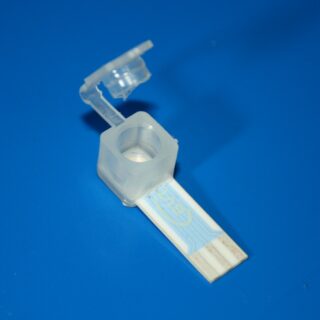
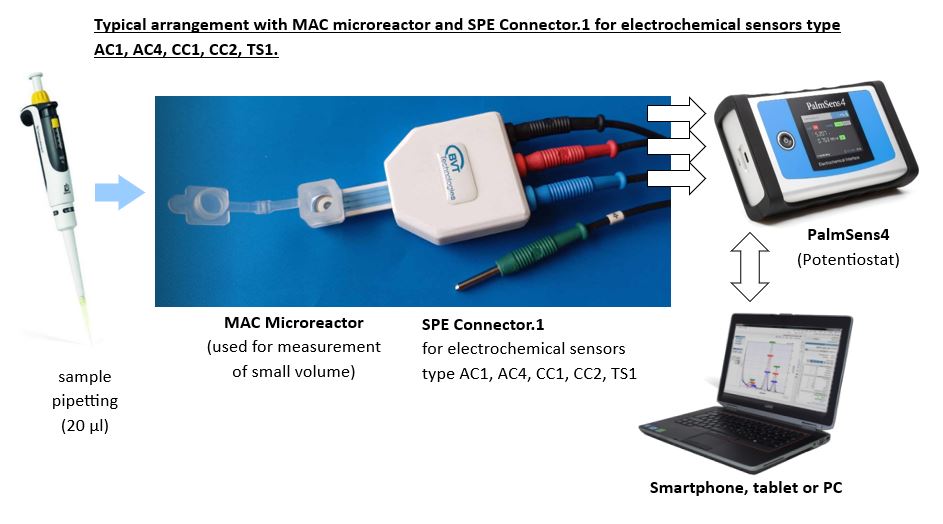
MAC Microreactor
Read moreMicroreactor for sensor used for measurement of small volume (20 µl) in closed system.
Dimensions: 7.26 (width) x 0.63 mm (thickness)
The MAC Microreactor is attached to the Sensor/s that the customer would like to use, and allows the customer to place a solution (20µl) for carrying out measurements directly above the WE in a contained area. The lid of the MAC Microreactor can be closed sealing the solution and helps avoid contaminants from affecting the test.
-
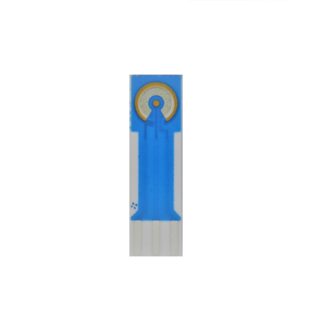
AC1 Electrochemical sensor
Read moreBasic amperometric low cost three-electrode sensor with patented structure made by thick film technology.
Dimensions: 25.4 x 7.26 x 0.63 mm
WE material: Au/Pt, Au, Pt, Ag, C
The sensor is formed on a corundum ceramic base. On to this surface the working, the reference and the auxiliary electrodes are applied. The working and the auxiliary electrodes are made of variety of materials. At the end of the sensor there is a contacting field which is connected with the active part by the silver conducting paths which are covered by a dielectric protection layer.
A bio-chemically active substance can be immobilised on the working electrode of the sensor to create a biosensor. All sensors can be equipped with heating and temperature sensing elements. Thermistor (must be calibrated) or Pt 1000 (the response corresponds to the ISO standard) is used as the temperature sensor.
We also offer:
- working electrode made of polished gold (WE diameter 1 or 2 mm) – sensor type: AC1P.W*.R*, with homogenous surface with roughness less than 1 µm
- working electrode made of a material of guaranteed purity of up to 99.99 % (WE diameter 2 mm) – sensor type: AC1.GP
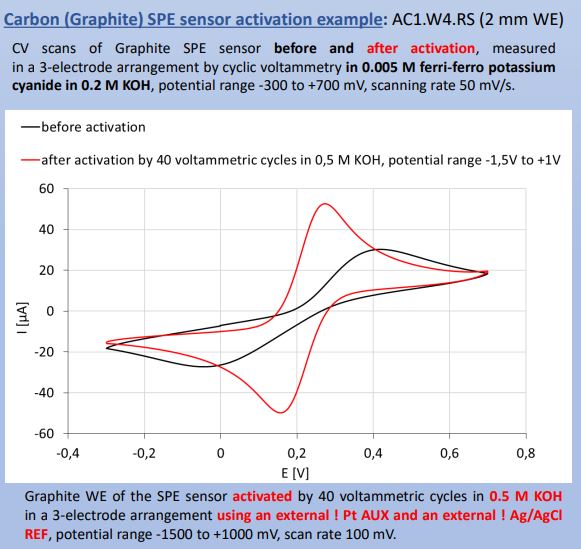
We also offer activated graphite sensors on customer request.
See activation example below:
* Have a look at product cathegory Discounted SPEs – which include offer of Screen Printed Electrodes (SPEs) at a reduced Price from our AC1 line of Sensors. They are fully functional, but with visual defects or inconsistancies.
– ideal for use by students to gain handling experience and knowledge on SPEs and their uses
– ideal for initial experiments in research
Related products
-
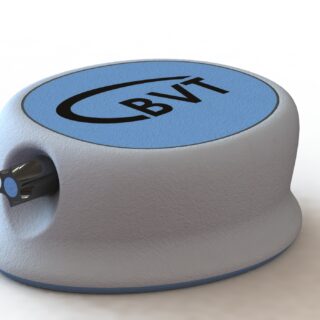
Single Seat Magnetic Stirrer
Read moreSingle-seat magnetic stirrer without heating used to stir liquids with a stirring bar.
The mixing speed can be changed continuously using the rotary control: 0-255 rpm. Lightweight and easily portable, suitable for mixing liquids with a volume of up to 1 l. The magnetic stirrer includes a connector connected to a 12 V power supply.
Original design of the magnetic stirrer in two colours. Upon agreement, it is possible to produce magnetic stirrers in colours according to the customer’s wishes.
The single-seat magnetic stirrer includes two glass magnetic stirring bars (1 piece of type GMS.1 and 1 piece of type GMS.2 below). It is possible to buy more pieces of glass magnetic stirring bars.
-
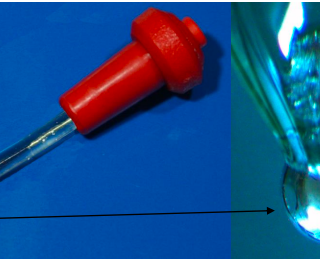
Hanging Platinum Drop Electrode
Read moreThe Hanging Platinum Drop Electrode (HPDE) is solid phase alanogy of HMDE.
The drop of liquid Pt at 2000 °C forms a drop of Pt. The surface of HPDE has nearly ideal surface which is impossible to obtain using polishing. HPDE has also spherical symmetry which enables mathematical treatment of its response.
The material is not toxic and it is chemically stable. The only disadvantage is HPDE cleaning, which can be, however, in some cases solved by carefull insertion of the electrode tip to the flame of an alcohol burner.
Thus HPDE can be used as reference electrode for complicated electrochemical studies, where it is necessary to distinguish the analytical signal from the signal generated by surface inhomogenities.Hanging platinum drop electrode (HPDE) is designed for measurements with thermostated cell TC4, TC5, TC6 and TC9.
-
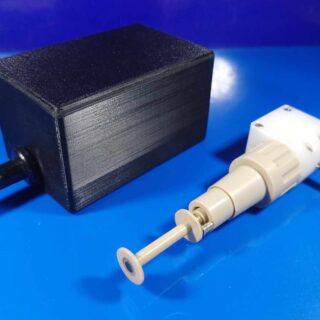
Mini Rotating Disk Electrode
Read moreThe Mini Rotating disk electrode (Mini RDE) in general enables defined mass transfer towards electrode surface.
The Mini RDE consists of the body of the RDE (motor) with 6 pcs of interchangeable electrode tips.
The device is equipped by control electronics and SW and powered by USB connection with PC.
Rotational speed of Mini RDE is 10 – 1300 rpm.RDE is suitable for measurements in glass cells of type TC4, TC5, TC6 and TC7. During measuring with RDE
in a classic three-electrode connection, it is advisable to use a classic reference RCEc.R* and auxiliary electrode ACEc.* For this product, we recommend our customers use the Training Service from BVT.
(https://bvt.cz/produkt/offer-of-long-term-automated-measurements-on-bvt-apparatus/)