


ZIVE SP1 – potentiostat/galvanostat/ZRA
- Potentiostat/galvanostat/ZRA at affordable price
- Control voltage range: ±10V
- Control current range:9 ranges, 10nA~1A (10nA with gain)
Application
Features
Experimental Techniques Basic techniques
Advanced Software Package(Included)
|
| Power amplifier (CE) | |
| Power | 12Watt(12V@1A) |
| Compliance voltage | ±12V |
| Max. current | ±1A |
| Control speed selection | 4ea |
| Bandwidth | 2MHz |
| Slew rate | 10V/usec |
| Potentiostat mode(voltage control) | |
| Voltage control | |
| Control voltage range | ±10, ±1V, ±100mV |
| Voltage resolution | 16 bit per each range |
| Voltage accuracy | ±0.02% f.s(gain x1) |
| Max. scan range | ±10V vs. ref. E |
| Current measurements | |
| Current measurement range | 9 ranges (auto/manual setting) 10nA ~ 1A 10nA with gain |
| Current measurement resolution | 16 bit; 30uA, 3uA, 300nA, 30nA, 3nA, 300pA 30pA, 3pA (300fA with gain) |
| Current measurement accuracy | ±0.05% f.s.(gain x1)>100nA f.s. |
| Galvanostat mode(current control) | |
| Current control | |
| Current control range | max. ±1A ± full sacle depending on selected range |
| Current control resolution | 16 bit; 30uA, 3uA, 300nA, 30nA, 3nA,300pA 30pA, 3pA (300fA with gain) |
| Current control accuracy | ±0.05% f.s.(gain x1)>100nA. |
| Voltage measurements | |
| Voltage measurement range | 10V, 1V, 100mV |
| Voltage measurement resolution | 16 bit; 0.3mV, 30uV, 3uV |
| Voltage measurement accuracy | ±0.02% f.s(gain x1) |
| Electrometer | |
| Max. input voltage | ±10V |
| Input impedance | 2×10¹³Ω||4.5pF |
| Bandwidth | >22MHz |
| CMRR | >114dB |
| EIS(Internal FRA) for system | |
| Frequency range | 10uHz ~ 1MHz |
| Frequency accuracy | 0.01% |
| Frequency resolution | 5000/decade |
| Amplitude | 0.1mV ~ 5V rms (potentiostatic) 0.1 ~ 70% f.s. (galvanostatic) |
| Mode | Static EIS: potentiostatic, galvanostatic, pseudo-galvanostatic, OCP Dynamic EIS: potentiodynamic, galvanodynamic Fixed frequency impedance: potentiostatic, galvanostatic, potentiodynamic, galvanodynamic Multisine EIS: potentiostatic, galvanostatic Intermittent PEIS/GEIS |
| Main system | |
| PCcommunication | USB2.0 high speed |
| Line voltage | 100~240VAC, 50/60Hz, 1Amp |
| Power adapter | 24V 2.5Amp |
| Size/Weight | 160×329.4×83.3mm(WxDxH) / 2.5Kg |
| Max. output power | 12Watt |
| Software | |
| Max. steps per experiments | 1000 |
| Shutdown safety limits | voltage, current, power, AuxV etc. |
| Max. sampling rate | 2usec or 3usec depending on data point number |
| Min. sampling time | unlimited |
| Sampling condition | time, dv/dt, dI/dt, etc. |
| Interface for system | |
| Auxiliary port | |
| Auxiliary voltage input | 1 analog input: ±10V |
| Zero resistance ammeter | 100nA~1A range |
| External booster interface | via booster interface cable |
| System | |
| Cell cable | 1 meter shielded type (standard) working, reference, counter, working sense, Auxiliary V |
| Control DAC |
DSP with FPGA 2x16bit DAC(50MHz) for bias & scan |
| Data acquisition ADC |
2x16bit ADCs(500kHz) for voltage,current 1x16bit ADCs(250kHz) for auxiliary reading |
| Calibration | automatic |
| Filter selection | 4ea (5Hz, 1kHz, 500kHz, 5MHz) |
| Scan rate | 0~200V/sec in common mode 0~5000V/sec in fast mode |
| Max. channel number | 8 channesl via USB connection |
| Internal data memory | 542,000 points |
| PC requirement | |
| Operating system | Windows 7/8/10(32bit/64bit OS) |
| PC specification(minimum) | Pentium4, RAM 1GB or higher |
| Display | 1600×900 high color or higher |
| USB | high speed 2.0 |
| General | |
| Dummy cell | One external dummy cell included |
| Impedance analysis software | ZMANTM software |
| DC data analysis software | IVMANTM software package |
Thespecificationsaresubjecttochangewithoutnotice.
Related products
-

Metal Wire Auxiliary Electrode – 50HX15 0.6/250 mm (redox.me)
Read moreThe metal wire counter (auxiliary) electrode is provided in the electrochemical cell as a current sink to shunt excess current away from the reference electrode. The counter electrode is generally chosen to be inert under reaction conditions, typically platinum, rhodium, palladium, or gold wire. It well fits aqueous (FKM O-Ring) and organic solvent (FFKM O-Ring) electrolyte requirements.
Application note
The metal wire electrode is immersed in the ion-conducting solution as a counter electrode. An electric current is passed between the working electrode and the counter electrode for a certain amount of time. After the process, the electrode should be washed several times with isopropanol or ethanol and dried under the nitrogen flow. Store the metal wire electrode in the glass vial sealed with O-rings (all included in the package).Specification
helix inner diameter: 4.8 mm
helix outer diameter: 6 mm
number of turns: 12
wire diameter: 0.6 mm
total wire length: 250 mm (215 mm long helix, 35 mm long straight wire)Intrastat data
HS Code: 71101910 (platinum), 71081310 (gold),
Country of Origin: Sweden
NET weight: 100 gProduct includes
1 metal wire electrode with PEEK plug and selected electrical connector
1 O-Ring
1 glass vial -
Hanging Platinum Drop Electrode
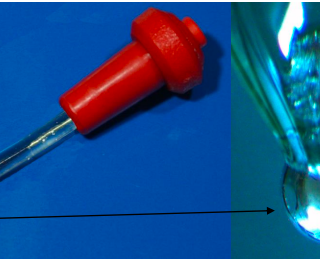
Read moreThe Hanging Platinum Drop Electrode (HPDE) is solid phase alanogy of HMDE.
The drop of liquid Pt at 2000 °C forms a drop of Pt. The surface of HPDE has nearly ideal surface which is impossible to obtain using polishing. HPDE has also spherical symmetry which enables mathematical treatment of its response.
The material is not toxic and it is chemically stable. The only disadvantage is HPDE cleaning, which can be, however, in some cases solved by carefull insertion of the electrode tip to the flame of an alcohol burner.
Thus HPDE can be used as reference electrode for complicated electrochemical studies, where it is necessary to distinguish the analytical signal from the signal generated by surface inhomogenities.Hanging platinum drop electrode (HPDE) is designed for measurements with thermostated cell TC4, TC5, TC6 and TC9.
-
8/16-Channel Potentiostat for High Resolution Data Logger
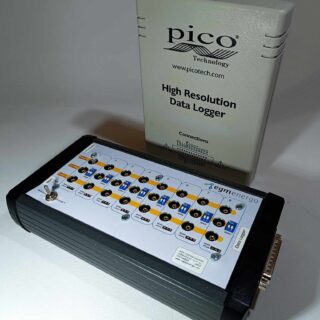
Read moreThe device consists of a combination of an multi-channel potentiostat/converter (BVT Technologies) and an external USB Pico ADC high resolution data logger (Pico Technology).
The data logger can be supplied in two versions: ADC-20 (20 bits, 8 channels) or ADC-24 (24 bits, 16 channels). For detailed specifications, see the attachment at the end of the document. The device allows measurements from up to 8 or from up to 16 independent channels. The basic output signal is a voltage in the range of -2.5 to 2.5 V. All channels are programmable (the output can be concentration, temperature, pressure…).
After connecting the device to a PC with Pico Technology’s Picolog 6 measurement program installed, the voltage [V] can be processed using math channels and directly recorded in real time as temperature, current, resistance, frequency, % and pressure, see measurement example at the end of the document.
For temperature measurement, the device is compatible with resistance thermometers (Ni 1000, Ni 5000, Pt 1000. Power is provided via USB-B, the maximum electrical consumption of the device is 500 mA.
Device Usage
- Temperature measurement with different temperature sensor (resistance thermometers Ni 1000, ni 5000, Pt 1000)
- Voltage measurement
- Conductivity and resistance measurement
- Amperometry measurement
* For this product, we recommend our customers use the Training Service from BVT.
(https://bvt.cz/produkt/offer-of-long-term-automated-measurements-on-bvt-apparatus/)
-

Platinum Coated Titanium Mesh Electrode with Holder – set of 10 pcs (redox.me)
Read moreThe metal counter (auxiliary) electrode is provided in electrochemical cell as a current sink to shunt excess current away from the reference electrode. Platinum Coated Titanium Mesh Electrode is a cheap alternative to pure Platinum Electrodes like Platinum Gauze Electrode or Metal Wire Auxiliary Electrode. Platinum coating makes this counter electrode inert under the reaction conditions and provides catalytic properties. The electrode is installed in the Basic Sample Holder (1 pcs included in the set), which allows full immersion of the electrode in the electrolyte (wet Tantalum contact). It well fits aqueous and organic solvent electrolyte requirements. Electrode size is customizable.
Application note
The Platinum Coated Titanium Mesh Electrode is fully immersed in the ion-conducting solution as a counter electrode. An electric current is passed between the working electrode and the Platinum Coated Titanium Mesh Electrode for a certain amount of time. After the process, the electrode should be washed several times with ethanol and dried under the nitrogen flow. Store the electrode in a dedicated compartment to avoid scratching. Discoloration may indicate the degradation (dissolution) of the Platinum layer and oxidation of Titanium mesh.
This electrode is used mainly in systems where there is a high risk of its contamination by organic or inorganic deposit during the electrochemical reaction. It is also a cheap replacement for pure Platinum electrode in electrodeposition processes.Specification
Titanium grade: GR1
working current: <5000 A/m2
Platinum content: >15 g/m2
Platinum coating thickness: 760 – 1500 nm
mesh hole size: 3 mm x 2 mm
mesh thickness: 0.5 mm
electrode size: 25x25mm2, 50x50mm2, 100x100mm2, custom
pH range: 1-12Intrastat data
HS Code: 71151000
Country of Origin: Sweden
NET weight: 100 gProduct includes
10 x Platinum Coated Titanium Mesh Electrode of selected size
1 x Basic Sample Holder (if selected)