


EmStat4 MUX (2-in-1: Potentiostat with integrated multiplexer)
Gone are the days with too many cables. With the EmStat4 MUX you have a potentiostat and a multiplexer in one! The EmStat4 MUX is a powerful potentiostat, galvanostat and impedance analyzer and supports all popular electrochemical techniques. Its 8 channels allow for sequential measurements, for example eight Screen-printed electrodes, or eight working electrodes in eight different cells. The instrument’s measurements can be highly customized using MethodSCRIPT. The 4 different cell connections available allow for many different setups. When the measurements are finished, you can easily save your results in PSTrace, or export your results to Excel.
More information could be found tought link:
https://www.palmsens.com/product/emstat4-mux/
- Integrated 8-channel multiplexer
- Supports 2-, 3- and 4-electrode setup using Sense Lead
- Potential range: ± 3V
- Compliance voltage: ± 5V
- Current ranges: 1 nA – 10 mA
- Maximum current: ± 30 mA
- FRA / EIS up to 200 kHz
Two modes of operation
- Consecutive mode: this mode switches channel when a complete measurement has finished
- Alternate mode: this mode switches all activated channels within the specified time interval of a measurement.
In both modes the unselected Working Electrodes can either be left floating or switched to Ground to keep the specified voltage.
Supports a 2-, 3- or 4-electrode setup
- Connect four electrodes per channel by using the Sense Leads.
- Or connect only three electrodes per channel by internally connecting all Sense electrodes to the Working Electodes in software.
- Do you need to connect only two electrodes per channel? Combine the reference and counter electrode physically on the cable, or with a single click on the PSTrace software.

8 to 128 channels
Is 8 channels not enough? If more channels are required, one or more MUX-R2 can be stacked to the EmStat4 MUX for a total of up to 128 channels.
Script your experiments!
Via the script window of PSTrace it is possible to perform a different experiment on each of the channels sequentially. Alternatively, you can use MethodSCRIPT to fully customize your measurements per channel.
Multichannel or Multiplexer?
To make it easier for you to decide, if a multiplexer or a multichannel device is more suitable for your application, we have created a short explanation of multiplexers and multichannels.
See: https://www.palmsens.com/app/uploads/2016/12/Multiplexer-Polypotentiostat-or-Multichannel.pdf
Related products
-

ZIVE SP1 – potentiostat/galvanostat/ZRA
Read more- Potentiostat/galvanostat/ZRA at affordable price
- Control voltage range: ±10V
- Control current range:9 ranges, 10nA~1A (10nA with gain)
Application - Battery
- Super capacitor
- Fuel cell
- Corrosion
- Sensor
- Solar cell
- Other Echem experiments
Features
- economical high quality potentiostat/galvanostat/impedance analyzer
- compact size with full functions
- ±10V@1Amp control range
- wide current ranges(1A to 10nA) for various applications
- built-in FRA : enables EIS tests by using software
- 14 EIS techniques capability including multisine
- capable of multitude of applications
– corrosion, general electrochemistry, sensor, battery, fuel cell,
supercapacitor, solar cell, etc. - bipolar pulse capability
- voltage pulse or current pulse charge/discharge test(GSM,CDMA etc.),
sine wave function for ripple simulation withenergysoftwarepackage
& pulse plating available - high speed data sampling time
– 2usec or 3usec depending on data point number - iR compensation and measurement
- 3 measurement/control voltage ranges &
9 measurement/control current ranges - internal 542,000 data point storage & continuing experiment regardless
of PC failure. - multichannel configuration available
- free software upgrade
Experimental Techniques
Basic techniques
- Potentiostatic
- Galvanostatic
- Double step potentiostatic
- Double step galvanostatic
- OCP measurement
- Potential sweep
- Current sweep
- Cyclic voltammetry
- Fast potential sweep
- Potentiostatic Ru measurement
- Galvanostatic Ru measurement
Advanced Software Package(Included)
- EIS software package(EISe)
– Potentiostat EIS
– Galvanostatic EIS
– Pseudo galvanostatic EIS
– OCP* EIS
– Potentiodynamic PEIS
– Galvanodynamic GEIS
– Poteniodynamic HFR
– Galvanodynamic HFR
– Potentiostatic HFR monitor
– Galvanostatic HFR monitor
– Multisine potentiostatic EIS
– Multisine galvanostatic EIS
– Intermittent potentiostatic EIS
– Intermittent galvanostatic EIS
(*) The system measures open circuit potential before each frequency
change and applies AC sine wave on this potential. - Corrosion software package(CORe)
– Tafel(Tafel experiment)
– Rp(Polarization resistance)
– RpEc trend
– PDYN(Potentiodynamic)
– CYPOL(Cyclic polarization resistance)
– GDYN(GalvanoDynamic)
– Reactivation
– Galvanic corrosion
– Potentiostatic ECN
– Galvanostatic ECN
– ZRA mode ECN - Energy software package(BATe)
a) Battery test technique
– CC/CV testforcycle life test of lithium battery
– CC/CC tet forcyclelifetestofNiCd or NiMH battery
– Discharging test
– EVS(electrochemical voltage spectroscopy)
– Variable scan rate CV
– Potentiostatic IV curve
– Galvanostatic IV curve
– Steady state CV
– PITT(Potentiostatic intermittent titration technique) test
– GITT(Galvanostatic intermittent titration technique) test
– Pulse mode is available for GSM & CDMA profile.
Pulse shape profile can be measured by user’s demand.
b) Control mode
– Charge : CC, CC-CV, pulse, sine wave
– Discharge : CC, CP, CR, pulse, sine wave
c) Cut-off condition
– Time, voltage, current, power, auxV etc.
– Various battery charge/discharge test is available including
pulse discharge for GSM, CDMA application - Electrochemical analysis software package(EASe)
a) Step techniques
– CA(Chronoamperometry)
– CC(Chronocoulometry)
– CP(Chronopotentiometry)
b) Sweep techniques
– LSV(Linear sweep voltammetry)
– SDV(Sampled DC voltammetry)
– Fast CV
– Fast LSV
c) Pulsed techniques
– DPV(Differential pulse voltammetry)
– SWV(Square wave voltammetry)
– DPA(Diff.pulse amperometry)
– NPV(Normal pulse voltammetry)
– RNPV(Reverse normal pulse voltammetry)
– DNPV(Differential normal pulse voltammetry)
-

Nexus
Read moreBuilding on PalmSens’ legacy of providing top-tier solutions for accurate low-current measurements, Nexus delivers an ultra-low-noise performance that exceeds even our existing portable devices, while also supporting measurements up to 1 Ampere.
More information could be found trough link:
https://www.palmsens.com/product/nexus/
- Bi)Potentiostat/ Galvanostat/ Impedance analyzer
- FRA / EIS: 10 μHz up to 1 MHz
- 11 current ranges: 100 pA to 1 A
- Dual EIS with second sense electrode
- Script your experiments using MethodSCRIPT
- Use with PSTrace software for Windows
Versatile
Our high-end instrument, the Nexus, is a Potentiostat, Galvanostat, and optional a Frequency Response Analyser (FRA) for Electrochemical Impedance Spectroscopy (EIS). The Nexus has a large potential range (-12V to +12V) and current range (100 pA to 1 A) with a high resolution and low noise.
The research software PSTrace makes using the Nexus a breeze. The scripting language MethodSCRIPT gives a user full control when needed. Looking for a multi-channel instrument? Just stack multiple instruments on top of each other.
Configurable
Nexus comes in different configurations:
- optional EIS/FRA module with maximum frequency of 1 MHz
- optional BiPotentiostat module for second WE
Standard included
Carrying padded bag containing:
- High quality, double shielded cell cable with
2 mm banana connectors for Working, Sense, Counter, Reference electrode and Ground - Chassis ground cable with croc clip (4 mm)
- Hardware Sync Link cable
- Crocodile clips
- Calibration report
- Dummy cell
- USB cable and Ethernet cable
- Manual and Quick Start document
- PSTrace software for Windows
- iR-compensation (ohmic drop compensation) module
- Second Sense lead cable
S2 and BiPot
Nexus includes a Second Sense lead (S2) and an optional BiPotentiostat (BiPot) module.
S2 – Additional voltage (potential) measurement point
BiPot – Independent second working electrode for simultaneous current measurement
These two features are independent and serve distinct purposes:
- S2 (Second Sense Lead)
S2 acts as an additional voltage-sensing input, with the same specifications as the main reference electrode. It measures the potential at a specific point in the cell and, because the current at that point is known, it can also be used to calculate impedance. - BiPot (BiPotentiostat Module)
The BiPot module introduces a second working electrode (WE2), operating versus the same reference and counter electrodes as the main channel. In BiPotentiostat mode, both working electrodes (WE1 and WE2) are recorded simultaneously. WE2 operates in potentiostatic mode, meaning it can independently control its potential and measure its current.
Why choose the Nexus?

-

AC1.GP. Electrochemical sensor with a working electrode of guaranteed purity
Read moreBasic amperometric three-electrode sensor with patented structure made by thick film technology.
Dimensions: 25.40 mm x 7.26 mm x 0.63 mm
WE material: gold, platinum, silver, copper, iron, nickel, cobalt, chromium, tantalum, irridium, rhenium, magnesium, palladium, zirconium and others
*Selection of sensor electrode materials other than those listed above is possible upon agreement with the customer.
The sensor is made on a corundum ceramic base. Working, reference and auxiliary electrodes are applied to this surface. Working, reference and auxiliary electrodes are made of different materials. At the end of the sensor there is a contact field that is connected to the active part by silver conductive paths that are covered with a dielectric protective layer. The working electrode of the sensor with a diameter of 2 mm is made of a material of guaranteed purity of up to 99.99 % depending on the selected material– standard layer thickness 0.0125 mm.
We also offer a working electrode made of polished gold AC1P.W*.R*, with homogenous surface with roughness less than 1 µm.
We also offer activated graphite sensors on customer request.
-
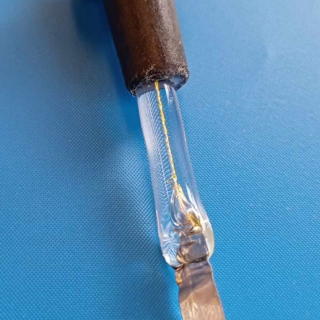
ACEc.Pt plate Auxiliary Classic Electrode Conic with platinum plate
Read moreACEc.Pt plate is a glass tube with platinum plate of guaranteed purity 99.99 %. Standard connection is with a 2 mm banana plug. Auxiliary classic electrode with platinum plate (ACEc.Pt plate) is designed for electrochemical measurements.
Dimensions of Pt plate: 15 x 5 mm Pt
(Pt thickness approx. 0.21 mm)The size of the platinum sheet can be adjusted at the customer’s request.