
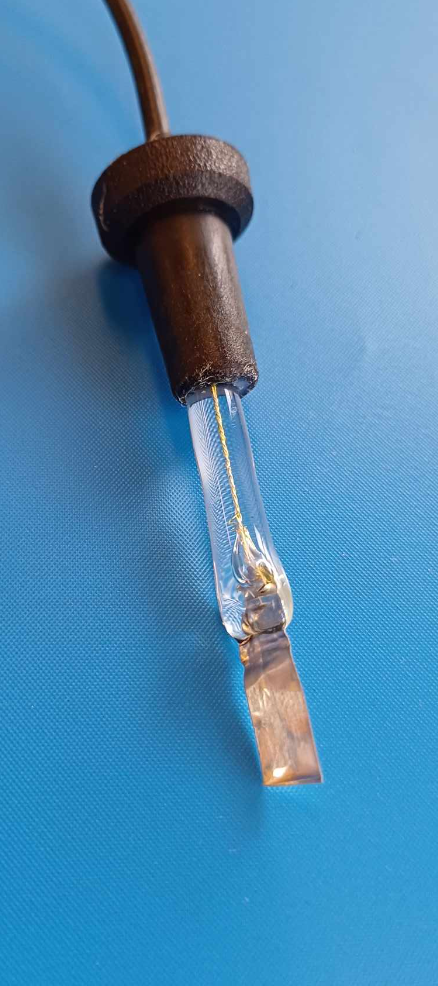
ACEc.Pt plate Auxiliary Classic Electrode Conic with platinum plate
ACEc.Pt plate is a glass tube with platinum plate of guaranteed purity 99.99 %. Standard connection is with a 2 mm banana plug. Auxiliary classic electrode with platinum plate (ACEc.Pt plate) is designed for electrochemical measurements.
Dimensions of Pt plate: 15 x 5 mm Pt
(Pt thickness approx. 0.21 mm)
The size of the platinum sheet can be adjusted at the customer’s request.
You may also like…
-
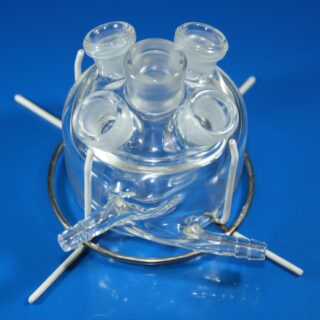
TC5 Electrochemical Glass Cell
Read moreBorosilicate glass cell serves for electrochemical measurements. The cell is jacketed.
The analyzed solution can be thermostated by external thermostat.
Cell openings are designed for electrochemical sensors connector KA1.C, classical electrodes WCEc, ACEc, RCEc and stirrer ST1, ST3 separately.
-
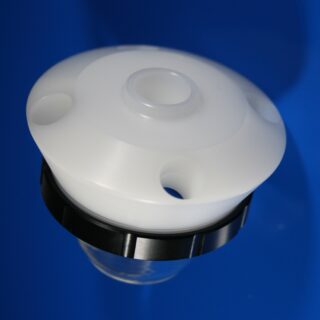
TC6 Electrochemical Glass Cell
Read moreBorosilicate glass cell serves for electrochemical measurements.
The analyzed solution can be thermostated by minithermostat MT1-1.
Cell openings are designed for electrochemical sensors connector KA1.C, classical electrodes WCEc, ACEc, RCEc and stirrer ST1, ST3 separately.
The device enables the measurement with inserted samples.
-
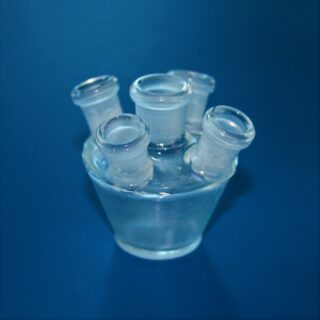
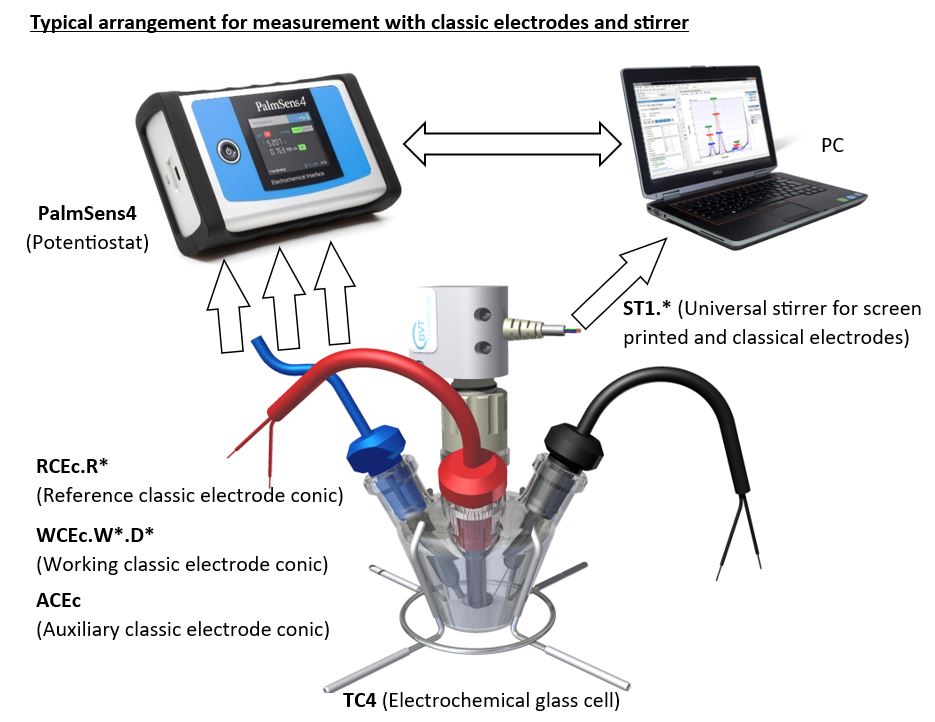
TC4 Electrochemical Glass Cell
Read moreSimple borosilicate glass cell serves for electrochemical measurements.
The temperature of the analyzed solution can be controlled when placing the cell in MT1-1 minithermostat.
Cell openings are designed for electrochemical sensors connector KA1.C, classical electrodes WCEc, ACEc, RCEc and stirrer ST1, ST3 separately.
Related products
-

Silver / Silver Chloride Refillable Reference Electrode – 6 mm dia. (redox.me)
Read moreIt is a compact refillable Ag/AgCl reference electrode equipped with ceramic frit molten into the glass body. This electrode outperforms competing products in terms of mechanical stability, voltage stability and lifetime. In general, the reference electrode is composed of a system of phases, which retain an essentially constant composition, and therefore provides a stable potential by which the working electrode potential can be monitored. The phases present in reference electrodes undergo reversible redox processes at a very high rate, enabling them to rapidly adjust to changes in the solution’s ionic activity, but leaving them sensitive to the passage of large current densities.
Application note
This electrode is commonly used with aqueous acidic electrolytes, but due to the low resistance of the frit it can be used with standard non-aqueous electrolytes, as well. The reference electrode should be stored with the rubber plug applied on the tip. Please see the full instruction here. Keeping in the solution may shorten its lifetime (the electrode operates well as long as there is at least ¼ of the solution in the electrode tube). Before use rinse it with deionized water. If air bubbles are present around the porous frit, flick the tip several times to remove them. For cleaning use detergent (dish washing detergent with water), alcohols or acetone and rinse it with deionized water at the end. To re-fill the electrode please follow this article.Specification
effective length: 30 mm or 70 mm
tube diameter: 6 mm
filling solution: 3M KCl
potential stability: <5 mV
frit resistance: 2-10 kohm at RT
operating temperature: 0-100 deg C
potential vs SHE at 25 °C: 0.207 VIntrastat data
HS Code: 90278930
Country of Origin: Sweden
NET weight: 100gProduct includes
1 Ag/AgCl refillable reference electrode
1 O-Ring
1 glass tube for storing purposes -

Platinum Coated Titanium Mesh Electrode with Holder – set of 10 pcs (redox.me)
Read moreThe metal counter (auxiliary) electrode is provided in electrochemical cell as a current sink to shunt excess current away from the reference electrode. Platinum Coated Titanium Mesh Electrode is a cheap alternative to pure Platinum Electrodes like Platinum Gauze Electrode or Metal Wire Auxiliary Electrode. Platinum coating makes this counter electrode inert under the reaction conditions and provides catalytic properties. The electrode is installed in the Basic Sample Holder (1 pcs included in the set), which allows full immersion of the electrode in the electrolyte (wet Tantalum contact). It well fits aqueous and organic solvent electrolyte requirements. Electrode size is customizable.
Application note
The Platinum Coated Titanium Mesh Electrode is fully immersed in the ion-conducting solution as a counter electrode. An electric current is passed between the working electrode and the Platinum Coated Titanium Mesh Electrode for a certain amount of time. After the process, the electrode should be washed several times with ethanol and dried under the nitrogen flow. Store the electrode in a dedicated compartment to avoid scratching. Discoloration may indicate the degradation (dissolution) of the Platinum layer and oxidation of Titanium mesh.
This electrode is used mainly in systems where there is a high risk of its contamination by organic or inorganic deposit during the electrochemical reaction. It is also a cheap replacement for pure Platinum electrode in electrodeposition processes.Specification
Titanium grade: GR1
working current: <5000 A/m2
Platinum content: >15 g/m2
Platinum coating thickness: 760 – 1500 nm
mesh hole size: 3 mm x 2 mm
mesh thickness: 0.5 mm
electrode size: 25x25mm2, 50x50mm2, 100x100mm2, custom
pH range: 1-12Intrastat data
HS Code: 71151000
Country of Origin: Sweden
NET weight: 100 gProduct includes
10 x Platinum Coated Titanium Mesh Electrode of selected size
1 x Basic Sample Holder (if selected) -
Hanging Platinum Drop Electrode
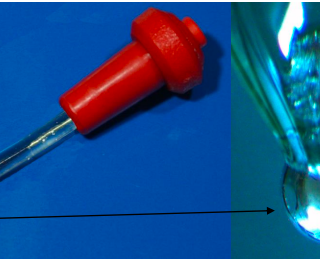
Read moreThe Hanging Platinum Drop Electrode (HPDE) is solid phase alanogy of HMDE.
The drop of liquid Pt at 2000 °C forms a drop of Pt. The surface of HPDE has nearly ideal surface which is impossible to obtain using polishing. HPDE has also spherical symmetry which enables mathematical treatment of its response.
The material is not toxic and it is chemically stable. The only disadvantage is HPDE cleaning, which can be, however, in some cases solved by carefull insertion of the electrode tip to the flame of an alcohol burner.
Thus HPDE can be used as reference electrode for complicated electrochemical studies, where it is necessary to distinguish the analytical signal from the signal generated by surface inhomogenities.Hanging platinum drop electrode (HPDE) is designed for measurements with thermostated cell TC4, TC5, TC6 and TC9.
-

Nexus
Read moreBuilding on PalmSens’ legacy of providing top-tier solutions for accurate low-current measurements, Nexus delivers an ultra-low-noise performance that exceeds even our existing portable devices, while also supporting measurements up to 1 Ampere.
More information could be found trough link:
https://www.palmsens.com/product/nexus/
- Bi)Potentiostat/ Galvanostat/ Impedance analyzer
- FRA / EIS: 10 μHz up to 1 MHz
- 11 current ranges: 100 pA to 1 A
- Dual EIS with second sense electrode
- Script your experiments using MethodSCRIPT
- Use with PSTrace software for Windows
Versatile
Our high-end instrument, the Nexus, is a Potentiostat, Galvanostat, and optional a Frequency Response Analyser (FRA) for Electrochemical Impedance Spectroscopy (EIS). The Nexus has a large potential range (-12V to +12V) and current range (100 pA to 1 A) with a high resolution and low noise.
The research software PSTrace makes using the Nexus a breeze. The scripting language MethodSCRIPT gives a user full control when needed. Looking for a multi-channel instrument? Just stack multiple instruments on top of each other.
Configurable
Nexus comes in different configurations:
- optional EIS/FRA module with maximum frequency of 1 MHz
- optional BiPotentiostat module for second WE
Standard included
Carrying padded bag containing:
- High quality, double shielded cell cable with
2 mm banana connectors for Working, Sense, Counter, Reference electrode and Ground - Chassis ground cable with croc clip (4 mm)
- Hardware Sync Link cable
- Crocodile clips
- Calibration report
- Dummy cell
- USB cable and Ethernet cable
- Manual and Quick Start document
- PSTrace software for Windows
- iR-compensation (ohmic drop compensation) module
- Second Sense lead cable
S2 and BiPot
Nexus includes a Second Sense lead (S2) and an optional BiPotentiostat (BiPot) module.
S2 – Additional voltage (potential) measurement point
BiPot – Independent second working electrode for simultaneous current measurement
These two features are independent and serve distinct purposes:
- S2 (Second Sense Lead)
S2 acts as an additional voltage-sensing input, with the same specifications as the main reference electrode. It measures the potential at a specific point in the cell and, because the current at that point is known, it can also be used to calculate impedance. - BiPot (BiPotentiostat Module)
The BiPot module introduces a second working electrode (WE2), operating versus the same reference and counter electrodes as the main channel. In BiPotentiostat mode, both working electrodes (WE1 and WE2) are recorded simultaneously. WE2 operates in potentiostatic mode, meaning it can independently control its potential and measure its current.
Why choose the Nexus?
