


Silver / Silver Chloride Refillable Reference Electrode – 6 mm dia. (redox.me)
It is a compact refillable Ag/AgCl reference electrode equipped with ceramic frit molten into the glass body. This electrode outperforms competing products in terms of mechanical stability, voltage stability and lifetime. In general, the reference electrode is composed of a system of phases, which retain an essentially constant composition, and therefore provides a stable potential by which the working electrode potential can be monitored. The phases present in reference electrodes undergo reversible redox processes at a very high rate, enabling them to rapidly adjust to changes in the solution’s ionic activity, but leaving them sensitive to the passage of large current densities.
Application note
This electrode is commonly used with aqueous acidic electrolytes, but due to the low resistance of the frit it can be used with standard non-aqueous electrolytes, as well. The reference electrode should be stored with the rubber plug applied on the tip. Please see the full instruction here. Keeping in the solution may shorten its lifetime (the electrode operates well as long as there is at least ¼ of the solution in the electrode tube). Before use rinse it with deionized water. If air bubbles are present around the porous frit, flick the tip several times to remove them. For cleaning use detergent (dish washing detergent with water), alcohols or acetone and rinse it with deionized water at the end. To re-fill the electrode please follow this article.
Specification
effective length: 30 mm or 70 mm
tube diameter: 6 mm
filling solution: 3M KCl
potential stability: <5 mV
frit resistance: 2-10 kohm at RT
operating temperature: 0-100 deg C
potential vs SHE at 25 °C: 0.207 V
Intrastat data
HS Code: 90278930
Country of Origin: Sweden
NET weight: 100g
Product includes
1 Ag/AgCl refillable reference electrode
1 O-Ring
1 glass tube for storing purposes
Select configuration
Electrode length: 30 mm / 70 mm
Related products
-

Platinum Coated Titanium Mesh Electrode with Holder – set of 10 pcs (redox.me)
Read moreThe metal counter (auxiliary) electrode is provided in electrochemical cell as a current sink to shunt excess current away from the reference electrode. Platinum Coated Titanium Mesh Electrode is a cheap alternative to pure Platinum Electrodes like Platinum Gauze Electrode or Metal Wire Auxiliary Electrode. Platinum coating makes this counter electrode inert under the reaction conditions and provides catalytic properties. The electrode is installed in the Basic Sample Holder (1 pcs included in the set), which allows full immersion of the electrode in the electrolyte (wet Tantalum contact). It well fits aqueous and organic solvent electrolyte requirements. Electrode size is customizable.
Application note
The Platinum Coated Titanium Mesh Electrode is fully immersed in the ion-conducting solution as a counter electrode. An electric current is passed between the working electrode and the Platinum Coated Titanium Mesh Electrode for a certain amount of time. After the process, the electrode should be washed several times with ethanol and dried under the nitrogen flow. Store the electrode in a dedicated compartment to avoid scratching. Discoloration may indicate the degradation (dissolution) of the Platinum layer and oxidation of Titanium mesh.
This electrode is used mainly in systems where there is a high risk of its contamination by organic or inorganic deposit during the electrochemical reaction. It is also a cheap replacement for pure Platinum electrode in electrodeposition processes.Specification
Titanium grade: GR1
working current: <5000 A/m2
Platinum content: >15 g/m2
Platinum coating thickness: 760 – 1500 nm
mesh hole size: 3 mm x 2 mm
mesh thickness: 0.5 mm
electrode size: 25x25mm2, 50x50mm2, 100x100mm2, custom
pH range: 1-12Intrastat data
HS Code: 71151000
Country of Origin: Sweden
NET weight: 100 gProduct includes
10 x Platinum Coated Titanium Mesh Electrode of selected size
1 x Basic Sample Holder (if selected) -
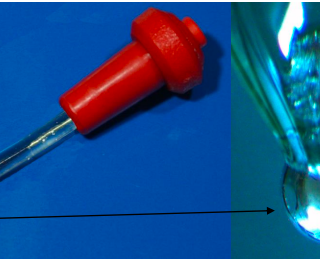
Hanging Platinum Drop Electrode
Read moreThe Hanging Platinum Drop Electrode (HPDE) is solid phase alanogy of HMDE.
The drop of liquid Pt at 2000 °C forms a drop of Pt. The surface of HPDE has nearly ideal surface which is impossible to obtain using polishing. HPDE has also spherical symmetry which enables mathematical treatment of its response.
The material is not toxic and it is chemically stable. The only disadvantage is HPDE cleaning, which can be, however, in some cases solved by carefull insertion of the electrode tip to the flame of an alcohol burner.
Thus HPDE can be used as reference electrode for complicated electrochemical studies, where it is necessary to distinguish the analytical signal from the signal generated by surface inhomogenities.Hanging platinum drop electrode (HPDE) is designed for measurements with thermostated cell TC4, TC5, TC6 and TC9.
-

EmStat4 MUX (2-in-1: Potentiostat with integrated multiplexer)
Read moreGone are the days with too many cables. With the EmStat4 MUX you have a potentiostat and a multiplexer in one! The EmStat4 MUX is a powerful potentiostat, galvanostat and impedance analyzer and supports all popular electrochemical techniques. Its 8 channels allow for sequential measurements, for example eight Screen-printed electrodes, or eight working electrodes in eight different cells. The instrument’s measurements can be highly customized using MethodSCRIPT. The 4 different cell connections available allow for many different setups. When the measurements are finished, you can easily save your results in PSTrace, or export your results to Excel.
More information could be found tought link:
https://www.palmsens.com/product/emstat4-mux/
- Integrated 8-channel multiplexer
- Supports 2-, 3- and 4-electrode setup using Sense Lead
- Potential range: ± 3V
- Compliance voltage: ± 5V
- Current ranges: 1 nA – 10 mA
- Maximum current: ± 30 mA
- FRA / EIS up to 200 kHz
Two modes of operation
- Consecutive mode: this mode switches channel when a complete measurement has finished
- Alternate mode: this mode switches all activated channels within the specified time interval of a measurement.
In both modes the unselected Working Electrodes can either be left floating or switched to Ground to keep the specified voltage.
Supports a 2-, 3- or 4-electrode setup
- Connect four electrodes per channel by using the Sense Leads.
- Or connect only three electrodes per channel by internally connecting all Sense electrodes to the Working Electodes in software.
- Do you need to connect only two electrodes per channel? Combine the reference and counter electrode physically on the cable, or with a single click on the PSTrace software.

8 to 128 channels
Is 8 channels not enough? If more channels are required, one or more MUX-R2 can be stacked to the EmStat4 MUX for a total of up to 128 channels.
Script your experiments!
Via the script window of PSTrace it is possible to perform a different experiment on each of the channels sequentially. Alternatively, you can use MethodSCRIPT to fully customize your measurements per channel.
Multichannel or Multiplexer?
To make it easier for you to decide, if a multiplexer or a multichannel device is more suitable for your application, we have created a short explanation of multiplexers and multichannels.
See: https://www.palmsens.com/app/uploads/2016/12/Multiplexer-Polypotentiostat-or-Multichannel.pdf
-

EmStat4T (Tailored electrochemistry through touch-controlled apps)
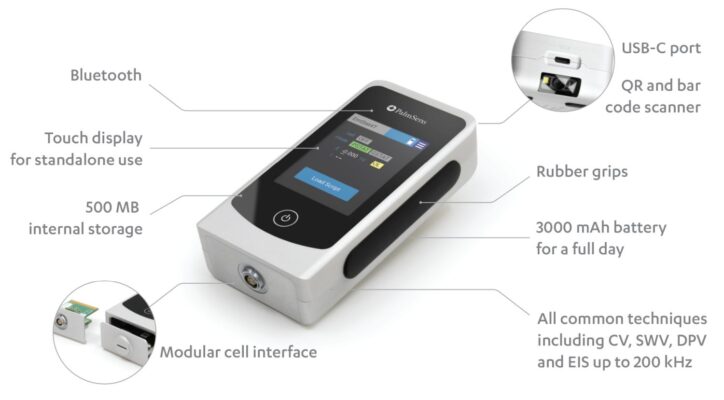
Read moreThe EmStat4T is a programmable handheld potentiostat with a touchscreen, which is ideal for sensor research and sensor-based applications. It offers two main modes of operation:
- Remote Control: where it functions as a conventional potentiostat, controlled directly by our PSTrace software for Windows or PStouch app for Android. These applications allow you to run measurements, view results, and perform data analysis.
- Standalone: where the instrument is controlled via its touch interface to run a wizard‑style app for electrochemical analysis. Compose custom apps easily using the Visual MethodSCRIPT Editor included in PSTrace for Windows. Apps eliminate the need for a computer, tablet, or smartphone. This makes the EmStat4T an ideal solution for point-of-care applications and field research such as environmental analysis or corrosion monitoring.
More information could be found tought link:
https://www.palmsens.com/emstat4t/
Tailored electrochemistry through touch-controlled apps
- Potential range ±3 V
- Max. current ±30 mA
- Supports common electrochemical techniques
- Standalone operation with MethodSCRIPT
- or remotely controlled by laptop or phone
- Bar/QR-code scanner
- Customizable cell interface with drop-detection for SPEs
Main Features
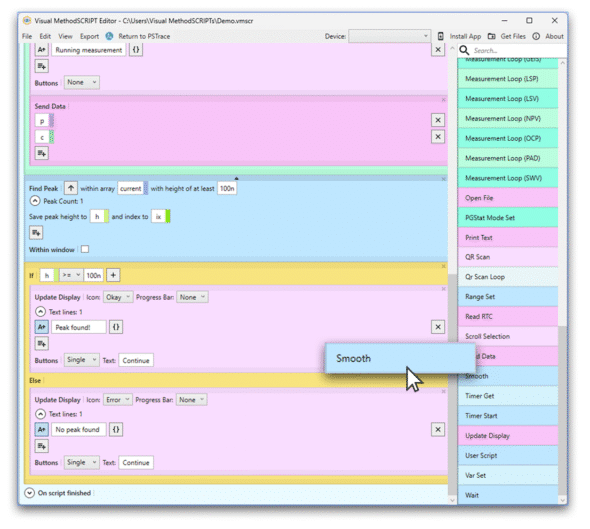 Visual MethodSCRIPT Editor
Create your EmStat4T apps
The powerful MethodSCRIPT™ language allows for easily creating your own applications to run on the EmStat4T. Compose apps using our Visual MethodSCRIPT Editor which generates the MethodSCRIPT for you.
Your measurements are safely stored

Internal Storage
The EmStat4T is equipped with 500 MB internal storage memory for storing your measurements. All internally stored measurements can be browsed and transferred back to the PC easily using the PSTrace software for Windows. Your data is always with your instrument wherever you take it.