


Bottom mount front contact electrochemical cell setup (redox.me)
This is a static voltammetry cell with variants for different sample dimensions. The sample is loaded from the bottom via magnetic or screw mount, while counter or/and reference electrodes are mounted in the lid as either 2-, or 3-electrode configuration. The cell is constructed with materials that are inert to the sample environment (glass and PEEK), and it can be used with FKM/EPDM O-rings or FFKM O-rings for aqueous or organic electrolyte requirements, respectively. The construction is gas-tight and inert gas can be bubbled through the electrolyte to remove and exclude contaminants such as air or water.
Application note:
The reference electrode tip should be placed close to the sample surface to ensure a negligible potential drop throughout the electrolyte solution during low-current experiments. In the magnetic variant of the cell, the strength with which the magnets hold the sample is adjusted by adding or removing the washers under the magnets. Thanks to this procedure, the distance between the magnets changes, with it, the force of their attraction. Various auxiliary electrodes are suitable for this cell, including metal wire and metal plate electrodes as well as carbon-based electrodes (graphite or Glassy Carbon). If a purge gas is used, stop the flow during experiments for better results.
Specification:
nominal exposure area: 0.07 cm2 for 5x5mm2, 0.2 cm2 for 7x7mm2, 0.5 cm2 for 10x10mm2, and 1.33 cm2 for 15x15mm2
minimum electrolyte volume: 2.5 mL
maximum electrolyte volume: 15 mL
electrode plug diameter: 6 mm
substrate size: 5x5mm2, 7x7mm2, 10x10mm2, and 15x15mm2, other sizes available on request
minimum substrate thickness: 0.4 mm*
*lower thicknesses are also feasible when using a pad below the sample
Intrastat data:
HS Code: 90309000
Country of Origin: Sweden
NET weight: 200 g
Setup includes:
1 x BM FC EC 15mL – Bottom Mount Front Contact Electrochemical Cell, 15mL (or BMM FC EC 15mL – Bottom Magnetic Mount Front Contact Electrochemical Cell, 15mL)
1 x lid
1 x glass chamber
1 x bottom casing
1 x sample mount
1 x tantalum contact
1 x plug
1 x set of Nylon screws (screw variant only)
1 x Reference electrode (Ag/AgCl, or Ag/Ag+), 70mm, 4 mm female banana socket
1 x Metal Wire Auxiliary Electrode – 50HX15 0.6/250 mm, platinum 99.9%, 4 mm female banana socket
Select configuration
Electrolyte type: water-based / organic electrolyte
Related products
-
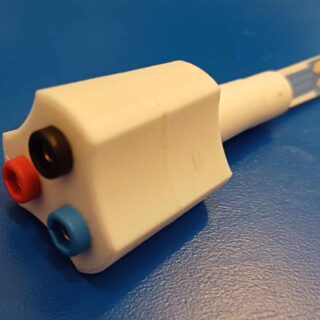
SPE Connector.GC.1 for measurements in glass
Read moreThe connector enables the use of the biosensor or electrochemical sensor based on the substrates AC1, AC4 and TS1 in glass cell TC4, TC5, TC6 or TC7.
The connector enables measurement with screen printed electrodes with width 7.26 mm and standard contact pads pitch (2.54 mm).
It is compatible with other SPE´s that use the same distance between the contact pads (2.54 mm). The cone at the connector sensor side is NJ 8/10 which enables to use the connector with any standard chemical vessels.Termination: 2 mm Banana plugs
-

AC1.GP. Electrochemical sensor with a working electrode of guaranteed purity
Read moreBasic amperometric three-electrode sensor with patented structure made by thick film technology.
Dimensions: 25.40 mm x 7.26 mm x 0.63 mm
WE material: gold, platinum, silver, copper, iron, nickel, cobalt, chromium, tantalum, irridium, rhenium, magnesium, palladium, zirconium and others
*Selection of sensor electrode materials other than those listed above is possible upon agreement with the customer.
The sensor is made on a corundum ceramic base. Working, reference and auxiliary electrodes are applied to this surface. Working, reference and auxiliary electrodes are made of different materials. At the end of the sensor there is a contact field that is connected to the active part by silver conductive paths that are covered with a dielectric protective layer. The working electrode of the sensor with a diameter of 2 mm is made of a material of guaranteed purity of up to 99.99 % depending on the selected material– standard layer thickness 0.0125 mm.
We also offer a working electrode made of polished gold AC1P.W*.R*, with homogenous surface with roughness less than 1 µm.
We also offer activated graphite sensors on customer request.
-
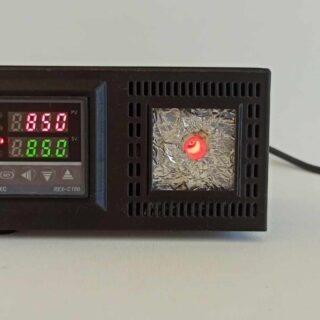
Activation furnance for electrochemical sensors
Read moreThe activation furnance is a device used for curing individual sensors of the AC1 type. At a defined temperature (up to 1000 °C) depending on the electrode and sensor materials. When the sensor is cured, the surface of the electrodes is cleaned from surface oxides and organic impurities, which results in regeneration of the sensor or its activation. In this way, for example, old sensors with immobilized enzyme layers can be cured for reuse – see example at the end ot the document.
-
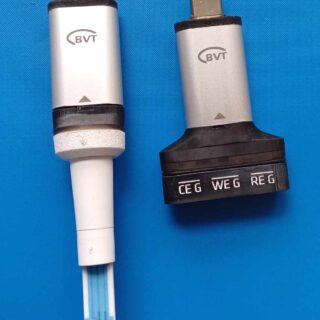
USB Potentiostat Galvanoplot
Read moreUSB Potentiostat Galvanoplot is a super small, low-cost and affordable device suitable for dedicated volume applications, which is optimized for screen-printed sensor and biosensor applications. It can be used in many other research areas and with other electrochemical sensors, for corrosion measurement, battery and super-capacitors or fuel cells.
It is capable of performing all common Amperometric and Voltammetric electrochemistry protocols (CA, LSV, CV, DPV, NPV, SVW, GAL) and can be used with three electrode (WE/RE/CE) and two electrode (WE/RE-CE) setups. Plug the device directly into an Android mobile device through OTG port for a true on-site analysis experience. It is possible to choose from two types of interfaces allowing direct insertion of the BVT SPE sensors or the use of 3 classical electrodes with 2 mm banana plugs (WE, RE, CE).
- Dimensions: 39x17x8 mm
- Weight: 5 g without sensor interface
- Voltage scan range: +-3V @1mV resolution
- Max current: 2000 nA (*at the request of the customer, it is possible to change the range, but this will change the resolution, noise and other parameters)
- Current resolution: 300pA@1KSPS/ 100pA@100SPS/ 30pA/10 SPS resolution
- Noise around: 50nA@1KSPS/ 7nA@100SPS/ 400pA/10 SPS
- Protocols: CA, LSV, CV, DPV, NPV, SVW, GAL
- Cell type: WE/RE/CE and WE/RE-CE
Connectivity: USB-C (Plug the device directly into an Android mobile device through OTG port for a true on-site analysis experience)
- Operating system compatibility: Windows 8, 10+
- Advanced analysis – filtering and auto peaks
Device Usage
- Electrochemical measurements
- Measurements with biosensors and electrochemical sensors
- Measurement of biochemical activity of a sample
- Corrosion measurement