
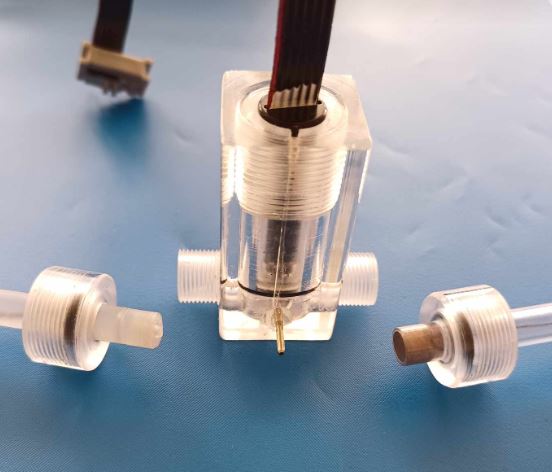
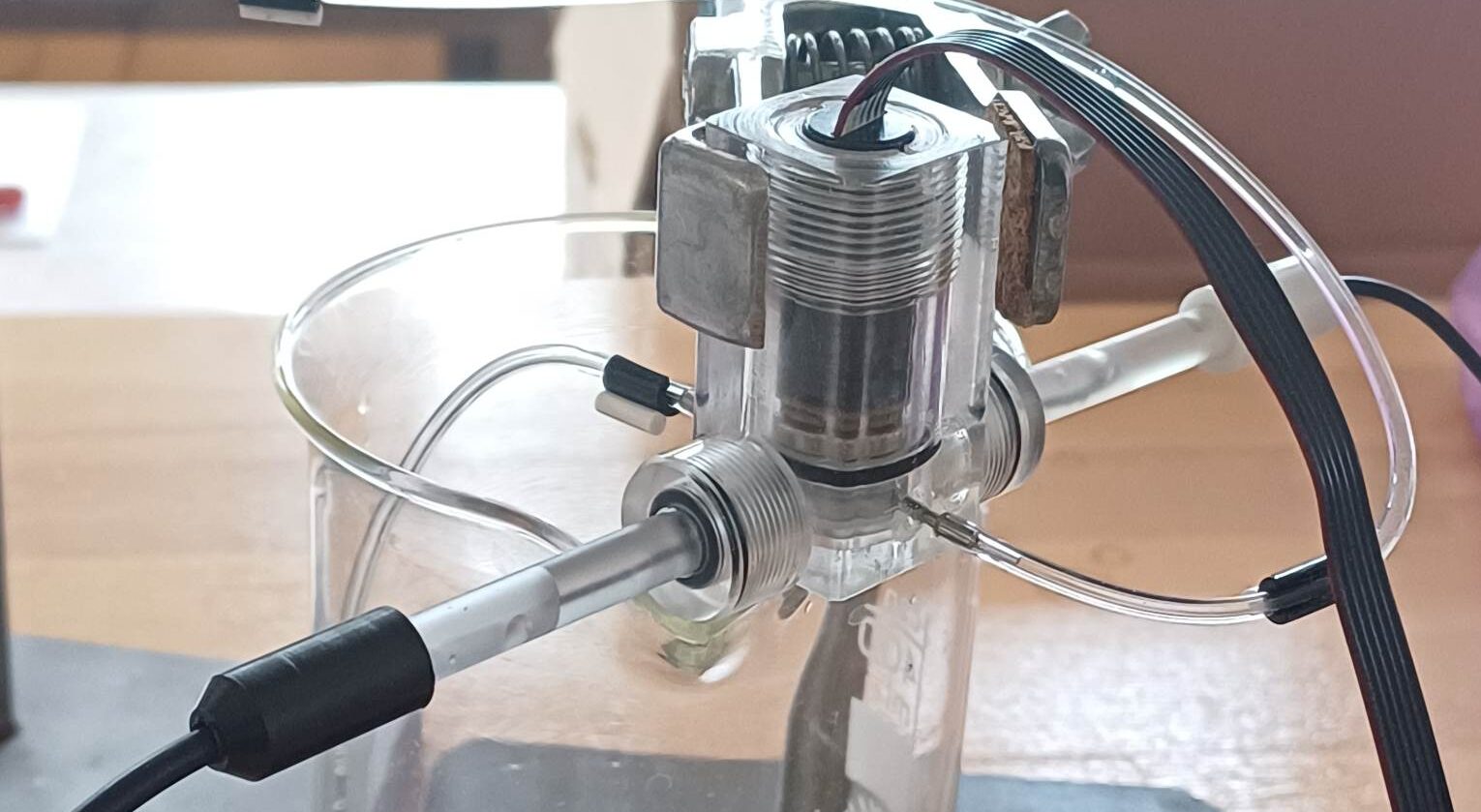
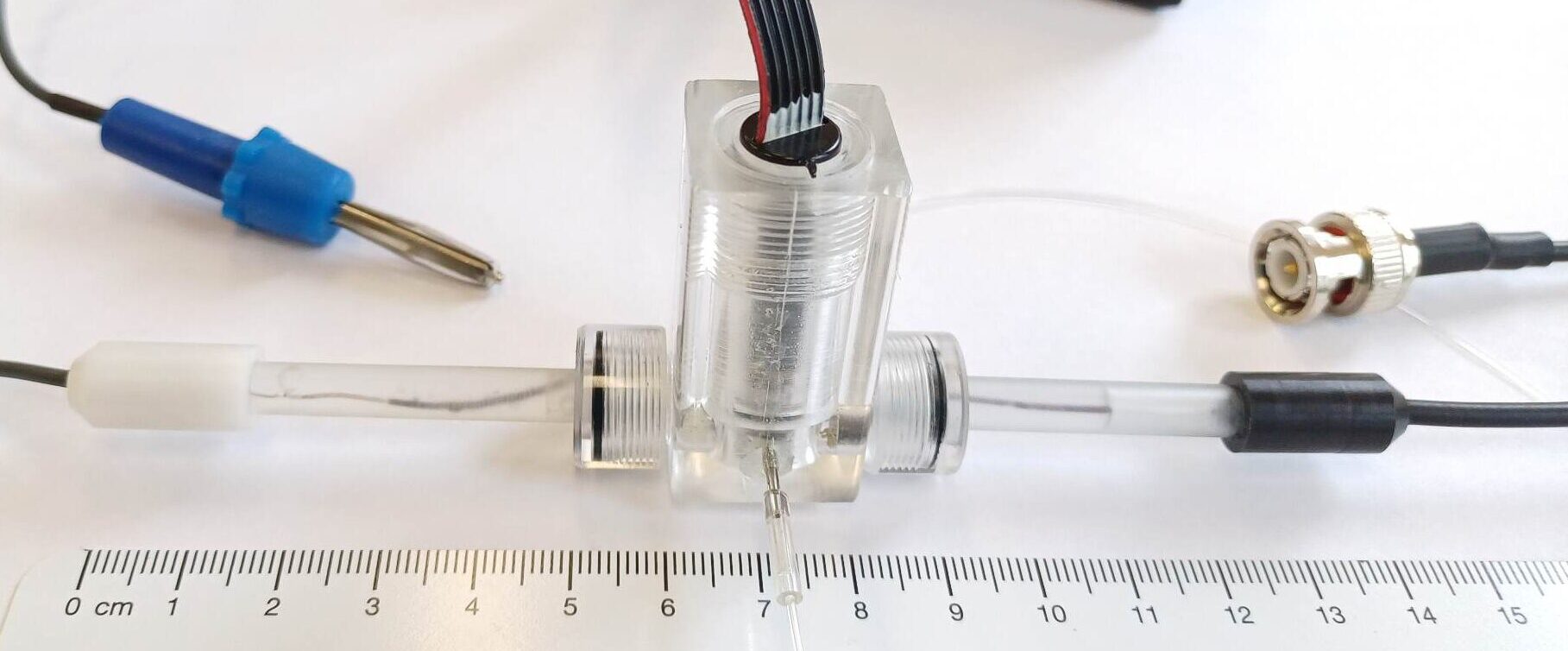
FC.1ISE.1REF Flow cell for single ion selective electrode with integrated stirring
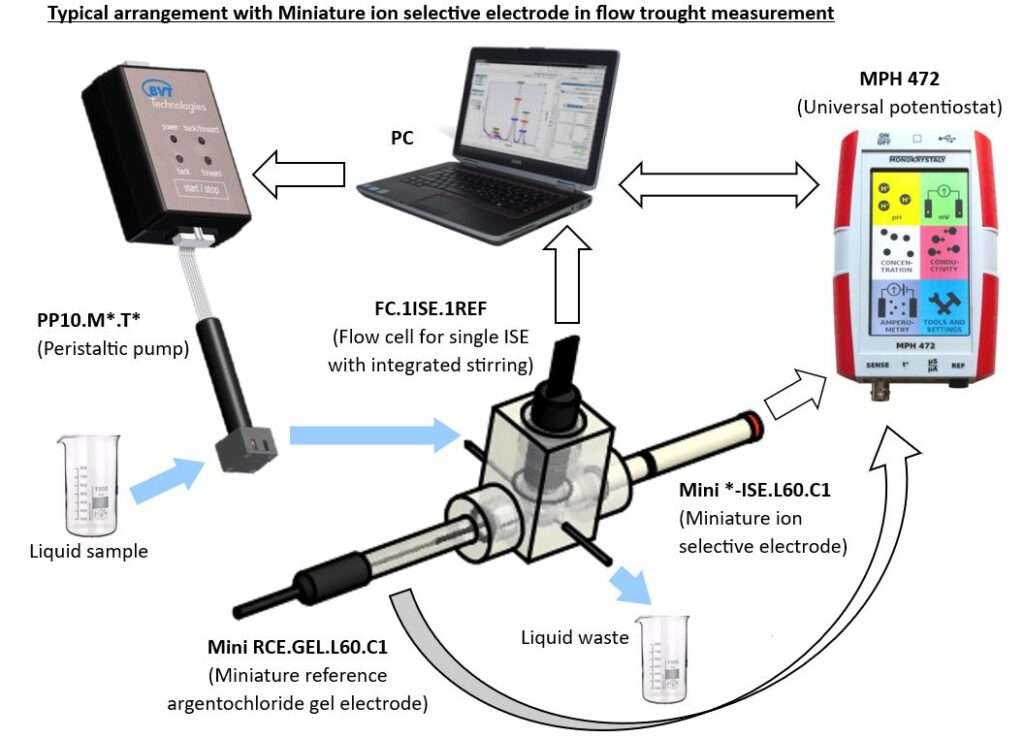
The flow cell with integrated stirring and reduced hydrodynamic noise is designed for the determination of single analyte using one miniature ion-selective electrode (ISE) and one miniature reference electrode with a diameter of 6 mm and length of 60 mm.
Rotation speed of integrated stirrer: 10-4000 rmp.
Miniature ion-selective electrodes and reference electrode were designed for integration into the flow cell for determination of Cl-, K+, Ca2+ and Na+ ions.
In flow mode, the system can operate automatically. The speed of the integrated stirrer can also be controlled by applying the corresponding voltage to the motor, connected to a stabilized source.
The flow cell with one selected ISE can be used for:
- Automatic or semi-automatic measurement of concentration of Cl-, K+, Ca2+ and Na+ ions in various solutions (following prior calibration)
- For continuous measurement of changes in concentration of Cl-, K+, Ca2+ and Na+ ions.
* For this product, we recommend our customers use the Training Service from BVT.
(https://bvt.cz/produkt/offer-of-long-term-automated-measurements-on-bvt-apparatus/)
You may also like…
-
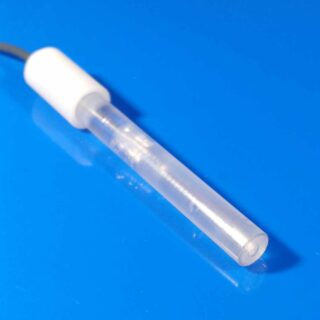
Mini RCE.GEL.L60.C1 Miniature reference argentochloride gel electrode
Read moreMiniature reference argentochloride gel electrode is designed for potentiometric measurements in connection with Miniature ion selective electrodes for potentiometric measurements of Chloride ions, Sodium ions, Calcium and Potassium ions concentration in aqueous solutions following prior calibration.
The conductive connection of the internal electrolyte (KCl gel) enclosed in a plastic tube is mediated by a porous frit.
Maintenance-free electrode – no need to top up the internal electrolyte (KCl gel).
Electrodes are applicable to all commonly used measuring apparatus, with input resistance of at least 1012 Ω.
Possibility of integration with a FC.1ISE.1REF Flow cell for single ion selective electrode with integrated stirring – possible automation and continuous measurement.
-
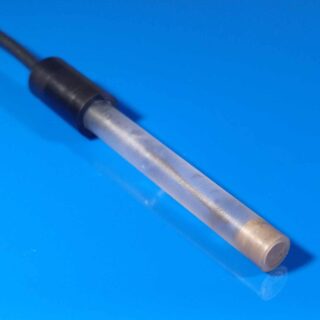
Mini *-ISE-L60.C* Miniature ion selective elecrodes
Read moreMiniature ion selective electrodes for potentiometric measurements of Chloride ions, Sodium ions, Calcium and Potassium ions concentration in aqueous solutions when used together with a reference electrode (following prior calibration) with a diameter of 6 mm and a length of 60 mm.
Specifically, these applications may include analyses for agricultural purposes, online monitoring of the representation of selected ions in water management, certain industrial areas or agriculture (hydroponic cultivation of plants) etc.
Electrodes are applicable to all commonly used measuring apparatus, with input resistance of at least 1012 Ω. The work with ion selective electrodes is time effective, requires an only small amount of chemicals, and a friendly price of measuring equipment (potentiostat with measuring method potentiometry).
Possibility of integration with a FC.1ISE.1REF Flow cell for single ion selective electrode with integrated stirring – possible automation and continuous measurement.
* For this product, we recommend our customers use the Training Service from BVT.
(https://bvt.cz/produkt/offer-of-long-term-automated-measurements-on-bvt-apparatus/)
-
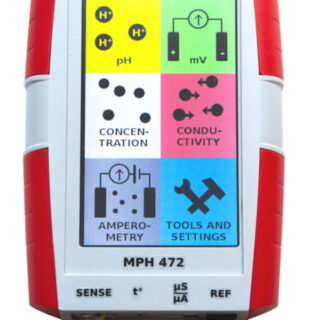
MPH 472 Universal Potentiostat
Read moreThe instrument enables measurement of amperometry, potentiometry and conductometry. Communication with the computer is provided via USB or Bluetooth. This hand-held device is equipped with GPS navigation so the measured data may be enhanced by the exact coordinates of the location where the measurement was made.
Measured data can be stored and later processed in a PC because of the SD card slot incorporation. The ability to record a waveforms or integrate the measure values is enabled. Basic evaluation methods are also implemented – linear and non-linear calibration and standard addition method is available. The influence of the type of oxygen electrode membrane, temperature or gas solubility can be compensated for the measured values.
The measured data are automatically recalculated and displayed in units of current, voltage, concentration (g∙L-1 or mol∙L-1) or saturation. Potentiometric measurement allows connection of pH electrodes and ISE.
Key Properties
- Up to 200 hours of battery life depending on the operating mode.
- Excellent analytical tools (graphs, unit conversions, internal standard method for potentiometry, coulometric titration, 10 Henry’s constants for various redox active gases).
- Power supply and data communication via USB, possibility of connection via Bluetooth.
- Data logging to memory card.
- Up to 5-point calibration for ISE and pH electrodes.
- Up to 4-point calibration of the conductivity cell makes it possible to compensate the non-linearity of the measurement.
- GPS equipment enables measurements in the field with location storage.
- Calibration stored separately in the device (possibility of changing the memory card without having to recalibrate the device).
- Possibility of separate calibration for 4 probes for amperometry and potentiometry.
- The possibility of using different temperature sensors (PT100, PT1000, Ni1000, ATC Monocrystals).
- Advanced power management (display sleep and automatic device shutdown can be set according to the user’s preferences
- Vector voltmeter for accurate conductivity measurement.
- Powerful thirty-two-bit microprocessor for accurate measurement calculations.
Improvements:
- Faster battery charging via USB charger.
- Vector voltmeter for precise conductometric measurement.
- A more sensitive GPS module.
- More robust input circuits for ametrometric measurement – less susceptible to noise.
More information can be found through the link: https://www.monokrystaly.cz/cs/ph-mv-ion-metry.html?fbclid=IwAR3ieir-mH-D10LZ-SZkrx74OHZYvOHjZPnOX8nfi9WdcwostsUgTAVaZPM#MPH471
Related products
-
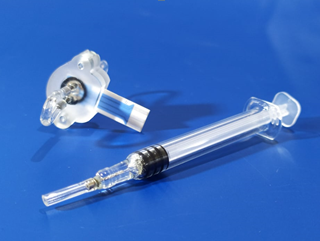
SIRE Sensor Cell Set (Sensor with Injectable Recognition Element)
Read moreThe SIRE Sensor Cell Set consists of a sensor with an integrated non-removable specialised chamber.
The set also contains a syringe which will allow the injection of the recognition element (Enzyme).
The SIRE Sensor Cell uses the concept of soluble enzymes into a reaction chamber separated from the sample by a semi permeable dialysis membrane. The analyte (for example maltose), enters into the reaction chamber by diffusion. The analyte reacts with the recognition enzymes creating H2O2 which is oxidized on a screen printed Pt electrode. The current corresponds to the amount of analyte.* For this product, we recommend our customers use the Training Service from BVT.
(https://bvt.cz/produkt/offer-of-long-term-automated-measurements-on-bvt-apparatus/)
-

Spectro-electrochemical flow cell setup (redox.me)
Read moreThis is a horizontally mounted, multi-purpose spectroelectrochemical cell designed to be used with standard UV-Vis or IR spectrometers. It enables obtaining electrochemical and spectroscopic information from liquid sample or thin films in systems where variations in applied potential induce changes in observed spectra. It consists of a polyether ether ketone (PEEK) flow chamber equipped with a magnetic or screw mount sample holder, screw mount quartz window holder and two different mini tripods. It well fits aqueous (FKM O-Rings) and organic solvent (FFKM O-Rings) electrolyte requirements.
The cell is meant to be used with a standard reference electrode having 6 mm in diameter and a counter electrode either in the form of a rod or helix with 6 mm in diameter and 15 mm active length.
Application note:
The spectroelectrochemical cell is used to study the relation between absorbance/transmittance and electrochemical potential. It enables real-time monitoring of optical change in electrochromic materials. It also enables in-situ spectral acquisition for detection, identification and characterization of short-lived electrochemically-generated species/intermediates, resulting in a detailed investigation of the mechanistic pathways of redox processes.Specification:
nominal exposure area: 1 cm2 (other values on request)
optical path length (electrolyte thickness): 12 mm
flow chamber volume: 1.75 mL
maximum substrate thickness: 4 mm
electrode plug diameter: 6 mm
minimum substrate size: 17 mm x 25 mm
recommended substrate size: 25 mm x 25 mmIntrastat data:
HS Code: 90275000
Country of Origin: Sweden
NET weight: 300 gSetup includes:
1 x Magnetic Mount Spectro-Electrochemical Flow Cell – MM spectro-EFC 1.75 mL (or Spectro-Electrochemical Flow Cell – spectro-EFC 1.75 mL)
1 x Metal Wire Auxiliary Electrode – 35HX15 0.6/235 mm (Platinum)
1 x Reference electrode (Ag/AgCl, or Ag/Ag+) -
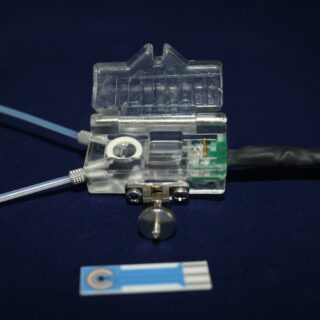
FC2.TL.* PMMA Flow Cell
Read moreThe flow cell enables the use of Screen printed sensors in a flow through arrangement.
The flow cell is suitable for sensors of type AC1, AC2, CC1, CC2 and CC3.
The Screen printed sensor is inserted into the slit of cell and tightened by closing of the door. The cell ensures the wall-jet flow around the working electrode and it is optimised so that no air bubbles cumulate in the cell. The cell contains also the contact and output cable.
With the sensors enclosed in a flow cell, it is possible to measure semi-automatically or automatically using a pump or liquid switch for sample supply. Under such conditions, maximum measurement reproducibility is ensured.
-

Raman Electrochemical Flow Cell, active area: 3.5 cm2, volume: 4.5 mL (redox.me)
Read moreThis cell combines two classical analytical techniques such as electrochemistry and Raman spectroscopy, to obtain in-situ chemical information about the reactions taking place during an electrochemical experiment. It consists mainly of three elements: (i) sample holder with Tantalum (formerly Copper) foil serving as an electric contact to working electrode surface, (ii) chamber in which reference and counter electrodes are installed together with electrolyte inlet and outlet and (iii) lid which seals the cell and holds the Sapphire window. The sample consisting of a thin film of electrochemically active material deposited on a rigid or flexible substrate (working electrode) is loaded from the bottom via magnetic or screw mount. The counter or/and reference electrodes are mounted in a top casing (either 2-, or 3-electrode setup. The oval counter electrode made of e.g. Platinum wire assures uniform distribution of the field lines along the path to working electrode. During an experiment Raman laser is focused onto the surface of a thin film working electrode through a transparent Sapphire window and thin layer of electrolyte (total optical path of 3.25 mm). The electrolyte thickness of 2.25 mm ensures free diffusion of ions (e.g. protons) and its counter ions.
The electrode adapter for installing 6 mm dia. electrodes inside Raman ECFC is available here. It enables using disk electrode, plug with clip or any other rod-shape electrode (e.g. graphite rod) or current collector (e.g. metal mesh, graphite coated metal mesh, metal foil, graphite coated metal foil, metal foam, carbon woven and non-woven fabrics, carbon paper, etc.) as working electrode instead of a flat electrode in default Raman ECFC configuration.
The screw mount variant of Raman ECFC can be converted into GDE Raman ECFC by using Gas Compartment. This conversion allows installation of Gas Diffusion Electrodes as working electrode.
The cell elements are constructed with materials that are inert to the sample (PEEK, Fluorocarbons). It well fits aqueous (FKM O-Rings) and organic solvent (FFKM O-Rings) electrolyte requirements. The construction is gas-tight and can be used when the removal and exclusion of contaminants such as oxygen and water is required by bubbling of an inert gas through the electrolyte (in an external reservoir).
Application note:
This cell can be used to track kinetic phenomena such as the near-surface proton concentration changes during oxidation and reduction reaction at working electrode. It can be also used to identify materials such as carbon, metal oxides, polymers and electrolytes, and to determine their structure and distribution. Various metals are suitable for this cell as auxiliary electrode including Platinum, Gold and Silver.Specification:
nominal exposure area: 3.5 cm2
electrolyte volume: 4.5 mL
optical path (including Sapphire window): 3.25 mm
electrode plug diameter: 6 mmIntrastat data:
HS Code: 90275000
Country of Origin: Sweden
NET weight: 200 gProduct includes:
1 x chamber
1 x Reference electrode (Ag/AgCl, or Ag/Ag+), 30mm
1 x Metal wire auxiliary electrode – ST 0.6/150 mm, Platinum
1 x Sapphire window – 0054PSPCM
1 x lid
1 x WE Tantalum contact
1 x sample holder
1 x plug – 0005CPEMA