


Metal Wire Auxiliary Electrode – 50HX15 0.6/250 mm (redox.me)
The metal wire counter (auxiliary) electrode is provided in the electrochemical cell as a current sink to shunt excess current away from the reference electrode. The counter electrode is generally chosen to be inert under reaction conditions, typically platinum, rhodium, palladium, or gold wire. It well fits aqueous (FKM O-Ring) and organic solvent (FFKM O-Ring) electrolyte requirements.
Application note
The metal wire electrode is immersed in the ion-conducting solution as a counter electrode. An electric current is passed between the working electrode and the counter electrode for a certain amount of time. After the process, the electrode should be washed several times with isopropanol or ethanol and dried under the nitrogen flow. Store the metal wire electrode in the glass vial sealed with O-rings (all included in the package).
Specification
helix inner diameter: 4.8 mm
helix outer diameter: 6 mm
number of turns: 12
wire diameter: 0.6 mm
total wire length: 250 mm (215 mm long helix, 35 mm long straight wire)
Intrastat data
HS Code: 71101910 (platinum), 71081310 (gold),
Country of Origin: Sweden
NET weight: 100 g
Product includes
1 metal wire electrode with PEEK plug and selected electrical connector
1 O-Ring
1 glass vial
Select configuration
Related products
-
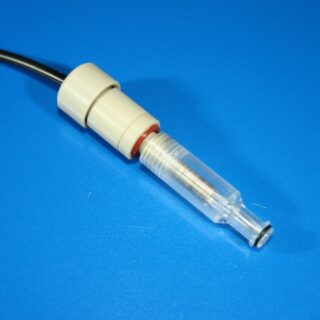
SOE.D*.E** Subminiature Oxygen Electrode
Read moreThe subminiature oxygen electrode consists of a PEEK body, platinum electrode, silver reference electrode and membrane holder.
The platinum electrode is melted in glass. The membrane holder with electrolyte is attached by thread. Subminiature oxygen electrode (SOE) is designed for measurements with thermostated cell TC4, TC5, TC6. It can be used for measurement in microtitration desk.
-
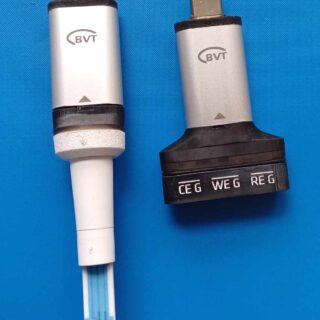
USB Potentiostat Galvanoplot
Read moreUSB Potentiostat Galvanoplot is a super small, low-cost and affordable device suitable for dedicated volume applications, which is optimized for screen-printed sensor and biosensor applications. It can be used in many other research areas and with other electrochemical sensors, for corrosion measurement, battery and super-capacitors or fuel cells.
It is capable of performing all common Amperometric and Voltammetric electrochemistry protocols (CA, LSV, CV, DPV, NPV, SVW, GAL) and can be used with three electrode (WE/RE/CE) and two electrode (WE/RE-CE) setups. Plug the device directly into an Android mobile device through OTG port for a true on-site analysis experience. It is possible to choose from two types of interfaces allowing direct insertion of the BVT SPE sensors or the use of 3 classical electrodes with 2 mm banana plugs (WE, RE, CE).
- Dimensions: 39x17x8 mm
- Weight: 5 g without sensor interface
- Voltage scan range: +-3V @1mV resolution
- Max current: 2000 nA (*at the request of the customer, it is possible to change the range, but this will change the resolution, noise and other parameters)
- Current resolution: 300pA@1KSPS/ 100pA@100SPS/ 30pA/10 SPS resolution
- Noise around: 50nA@1KSPS/ 7nA@100SPS/ 400pA/10 SPS
- Protocols: CA, LSV, CV, DPV, NPV, SVW, GAL
- Cell type: WE/RE/CE and WE/RE-CE
Connectivity: USB-C (Plug the device directly into an Android mobile device through OTG port for a true on-site analysis experience)
- Operating system compatibility: Windows 8, 10+
- Advanced analysis – filtering and auto peaks
Device Usage
- Electrochemical measurements
- Measurements with biosensors and electrochemical sensors
- Measurement of biochemical activity of a sample
- Corrosion measurement
-

Platinum Coated Titanium Mesh Electrode with Holder – set of 10 pcs (redox.me)
Read moreThe metal counter (auxiliary) electrode is provided in electrochemical cell as a current sink to shunt excess current away from the reference electrode. Platinum Coated Titanium Mesh Electrode is a cheap alternative to pure Platinum Electrodes like Platinum Gauze Electrode or Metal Wire Auxiliary Electrode. Platinum coating makes this counter electrode inert under the reaction conditions and provides catalytic properties. The electrode is installed in the Basic Sample Holder (1 pcs included in the set), which allows full immersion of the electrode in the electrolyte (wet Tantalum contact). It well fits aqueous and organic solvent electrolyte requirements. Electrode size is customizable.
Application note
The Platinum Coated Titanium Mesh Electrode is fully immersed in the ion-conducting solution as a counter electrode. An electric current is passed between the working electrode and the Platinum Coated Titanium Mesh Electrode for a certain amount of time. After the process, the electrode should be washed several times with ethanol and dried under the nitrogen flow. Store the electrode in a dedicated compartment to avoid scratching. Discoloration may indicate the degradation (dissolution) of the Platinum layer and oxidation of Titanium mesh.
This electrode is used mainly in systems where there is a high risk of its contamination by organic or inorganic deposit during the electrochemical reaction. It is also a cheap replacement for pure Platinum electrode in electrodeposition processes.Specification
Titanium grade: GR1
working current: <5000 A/m2
Platinum content: >15 g/m2
Platinum coating thickness: 760 – 1500 nm
mesh hole size: 3 mm x 2 mm
mesh thickness: 0.5 mm
electrode size: 25x25mm2, 50x50mm2, 100x100mm2, custom
pH range: 1-12Intrastat data
HS Code: 71151000
Country of Origin: Sweden
NET weight: 100 gProduct includes
10 x Platinum Coated Titanium Mesh Electrode of selected size
1 x Basic Sample Holder (if selected) -
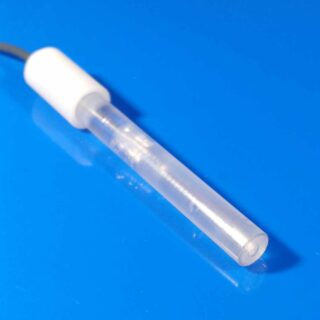
Mini RCE.GEL.L60.C1 Miniature reference argentochloride gel electrode
Read moreMiniature reference argentochloride gel electrode is designed for potentiometric measurements in connection with Miniature ion selective electrodes for potentiometric measurements of Chloride ions, Sodium ions, Calcium and Potassium ions concentration in aqueous solutions following prior calibration.
The conductive connection of the internal electrolyte (KCl gel) enclosed in a plastic tube is mediated by a porous frit.
Maintenance-free electrode – no need to top up the internal electrolyte (KCl gel).
Electrodes are applicable to all commonly used measuring apparatus, with input resistance of at least 1012 Ω.
Possibility of integration with a FC.1ISE.1REF Flow cell for single ion selective electrode with integrated stirring – possible automation and continuous measurement.