


Basic electrochemical cell setup (redox.me)
This is a stationary solution basic electrochemical cell for measurements of electrodes in a form of:
a) rod/disc (6 mm dia.),
b) thin film deposited on a flat substrate (using a wire clip) and
c) membrane (using a wire clip).
The working, counter, and reference electrodes are mounted in a top casing either in 2-, or 3-electrode setup. The cell elements are constructed with materials that are inert to the sample (glass and PEEK). It well fits aqueous (FKM/EPDM O-Rings) and organic solvent (FFKM O-Rings) electrolyte requirements. The construction is gas-tight and can be used when the removal and exclusion of contaminants such as oxygen and water is required by bubbling of an inert gas through the electrolyte. The cell chamber is available in several material variants here (glass, PTFE, PEEK)
Application note:
The reference electrode tip should be placed at the level of working electrode center. This will ensure a low potential drop throughout the electrolyte solution for low-current experiment. Various auxiliary electrodes are suitable for this cell including metal wire and metal foil electrodes as well as graphite rod. The bubbling of gas through the solution must be stopped prior to experiment.
Specification:
maximum electrolyte volume: 50 mL
electrode plug diameter: 6 mm
number of electrode slots: 3
Intrastat data:
HS Code: 90309000
Country of Origin: Sweden
NET weight: 200 g
Setup includes:
| Item | Qty | B-A-BEC-50 | B-O-BEC-50 |
|---|---|---|---|
| BEC 50 mL – Basic Electrochemical Cell | 1 | C-A-BEC-50 | C-O-BEC-50 |
| Metal wire auxiliary electrode – 50HX15 0.6/250 mm, platinum (99,9%), 1 mm dia. gold plated pin | 1 | E-A-50HX15_Pt-1mm | E-O-50HX15_Pt-1mm |
| Silver / Silver Chloride Reference Electrode – Ag/AgCl 70 mm | 1 | E-Ag/AgCl_70 | |
| Non-aqueous Silver / Silver Ion Reference Electrode – Ag/Ag+ 70 mm | 1 | E-Ag/Ag+_70 | |
| Working disk electrode – 2 mm dia., PEEK BODY 6 mm dia. – 70 mm, glassy carbon | 1 | E-A-DISK_GC-70 | E-O-DISK_GC-70 |
| 10 pcs of Tantalum wire clip with septum plug 0.6 mm dia., 60 mm long | 1 | E-A-Ta_CLIP-0.6/60-10p | E-O-Ta_CLIP-0.6/60-10p |
Select configuration
Variant: water based / organic electrolyte
Related products
-

Front contact photo-electrochemical H-Cell setup (redox.me)
Read moreThis is a horizontally mounted, double compartment photo-electrochemical H-Cell used to simultaneously or individually investigate thin film photo-anode and photo-cathode. The cell elements are made of PEEK and Fluoropolymers. It well fits aqueous (FKM O-Rings) and organic solvent (FFKM O-Rings) electrolyte requirements. The construction is gas-tight having two separate chambers, each equipped with gas inlet and outlet. This allows bubbling the solution and evacuating gases. Chambers are separated with an ion-exchange membrane (e.g., DuPont’s Nafion® membrane), so the electrochemical products appearing at photo-anode and (photo-)cathode do not affect the opposite electrode.
Application note:
This cell allows several approaches to perform measurements in 2- or 3-electrode setups. It is designed to investigate performance of a thin film photo-anode or photo-cathode (e.g. nanocrystalline material or conducting polymer) deposited on a rigid or flexible transparent substrate (typically fused quartz glass). The counter electrode is mounted in the second chamber either in a top casing or attached on the side of the cell as a thin film deposited on rigid or flexible substrate. The reference electrode is mounted in a top casing of the same chamber as the studied photo-electrode. Various auxiliary electrodes are suitable for this cell including metal wire, gauze and foil electrodes as well as non-metal electrodes and thin films. Typical applications include: basic photochemistry (photo-catalysis), photolytic water splitting, photoinduced charge separation and photo-corrosion.Specification:
minimum electrolyte volume: 2×10 mL
maximum electrolyte volume: 2×15 mL
electrode plug diameter: 6 mm
maximum substrate thickness: 3 mmIntrastat data:
HS Code: 90309000
Country of Origin: Sweden
NET weight: 600gSetup includes:
1 x Front Contact Photo-Electrochemical H-Cell
2 x lid – 0001CPEMA
2 x chamber
2 x sample mount
2 x Tantalum contacts
1 x micro tripod
4 x plug
1 x set of O-Rings (18 pcs)
1 x Metal Wire Auxiliary Electrode – 50HX15 0.6/250 mm (Platinum)
2 x Reference electrode (Ag/AgCl, or Ag/Ag+), 30 mm -
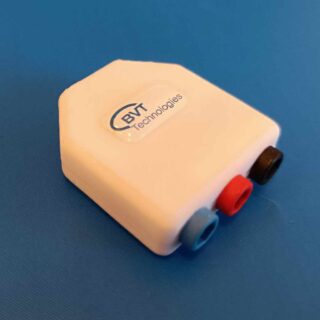
SPE Connector.1 for electrochemical sensors
Read moreThe connector enables the use of the biosensor or electrochemical sensor based on the substrates AC1, AC4, AC13 and TS1 1 in classical electrochemical arrangement.
The connector enables measurement with screen printed electrodes with width 7.26 mm and standard contact pads pitch (2.54 mm).
It is compatible with other SPE´s that use the same distance between the contact pads (2.54 mm).Termination: 2 mm Banana plugs
-

Spectro-electrochemical flow cell setup (redox.me)
Read moreThis is a horizontally mounted, multi-purpose spectroelectrochemical cell designed to be used with standard UV-Vis or IR spectrometers. It enables obtaining electrochemical and spectroscopic information from liquid sample or thin films in systems where variations in applied potential induce changes in observed spectra. It consists of a polyether ether ketone (PEEK) flow chamber equipped with a magnetic or screw mount sample holder, screw mount quartz window holder and two different mini tripods. It well fits aqueous (FKM O-Rings) and organic solvent (FFKM O-Rings) electrolyte requirements.
The cell is meant to be used with a standard reference electrode having 6 mm in diameter and a counter electrode either in the form of a rod or helix with 6 mm in diameter and 15 mm active length.
Application note:
The spectroelectrochemical cell is used to study the relation between absorbance/transmittance and electrochemical potential. It enables real-time monitoring of optical change in electrochromic materials. It also enables in-situ spectral acquisition for detection, identification and characterization of short-lived electrochemically-generated species/intermediates, resulting in a detailed investigation of the mechanistic pathways of redox processes.Specification:
nominal exposure area: 1 cm2 (other values on request)
optical path length (electrolyte thickness): 12 mm
flow chamber volume: 1.75 mL
maximum substrate thickness: 4 mm
electrode plug diameter: 6 mm
minimum substrate size: 17 mm x 25 mm
recommended substrate size: 25 mm x 25 mmIntrastat data:
HS Code: 90275000
Country of Origin: Sweden
NET weight: 300 gSetup includes:
1 x Magnetic Mount Spectro-Electrochemical Flow Cell – MM spectro-EFC 1.75 mL (or Spectro-Electrochemical Flow Cell – spectro-EFC 1.75 mL)
1 x Metal Wire Auxiliary Electrode – 35HX15 0.6/235 mm (Platinum)
1 x Reference electrode (Ag/AgCl, or Ag/Ag+) -

Standard electrochemical cell setup (redox.me)
Read moreThis is a stationary solution standard electrochemical (electrolytic) cell for measurements of electrodes in a form of:
a) rod/disc (6 mm dia.),
b) thin film deposited on a flat substrate (using a sample holder) and
c) free-standing membrane (using the basic sample holder).
The working, counter, and reference electrodes are mounted in a top casing either in 2-, or 3-electrode setup. The cell has two spare ports for connection of e.g. thermometer, Clark electrode, pH meter electrode, or other 6 mm dia. electrode/probe.
The cell elements are constructed with materials that are inert to the sample (glass and PEEK). It well fits aqueous (EPDM O-Rings) and organic solvent (FFKM O-Rings) electrolyte requirements. The construction is gas-tight and can be used when the removal and exclusion of contaminants such as oxygen and water is required by bubbling of an inert gas through the electrolyte. The jacketed model is available here.
Application note
The reference electrode tip should be placed close to a working electrode center. This will ensure a low potential drop throughout the electrolyte solution for low-current experiment. Various auxiliary electrodes are suitable for this cell including metal wire and metal foil electrodes as well as graphite rod. The bubbling of gas through the solution must be stopped prior to experiment.Specification:
maximum electrolyte volume: 100, 150, 200, 250, 350, 500 or 1000 mL
electrode plug diameter: 6 mm
number of electrode ports: 5
vial material: borosilicate 3.3 glassIntrastat data:
HS Code: 90309000
Country of Origin: Sweden
NET weight: 200 g (100, 150 mL), 300 g (200, 250, 350 mL), 400 g (500 mL), 600 g (1000 mL)