


Basic Sample Holder – metal contact, 4 mm max. thickness (redox.me)
Basic Sample Holder with a metal contact works as an electrical conductor between an electrode material (free-standing or deposited on a substrate) and an external circuit. This holder consists of PEEK body, pure Tantalum, Stainless Steel 316L, Titanium, Copper or Nickel metal electrical contact, and PEEK screw to fix the electrode. It is compatible with most of inorganic and organic based plates, free-standing membranes or thin films deposited on flexible and rigid substrates. A maximum thickness of the sample is 4 mm. Tantalum is known to be inert to practically all organic and inorganic compounds. Tantalum’s corrosion resistance is very similar to that of glass, as both are unsuitable for use in hydrofluoric acid and strong hot alkali applications. Therefore, in those cases, we recommend the other wire contact variant. The metal contact can be fully immersed in the electrolyte.
Application note
Generally, the electrode is fabricated by fixing the electrochemical active sample into the holder using a screw. Such electrode is immersed in the ion-conducting solution as a working electrode or counter electrode. An electric current is passed between the working electrode and the counter electrode for a certain amount of time. Metal wire contact is permanently installed in the PEEK body. The holder is designed to be used multiple times. The holder should be cleaned prior to the installation of electrode material.
Specification
holder body material: PEEK
rod diameter: 6 mm
contact material: Ta, SS 316L, Ti, Cu or Ni
contact wire diameter: 0.6 mm
contact wire total length: 110 mm
holder length: 70 mm
maximum sample thickness: 4 mm
Intrastat data
HS Code: 90309000
Country of Origin: Sweden
NET weight: 100 g
Product includes
1 x Basic Sample Holder
1 x PEEK M3 screw
1 O-Ring (FKM for aqueous or FFKM for organic electrolytes)
Select configuration
Related products
-

EmStat4T (Tailored electrochemistry through touch-controlled apps)
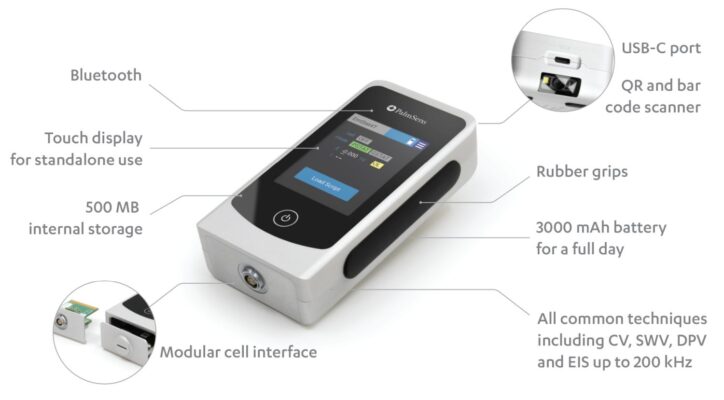
Read moreThe EmStat4T is a programmable handheld potentiostat with a touchscreen, which is ideal for sensor research and sensor-based applications. It offers two main modes of operation:
- Remote Control: where it functions as a conventional potentiostat, controlled directly by our PSTrace software for Windows or PStouch app for Android. These applications allow you to run measurements, view results, and perform data analysis.
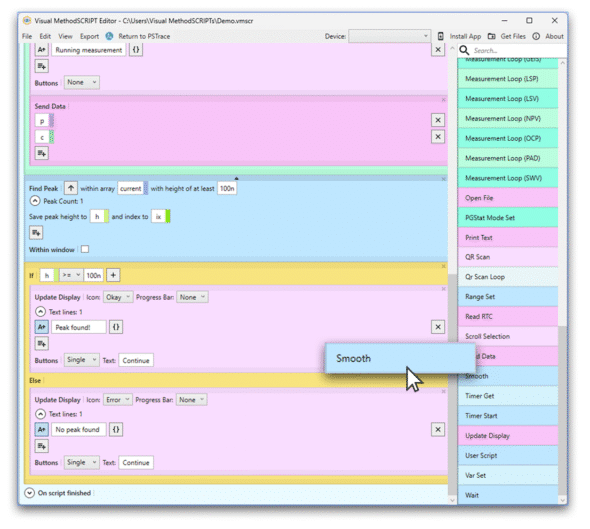
- Standalone: where the instrument is controlled via its touch interface to run a wizard‑style app for electrochemical analysis. Compose custom apps easily using the Visual MethodSCRIPT Editor included in PSTrace for Windows. Apps eliminate the need for a computer, tablet, or smartphone. This makes the EmStat4T an ideal solution for point-of-care applications and field research such as environmental analysis or corrosion monitoring.
More information could be found tought link:
https://www.palmsens.com/emstat4t/
Tailored electrochemistry through touch-controlled apps
- Potential range ±3 V
- Max. current ±30 mA
- Supports common electrochemical techniques
- Standalone operation with MethodSCRIPT
- or remotely controlled by laptop or phone
- Bar/QR-code scanner
- Customizable cell interface with drop-detection for SPEs
Main Features
 Visual MethodSCRIPT Editor
Create your EmStat4T apps
The powerful MethodSCRIPT™ language allows for easily creating your own applications to run on the EmStat4T. Compose apps using our Visual MethodSCRIPT Editor which generates the MethodSCRIPT for you.
Your measurements are safely stored

Internal Storage
The EmStat4T is equipped with 500 MB internal storage memory for storing your measurements. All internally stored measurements can be browsed and transferred back to the PC easily using the PSTrace software for Windows. Your data is always with your instrument wherever you take it.
-
ACEc.Pt plate Auxiliary Classic Electrode Conic with platinum plate
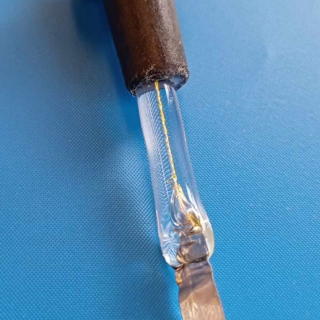
Read moreACEc.Pt plate is a glass tube with platinum plate of guaranteed purity 99.99 %. Standard connection is with a 2 mm banana plug. Auxiliary classic electrode with platinum plate (ACEc.Pt plate) is designed for electrochemical measurements.
Dimensions of Pt plate: 15 x 5 mm Pt
(Pt thickness approx. 0.21 mm)The size of the platinum sheet can be adjusted at the customer’s request.
-

Metal Wire Auxiliary Electrode – 50HX15 0.6/250 mm (redox.me)
Read moreThe metal wire counter (auxiliary) electrode is provided in the electrochemical cell as a current sink to shunt excess current away from the reference electrode. The counter electrode is generally chosen to be inert under reaction conditions, typically platinum, rhodium, palladium, or gold wire. It well fits aqueous (FKM O-Ring) and organic solvent (FFKM O-Ring) electrolyte requirements.
Application note
The metal wire electrode is immersed in the ion-conducting solution as a counter electrode. An electric current is passed between the working electrode and the counter electrode for a certain amount of time. After the process, the electrode should be washed several times with isopropanol or ethanol and dried under the nitrogen flow. Store the metal wire electrode in the glass vial sealed with O-rings (all included in the package).Specification
helix inner diameter: 4.8 mm
helix outer diameter: 6 mm
number of turns: 12
wire diameter: 0.6 mm
total wire length: 250 mm (215 mm long helix, 35 mm long straight wire)Intrastat data
HS Code: 71101910 (platinum), 71081310 (gold),
Country of Origin: Sweden
NET weight: 100 gProduct includes
1 metal wire electrode with PEEK plug and selected electrical connector
1 O-Ring
1 glass vial -

Modular PEM Electrolyzer Test Station up to 3 kW (redox.me)
Read moreThe Modular PEM Electrolyzer Test Station is a versatile and flexible solution designed for the testing and evaluation of proton exchange membrane (PEM) electrolyzers. Unlike fully automated, integrated systems, this platform features modular components that can be easily swapped by the end user, allowing for customized setups and adaptability to different testing needs. The platform is engineered to provide precise control and measurement of electrochemical performance while offering the convenience of easily replaceable parts.
This design enables users to test various configurations, integrate new modules, and adapt the system to specific research or development objectives without the need for specialized equipment or extensive downtime. Ideal for research labs and development environments, this platform supports the advancement of PEM electrolyzer technology through hands-on, flexible experimentation.
Application note:
Ideal for researchers investigating new PEM materials, flow field designs, and cell configurations. The system is an excellent tool for academic institutions and training centers, providing students and researchers with a hands-on understanding of PEM electrolysis processes and system operation. PEM Electrolyzer Test Station with power up to 3 kW is suitable for testing lab-scale or small to medium-scale electrolyzers, typically up to 60 cm². If the power requirements for a given electrolyzer are less than 2 A/cm², larger electrolyzers up to 100 cm² or more can also be tested.
The entire system, as well as its component parts, are CE certified, which signifies that a product meets European Union (EU) health, safety, and environmental protection standards. Other certificates are available upon request.The Modular PEM Electrolyzer Test Station is continuously being improved, so the photos may not fully represent the current version of the device.
Specification:
weight: 150 kg
height: 129 cm (25U)
width: 135 cm (85 cm with folded monitors)
depth: 90 cm
maximum input power: 3 kW
maximum input current: 120 A
maximum input volatge: 60 V
power connection: 230V, 3 kW, single phaseIntrastat data:
HS Code: 85433000
Country of Origin: Sweden
NET weight: 150 kgSetup includes:
1 x Modular PEM Electrolyzer Test Station or selected module(s)