

ZIVE SP2 – high quality potentiostat/galvanostat/impedance analyzer
- Versatile high quality potentiostat/galvanostat/impedance analyzer
- Control voltage range: ±10V, ±1V, ±100mV
- Control current range: 200pA ~ 2A (200pA with gain, 11 ranges)
Application
Features
Experimental Techniques Basic techniques
Advanced software techniques(Included)
Options
|
The specifications are subject to change without notice. |
Related products
-

Raman Electrochemical Flow Cell, active area: 3.5 cm2, volume: 4.5 mL (redox.me)
Read moreThis cell combines two classical analytical techniques such as electrochemistry and Raman spectroscopy, to obtain in-situ chemical information about the reactions taking place during an electrochemical experiment. It consists mainly of three elements: (i) sample holder with Tantalum (formerly Copper) foil serving as an electric contact to working electrode surface, (ii) chamber in which reference and counter electrodes are installed together with electrolyte inlet and outlet and (iii) lid which seals the cell and holds the Sapphire window. The sample consisting of a thin film of electrochemically active material deposited on a rigid or flexible substrate (working electrode) is loaded from the bottom via magnetic or screw mount. The counter or/and reference electrodes are mounted in a top casing (either 2-, or 3-electrode setup. The oval counter electrode made of e.g. Platinum wire assures uniform distribution of the field lines along the path to working electrode. During an experiment Raman laser is focused onto the surface of a thin film working electrode through a transparent Sapphire window and thin layer of electrolyte (total optical path of 3.25 mm). The electrolyte thickness of 2.25 mm ensures free diffusion of ions (e.g. protons) and its counter ions.
The electrode adapter for installing 6 mm dia. electrodes inside Raman ECFC is available here. It enables using disk electrode, plug with clip or any other rod-shape electrode (e.g. graphite rod) or current collector (e.g. metal mesh, graphite coated metal mesh, metal foil, graphite coated metal foil, metal foam, carbon woven and non-woven fabrics, carbon paper, etc.) as working electrode instead of a flat electrode in default Raman ECFC configuration.
The screw mount variant of Raman ECFC can be converted into GDE Raman ECFC by using Gas Compartment. This conversion allows installation of Gas Diffusion Electrodes as working electrode.
The cell elements are constructed with materials that are inert to the sample (PEEK, Fluorocarbons). It well fits aqueous (FKM O-Rings) and organic solvent (FFKM O-Rings) electrolyte requirements. The construction is gas-tight and can be used when the removal and exclusion of contaminants such as oxygen and water is required by bubbling of an inert gas through the electrolyte (in an external reservoir).
Application note:
This cell can be used to track kinetic phenomena such as the near-surface proton concentration changes during oxidation and reduction reaction at working electrode. It can be also used to identify materials such as carbon, metal oxides, polymers and electrolytes, and to determine their structure and distribution. Various metals are suitable for this cell as auxiliary electrode including Platinum, Gold and Silver.Specification:
nominal exposure area: 3.5 cm2
electrolyte volume: 4.5 mL
optical path (including Sapphire window): 3.25 mm
electrode plug diameter: 6 mmIntrastat data:
HS Code: 90275000
Country of Origin: Sweden
NET weight: 200 gProduct includes:
1 x chamber
1 x Reference electrode (Ag/AgCl, or Ag/Ag+), 30mm
1 x Metal wire auxiliary electrode – ST 0.6/150 mm, Platinum
1 x Sapphire window – 0054PSPCM
1 x lid
1 x WE Tantalum contact
1 x sample holder
1 x plug – 0005CPEMA -

Sample Holder 25 mm x 25 mm (redox.me)
Read moreThe sample holder (known also as flat specimen holder) is used for holding flat, circular or square/rectangular samples. It enables contacting the sample from the front (e.g. ITO/FTO glass, Monolayer Graphene on SiC, or Boron-Doped Diamond thin film on various substrates) and from the back (e.g. metal specimen, Glassy Carbon plate, Boron-Doped Diamond plate). The default nominal aperture is 1cm2, but other value can be provided on request. The large electrical contact with Tantalum (formerly Copper) foil surface (not being in contact with an electrolyte) ensures optimal current collection by minimizing electrical resistance and unifying current distribution. The rod with electrical connection has a diameter of 6 mm, which makes the sample holder compatible with our voltammetry cells and jacketed cells, as long as it fits in. We may also provide an adapter to install this sample holder in openings larger than 6 mm dia.
The sample holder elements are constructed with materials that are inert to the electrochemical system (PEEK, Fluorocarbons). It well fits aqueous (FKM/EPDM O-Rings) and organic solvent (FFKM O-Rings) electrolyte requirements. The construction is well sealed which prevents the electrolyte to leak inside.
Application note
The sample holder is used largely for corrosion studies. It can be installed in a beaker type cell as well as in testing environments such as open water reservoirs, cans, tanks etc. It can also be used wherever it is necessary to make an electrode using a thin layer of an active material deposited on a flat substrate (conducting or insulating).Specification
nominal aperture range: 0.008 cm2 (1 mm dia.) – 4.155 cm2 (23 mm dia.)
minimum aperture: 0.008 cm2 (1 mm dia.)
maximum aperture: 4.9 cm2 (23 mm dia.)
electrical connection diameter (rod): 6 mm
minimum substrate size:nominal aperture minimum substrate size 0.008 cm2 (1 mm dia.) 10 x 10 mm2 (square) or 12 mm dia. (circular). 0.196 cm2 (5 mm dia.) 7 x 7 mm2 (square) or 10 mm dia. (circular). 0.283 cm2 (6 mm dia.) 8 x 8 mm2 (square) or 11 mm dia. (circular). 0.385 cm2 (7 mm dia.) 9 x 9 mm2 (square) or 12 mm dia. (circular). 1 cm2 (11.3 mm dia.) 13 x 13 mm2 (square) or 16 mm dia. (circular). 1.76 cm2 (15 mm dia.) 17 x 17 mm2 (square) or 20 mm dia. (circular). 3 cm2 (19.5 mm dia.) 22 x 22 mm2 (square) or 24 mm dia. (circular). 3.5 cm2 (21 mm dia.) 23 x 23 mm2 (square) or 25 mm dia. (circular). 4.155 cm2 (23 mm dia.) 25 x 25 mm2 (square only) maximum substrate size: 25 x 25 mm2
maximum sample thickness: 4 mm
contact type: front or backIntrastat data
HS Code: 90309000
Country of Origin: Sweden
NET weight: 100 gProduct includes
1 x chamber
1 x lid
1 x contact (Tantalum foil)
1 x rod with electrical connection -

Platinum Coated Titanium Mesh Electrode with Holder – set of 10 pcs (redox.me)
Read moreThe metal counter (auxiliary) electrode is provided in electrochemical cell as a current sink to shunt excess current away from the reference electrode. Platinum Coated Titanium Mesh Electrode is a cheap alternative to pure Platinum Electrodes like Platinum Gauze Electrode or Metal Wire Auxiliary Electrode. Platinum coating makes this counter electrode inert under the reaction conditions and provides catalytic properties. The electrode is installed in the Basic Sample Holder (1 pcs included in the set), which allows full immersion of the electrode in the electrolyte (wet Tantalum contact). It well fits aqueous and organic solvent electrolyte requirements. Electrode size is customizable.
Application note
The Platinum Coated Titanium Mesh Electrode is fully immersed in the ion-conducting solution as a counter electrode. An electric current is passed between the working electrode and the Platinum Coated Titanium Mesh Electrode for a certain amount of time. After the process, the electrode should be washed several times with ethanol and dried under the nitrogen flow. Store the electrode in a dedicated compartment to avoid scratching. Discoloration may indicate the degradation (dissolution) of the Platinum layer and oxidation of Titanium mesh.
This electrode is used mainly in systems where there is a high risk of its contamination by organic or inorganic deposit during the electrochemical reaction. It is also a cheap replacement for pure Platinum electrode in electrodeposition processes.Specification
Titanium grade: GR1
working current: <5000 A/m2
Platinum content: >15 g/m2
Platinum coating thickness: 760 – 1500 nm
mesh hole size: 3 mm x 2 mm
mesh thickness: 0.5 mm
electrode size: 25x25mm2, 50x50mm2, 100x100mm2, custom
pH range: 1-12Intrastat data
HS Code: 71151000
Country of Origin: Sweden
NET weight: 100 gProduct includes
10 x Platinum Coated Titanium Mesh Electrode of selected size
1 x Basic Sample Holder (if selected) -
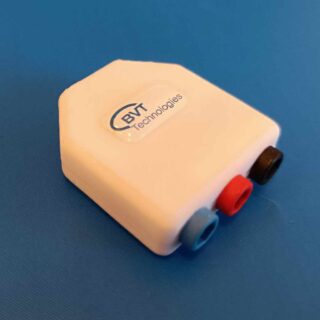
SPE Connector.1 for electrochemical sensors
Read moreThe connector enables the use of the biosensor or electrochemical sensor based on the substrates AC1, AC4, AC13 and TS1 1 in classical electrochemical arrangement.
The connector enables measurement with screen printed electrodes with width 7.26 mm and standard contact pads pitch (2.54 mm).
It is compatible with other SPE´s that use the same distance between the contact pads (2.54 mm).Termination: 2 mm Banana plugs