

ZIVE SP5 – high quality potentiostat/galvanostat/impedance analyzer
- Versatile high quality potentiostat/galvanostat/impedance analyzer
- Control voltage range : ±10V, ±1V, ±100mV
- Control current range : 50pA ~ 5A (500pA with gain, 11 ranges)
Application
- Battery / Super capacitor
- Fuel cell
- Corrosion
- Sensor
- Solar cell
- Other Echem experiments
Features
- high quality potentiostat/galvanostat/impedance analyzer
- ±10V@5Amp control range
- current range (11 ranges)
– 5nA to 5A
– 500pA with gain - frequency range : 10uHz ~ 1MHz
- built-in FRA : enables EIS tests
- 14 EIS techniques capability(option) including multisine
- capable of multitude of applications
– corrosion, general electrochemistry, sensor, battery, fuel cell,
supercapacitor, solar cell, etc. - bipolar pulse capability
- voltage pulse or current pulse charge/discharge test(GSM,CDMA etc.),
sine wave function for ripple simulation in battery test package
& pulse plating available - high speed data sampling time
– 2usec or 3usec depending on data point numbers - fast sweep mode(5000V/sec with 10mV data sampling)
- iR compensation & measurement
- 3 measurement/control voltage ranges &
11 measurement/control current ranges - internal 542,000 data point storage & continuing experiment regardless
of PC failure. - LCD diaplay
- multichannel configuration available by connecting multiple SP5 or other ZIVE products
- external booster (ZIVE ZB series) available
- inclues basic software, Energy/Impedance/Battery/Echem analysis software packages
- can use EIS data analysis software, ZMANTM and DC data analysis software
IVMANTMwithough purchasing license code - free software upgrade
Experimental Techniques
Basic techniques
- Potentiostatic
- Galvanostatic
- Double step potentiostatic
- Double step galvanostatic
- OCP measurement
- Potential sweep
- Current sweep
- Cyclic voltammetry
- Fast potential sweep
- Potentiostatic Ru measurement
- Galvanostatic Ru measurement
Advanced software techniques(included)
- EIS software package(EIS)
– Potentiostat EIS
– Galvanostatic EIS
– Pseudo galvanostatic EIS
– OCP* EIS
– Potentiodynamic PEIS
– Galvanodynamic GEIS
– Poteniodynamic HFR
– Galvanodynamic HFR
– Galvanostatic HFR monitor
– Potentiostatic HFR monitor
– Multisine potentiostatic EIS
– Multisine galvanostatic EIS
– Intermittent potentiostatic EIS
– Intermittent galvanostatic EIS
(*) The system measures open circuit potential before each frequency
change and applies AC sine wave on this potential.
- Corrosion software package(COR)
– Tafel(Tafel experiment)
– Rp(Polarization resistance)
– RpEc trend
– PDYN(Potentiodynamic)
– CYPOL(Cyclic polarization resistance)
– GDYN(GalvanoDynamic)
– Reactivation
– Galvanic corrosion
– Potentiostatic ECN
– Galvanostatic ECN
– ZRA mode ECN
- Energy software package(BAT)
a) Battery test technique
– CC/CV test for cycle life test of lithium battery
– CC/CC tet for cycle life test of NiCd or NiMH battery
– Discharging test
– EVS(electrochemical voltage spectroscopy)
– Variable scan rate CV
– Potentiostatic IV curve
– Galvanostatic IV curve
– Steady state CV
– PITT(Potentiostatic intermittent titration technique) test
– GITT(Galvanostatic intermittent titration technique) test
– Pulse mode is available for GSM & CDMA profile.
Pulse shape profile can be measured by user’s demand.
b) Control mode
– Charge : CC, CC-CV, pulse, sine wave
– Discharge : CC, CP, CR, pulse, sine wave
c) Cut-off condition
– Time, voltage, current, power, auxV etc.
– Various battery charge/discharge test is available including
pulse discharge for GSM, CDMA application
- Electrochemical analysis software package(EAS)
a) Step techniques
– CA(Chronoamperometry)
– CC(Chronocoulometry)
– CP(Chronopotentiometry)
b) Sweep techniques
– LSV(Linear sweep voltammetry)
– SDV(Sampled DC voltammetry)
– Fast CV
– Fast LSV
c) Pulsed techniques
– DPV(Differential pulse voltammetry)
– SWV(Square wave voltammetry)
– DPA(Diff.pulse amperometry)
– NPV(Normal pulse voltammetry)
– RNPV(Reverse normal pulse voltammetry)
– DNPV(Differential normal pulse voltammetry)
Options
- Power booster
The specifications are subject to change without notice. |
||||||||||||||||||||||||||||||||||||||||||||||||||||||||||||||||||||||||||||||||||||||||||||||||||||||||||||||||||||||||||||||||||||||||||||||||||||||||||||||||||
Related products
-

ZIVE MP1-4CH housing – high quality multichannel potentiostat/galvanostat/impedance analyzer
Read more- High quality multichannel potentiostat/galvanostat/impedance analyzer
- Voltage range : ±10V
- Current range : 100nA~1A (10nA with gain)
- Channel expandable up to 16 channels per PC
Application
- Corrosion
- Material testing
- Sensor
- Bio-Electrochemistry
- Battery / Supercapacitor
- Fuel cell
- Solar cell
- Other Echem experiments
Features
- high quality multichannel potentiostat/galvanostat/impedance analyzer
- voltage range : ±10V
- current range : 9 ranges
– 100nA to 1A (10nA with gain) - capable of multitude of applications
– corrosion, general electrochemistry, sensor, battery, fuel cell,
supercapacitor, solar cell, etc. - plug & play type fully independent channel
- channel expandable up to 16 channels per PC
- frequency range : 10uHz ~ 1Mhz
- 14 EIS techniques capability including multisine
- voltage pulse or current pulse charge/discharge test(GSM,CDMA etc.),
sine wave function for ripple simulation in energy software package
& pulse plating available - high speed data sampling time
– 2usec or 3usec depending on data point numbers - fast sweep mode(5000V/sec with 10mV data sampling)
- iR compensation and measurement
- 3 measurement/control voltage ranges &
9 measurement/control current ranges - internal 542,000 data point storage & continuing experiment regardless
of PC failure. - can be interfaced to a separate booster for high current applications
- one auxiliary voltage measurement is available
- inclues basic software, Energy/Impedance/Battery/Echem analysis software packages
- free software upgrade
Experimental Techniques
Basic techniques
- Potentiostatic
- Galvanostatic
- Double step potentiostatic
- Double step galvanostatic
- OCP measurement
- Potential sweep
- Current sweep
- Cyclic voltammetry
- Fast potential sweep
- Potentiostatic Ru measurement
- Galvanostatic Ru measurement
Advanced Software Package(Included)
- EIS software package(EISe)
– Potentiostat EIS
– Galvanostatic EIS
– Pseudo galvanostatic EIS
– OCP* EIS
– Potentiodynamic PEIS
– Galvanodynamic GEIS
– Poteniodynamic HFR
– Galvanodynamic HFR
– Potentiostatic HFR monitor
– Galvanostatic HFR monitor
– Multisine potentiostatic EIS
– Multisine galvanostatic EIS
– Intermittent potentiostatic EIS
– Intermittent galvanostatic EIS
(*) The system measures open circuit potential before each frequency
change and applies AC sine wave on this potential. - Corrosion software package(CORe)
– Tafel(Tafel experiment)
– Rp(Polarization resistance)
– RpEc trend
– PDYN(Potentiodynamic)
– CYPOL(Cyclic polarization resistance)
– GDYN(GalvanoDynamic)
– Reactivation
– Galvanic corrosion
– Potentiostatic ECN
– Galvanostatic ECN
– ZRA mode ECN - Energy software package(BATe)
a) Battery test technique
– CC/CV testforcycle life test of lithium battery
– CC/CC tet forcyclelifetestofNiCd or NiMH battery
– Discharging test
– EVS(electrochemical voltage spectroscopy)
– Variable scan rate CV
– Potentiostatic IV curve
– Galvanostatic IV curve
– Steady state CV
– PITT(Potentiostatic intermittent titration technique) test
– GITT(Galvanostatic intermittent titration technique) test
– Pulse mode is available for GSM & CDMA profile.
Pulse shape profile can be measured by user’s demand.
b) Control mode
– Charge : CC, CC-CV, pulse, sine wave
– Discharge : CC, CP, CR, pulse, sine wave
c) Cut-off condition
– Time, voltage, current, power, auxV etc.
– Various battery charge/discharge test is available including
pulse discharge for GSM, CDMA application - Electrochemical analysis software package(EASe)
a) Step techniques
– CA(Chronoamperometry)
– CC(Chronocoulometry)
– CP(Chronopotentiometry)
b) Sweep techniques
– LSV(Linear sweep voltammetry)
– SDV(Sampled DC voltammetry)
– Fast CV
– Fast LSV
c) Pulsed techniques
– DPV(Differential pulse voltammetry)
– SWV(Square wave voltammetry)
– DPA(Diff.pulse amperometry)
– NPV(Normal pulse voltammetry)
– RNPV(Reverse normal pulse voltammetry)
– DNPV(Differential normal pulse voltammetry)
Options
- Power booster
-

EmStat4T (Tailored electrochemistry through touch-controlled apps)
Read moreThe EmStat4T is a programmable handheld potentiostat with a touchscreen, which is ideal for sensor research and sensor-based applications. It offers two main modes of operation:
- Remote Control: where it functions as a conventional potentiostat, controlled directly by our PSTrace software for Windows or PStouch app for Android. These applications allow you to run measurements, view results, and perform data analysis.
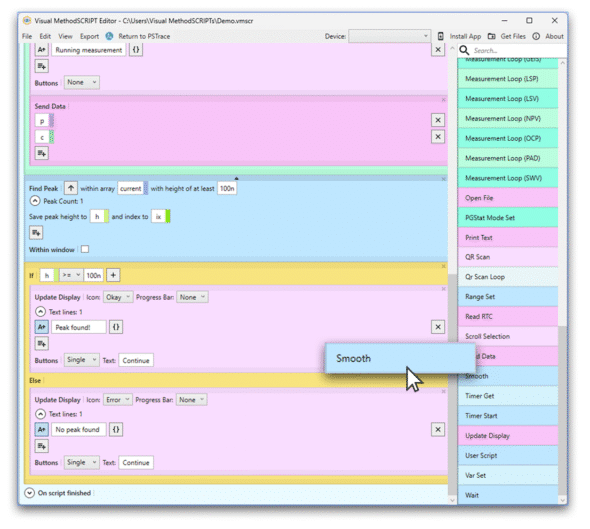
- Standalone: where the instrument is controlled via its touch interface to run a wizard‑style app for electrochemical analysis. Compose custom apps easily using the Visual MethodSCRIPT Editor included in PSTrace for Windows. Apps eliminate the need for a computer, tablet, or smartphone. This makes the EmStat4T an ideal solution for point-of-care applications and field research such as environmental analysis or corrosion monitoring.
More information could be found tought link:
https://www.palmsens.com/emstat4t/
Tailored electrochemistry through touch-controlled apps
- Potential range ±3 V
- Max. current ±30 mA
- Supports common electrochemical techniques
- Standalone operation with MethodSCRIPT
- or remotely controlled by laptop or phone
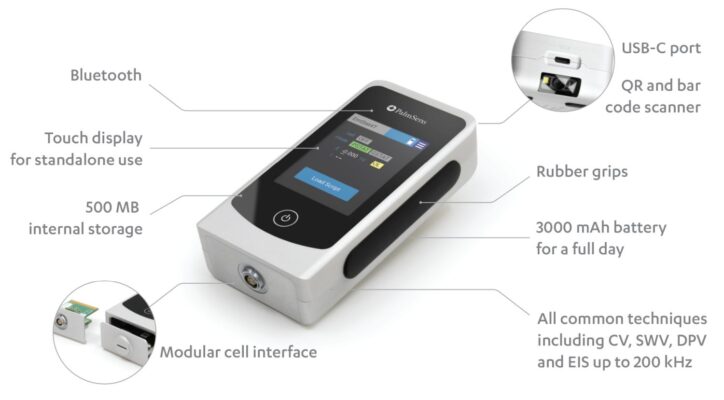
- Bar/QR-code scanner
- Customizable cell interface with drop-detection for SPEs
Main Features
 Visual MethodSCRIPT Editor
Create your EmStat4T apps
The powerful MethodSCRIPT™ language allows for easily creating your own applications to run on the EmStat4T. Compose apps using our Visual MethodSCRIPT Editor which generates the MethodSCRIPT for you.
Your measurements are safely stored

Internal Storage
The EmStat4T is equipped with 500 MB internal storage memory for storing your measurements. All internally stored measurements can be browsed and transferred back to the PC easily using the PSTrace software for Windows. Your data is always with your instrument wherever you take it.
-
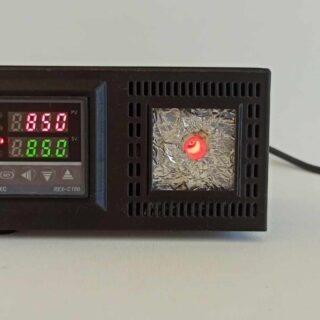
Activation furnance for electrochemical sensors
Read moreThe activation furnance is a device used for curing individual sensors of the AC1 type. At a defined temperature (up to 1000 °C) depending on the electrode and sensor materials. When the sensor is cured, the surface of the electrodes is cleaned from surface oxides and organic impurities, which results in regeneration of the sensor or its activation. In this way, for example, old sensors with immobilized enzyme layers can be cured for reuse – see example at the end ot the document.
-

Working Disk Electrode – PEEK body 6 mm dia., 70 mm long (redox.me)
Read moreThis is a Standard Working Electrode in which a disk of electrode material (glassy carbon, gold, platinum, silver, boron-doped diamond, palladium, titanium, and copper) is embedded into the PEEK body by a compressed PTFE or PEEK sleeve. It well fits aqueous and organic solvent electrolyte requirements. If you need a different disk material, please contact us.
Application note
The disk electrode is immersed in the ion-conducting solution as a working electrode. An electric current is passed between the working electrode and the counter electrode for a certain amount of time. After the experiment, the electrode should be washed several times with ethanol or isopropanol. If the disk electrode was used as a current collector with other electrode material, or when there are visible traces of material absorption, it should be polished down to the mirror surface after the experiment is completed. Store the working disk electrode in the glass tube sealed with an O-ring (all included in the package). Instruction on maintenance is provided on the Electrode Polishing Kit product page.Specification
disk diameter: 2, 3, 4 or 5 mm
disk length: 1.5 mm for BDD, 3 mm for the rest
body material: PEEK with PTFE or PEEK sleeve
body diameter: 6 mm
body length: 70 mmIntrastat data
HS Code: 85451900
Country of Origin: Sweden
NET weight: 100 gProduct includes
1x working disk electrode
1x O-ring
1x glass tube