


ZIVE MP1-4CH housing – high quality multichannel potentiostat/galvanostat/impedance analyzer
- High quality multichannel potentiostat/galvanostat/impedance analyzer
- Voltage range : ±10V
- Current range : 100nA~1A (10nA with gain)
- Channel expandable up to 16 channels per PC
Application
- Corrosion
- Material testing
- Sensor
- Bio-Electrochemistry
- Battery / Supercapacitor
- Fuel cell
- Solar cell
- Other Echem experiments
Features
- high quality multichannel potentiostat/galvanostat/impedance analyzer
- voltage range : ±10V
- current range : 9 ranges
– 100nA to 1A (10nA with gain) - capable of multitude of applications
– corrosion, general electrochemistry, sensor, battery, fuel cell,
supercapacitor, solar cell, etc. - plug & play type fully independent channel
- channel expandable up to 16 channels per PC
- frequency range : 10uHz ~ 1Mhz
- 14 EIS techniques capability including multisine
- voltage pulse or current pulse charge/discharge test(GSM,CDMA etc.),
sine wave function for ripple simulation in energy software package
& pulse plating available - high speed data sampling time
– 2usec or 3usec depending on data point numbers - fast sweep mode(5000V/sec with 10mV data sampling)
- iR compensation and measurement
- 3 measurement/control voltage ranges &
9 measurement/control current ranges - internal 542,000 data point storage & continuing experiment regardless
of PC failure. - can be interfaced to a separate booster for high current applications
- one auxiliary voltage measurement is available
- inclues basic software, Energy/Impedance/Battery/Echem analysis software packages
- free software upgrade
Experimental Techniques
Basic techniques
- Potentiostatic
- Galvanostatic
- Double step potentiostatic
- Double step galvanostatic
- OCP measurement
- Potential sweep
- Current sweep
- Cyclic voltammetry
- Fast potential sweep
- Potentiostatic Ru measurement
- Galvanostatic Ru measurement
Advanced Software Package(Included)
- EIS software package(EISe)
– Potentiostat EIS
– Galvanostatic EIS
– Pseudo galvanostatic EIS
– OCP* EIS
– Potentiodynamic PEIS
– Galvanodynamic GEIS
– Poteniodynamic HFR
– Galvanodynamic HFR
– Potentiostatic HFR monitor
– Galvanostatic HFR monitor
– Multisine potentiostatic EIS
– Multisine galvanostatic EIS
– Intermittent potentiostatic EIS
– Intermittent galvanostatic EIS
(*) The system measures open circuit potential before each frequency
change and applies AC sine wave on this potential. - Corrosion software package(CORe)
– Tafel(Tafel experiment)
– Rp(Polarization resistance)
– RpEc trend
– PDYN(Potentiodynamic)
– CYPOL(Cyclic polarization resistance)
– GDYN(GalvanoDynamic)
– Reactivation
– Galvanic corrosion
– Potentiostatic ECN
– Galvanostatic ECN
– ZRA mode ECN - Energy software package(BATe)
a) Battery test technique
– CC/CV testforcycle life test of lithium battery
– CC/CC tet forcyclelifetestofNiCd or NiMH battery
– Discharging test
– EVS(electrochemical voltage spectroscopy)
– Variable scan rate CV
– Potentiostatic IV curve
– Galvanostatic IV curve
– Steady state CV
– PITT(Potentiostatic intermittent titration technique) test
– GITT(Galvanostatic intermittent titration technique) test
– Pulse mode is available for GSM & CDMA profile.
Pulse shape profile can be measured by user’s demand.
b) Control mode
– Charge : CC, CC-CV, pulse, sine wave
– Discharge : CC, CP, CR, pulse, sine wave
c) Cut-off condition
– Time, voltage, current, power, auxV etc.
– Various battery charge/discharge test is available including
pulse discharge for GSM, CDMA application - Electrochemical analysis software package(EASe)
a) Step techniques
– CA(Chronoamperometry)
– CC(Chronocoulometry)
– CP(Chronopotentiometry)
b) Sweep techniques
– LSV(Linear sweep voltammetry)
– SDV(Sampled DC voltammetry)
– Fast CV
– Fast LSV
c) Pulsed techniques
– DPV(Differential pulse voltammetry)
– SWV(Square wave voltammetry)
– DPA(Diff.pulse amperometry)
– NPV(Normal pulse voltammetry)
– RNPV(Reverse normal pulse voltammetry)
– DNPV(Differential normal pulse voltammetry)
Options
- Power booster
| Power amplifier (CE) | |
| Power | 12Watt(12V@1A) |
| Compliance voltage | ±12V |
| Max. current | ±1A |
| Control speed selection | 4 ea |
| Bandwidth | 2MHz |
| Slew rate | 10V/usec |
| Potentiostat mode(voltage control) | |
| Voltage control | |
| Control voltage range | ±10, ±1V, ±100mV |
| Voltage resolution | 16 bit per each range |
| Voltage accuracy | ±0.02% fs (gain x1) |
| Max. scan range | ±10V vs. ref. E |
| Current measurements | |
| Current range | 9 ranges (auto/manual setting) 100nA ~ 1A (10nA with gain) |
| Current resolution | 16 bit; 30uA, 3uA, 300nA, 30nA, 3nA, 300pA 30pA, 3pA (300fA with gain) |
| Current accuracy | ±0.05% f.s.(gain x1) >100nA |
| Galvanostat mode(current control) | |
| Current control | |
| Control current range | max. ±1A ± full sacle depending on selected range |
| Current resolution | 16 bit; 30uA, 3uA, 300nA, 30nA, 3nA, 300pA 30pA, 3pA (300fA with gain) |
| Current accuracy | ±0.05% f.s.(gain x1) >100nA f.s. |
| Voltage measurements | |
| Voltage range | 10V, 1V, 100mV |
| Voltage resolution | 16 bit; 0.3mV, 30uV, 3uV |
| Voltage accuracy | ±0.02% fs (gain x1) |
| Electrometer | |
| Max. input voltage | ±10V |
| Input impedance | 2×10¹³Ω||4.5pF |
| Bandwidth | >22MHz |
| CMRR | >114dB |
| EIS(Internal FRA) for system | |
| Frequency range | 10uHz ~ 1MHz |
| Frequency accuracy | <0.01%> |
| Frequency resolution | 5000/decade |
| Amplitude | 0.1mV ~ 5V rms (potentiostatic) 0.1 ~ 70% f.s. (galvanostatic) |
| Mode | Static EIS: potentiostatic, galvanostatic, pseudo-galvanostatic, OCP Dynamic EIS: potentiodynamic, galvanodynamic Fixed frequency impedance: potentiostatic, galvanostatic, potentiodynamic, galvanodynamic Multisine EIS: potentiostatic, galvanostatic |
| Main system | |
| PC communication | USB2.0 high speed |
| Line voltage | 100~240VAC, 50/60Hz, 1Amp |
| Max. channel number per unit | 4 independent channel per unit |
| Max. channel | 16 channels expandable per PC |
| Size | 199.4×465.6x315mm(WxHxD)/4ch housing system |
| Software | |
| Max. steps per experiments | 1000 |
| Shutdown safety limits | voltage, current, power, auxV, etc. |
| Max. sampling rate | 2usec or 3usec depending on data point numbers |
| Min. sampling time | unlimited |
| Sampling condition | time, dv/dt, dI/dt, etc. |
| Interface for system | |
| Auxiliary port | |
| – Auxiliary voltage input | 1 analog input: ±10V |
| – Zero resistance ammeter | 100nA~1A ranges |
| – External booster interface | via booster I/F cable |
| Channel System | |
| Cell cable | 1 meter shielded type (standard) working, reference, counter, working sense, auxiliary V+, AuxV- |
| Control DAC |
DSP with FPGA 2x16bit DAC(50MHz) for bias & scan |
| Data acquisition ADC |
2x16bit ADCs(500kHz) for voltage & current 1x16bit ADCs(250kHz) for auxiliary reading |
| Calibration | automatic |
| Filter | 4ea (5Hz, 1kHz, 500kHz, 5MHz) |
| Scan rate | 0 ~ 200V/sec in common mode 0 ~ 5000V/sec in fast mode |
| Front panel LED | busy, run |
| Internal data memory | 542,000 points |
| Max. output power | 12 Watt per channel |
| PC requirement | |
| Operating system | WindowsXP SP3/7/8/10(32bit/64bit) |
| PC specification(minimum) | Pentium4, RAM 1GB or higher |
| Display | 1600×900 high color or higher |
| USB | high speed 2.0 |
| General | |
| Dummy cell | one external dummy cell included |
| Impedance analysis software | ZmanTM |
| DC data analysis software | IVMANTM |
The specifications are subject to change without notice.
Related products
-
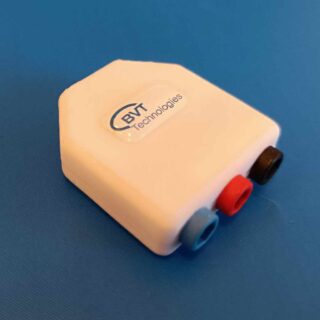
SPE Connector.1 for electrochemical sensors
Read moreThe connector enables the use of the biosensor or electrochemical sensor based on the substrates AC1, AC4, AC13 and TS1 1 in classical electrochemical arrangement.
The connector enables measurement with screen printed electrodes with width 7.26 mm and standard contact pads pitch (2.54 mm).
It is compatible with other SPE´s that use the same distance between the contact pads (2.54 mm).Termination: 2 mm Banana plugs
-
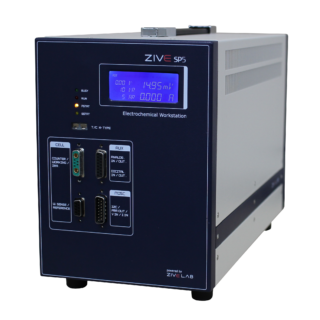
ZIVE SP5 – high quality potentiostat/galvanostat/impedance analyzer
Read more- Versatile high quality potentiostat/galvanostat/impedance analyzer
- Control voltage range : ±10V, ±1V, ±100mV
- Control current range : 50pA ~ 5A (500pA with gain, 11 ranges)
Application
- Battery / Super capacitor
- Fuel cell
- Corrosion
- Sensor
- Solar cell
- Other Echem experiments
Features
- high quality potentiostat/galvanostat/impedance analyzer
- ±10V@5Amp control range
- current range (11 ranges)
– 5nA to 5A
– 500pA with gain - frequency range : 10uHz ~ 1MHz
- built-in FRA : enables EIS tests
- 14 EIS techniques capability(option) including multisine
- capable of multitude of applications
– corrosion, general electrochemistry, sensor, battery, fuel cell,
supercapacitor, solar cell, etc. - bipolar pulse capability
- voltage pulse or current pulse charge/discharge test(GSM,CDMA etc.),
sine wave function for ripple simulation in battery test package
& pulse plating available - high speed data sampling time
– 2usec or 3usec depending on data point numbers - fast sweep mode(5000V/sec with 10mV data sampling)
- iR compensation & measurement
- 3 measurement/control voltage ranges &
11 measurement/control current ranges - internal 542,000 data point storage & continuing experiment regardless
of PC failure. - LCD diaplay
- multichannel configuration available by connecting multiple SP5 or other ZIVE products
- external booster (ZIVE ZB series) available
- inclues basic software, Energy/Impedance/Battery/Echem analysis software packages
- can use EIS data analysis software, ZMANTM and DC data analysis software
IVMANTMwithough purchasing license code - free software upgrade
Experimental Techniques
Basic techniques
- Potentiostatic
- Galvanostatic
- Double step potentiostatic
- Double step galvanostatic
- OCP measurement
- Potential sweep
- Current sweep
- Cyclic voltammetry
- Fast potential sweep
- Potentiostatic Ru measurement
- Galvanostatic Ru measurement
Advanced software techniques(included)
- EIS software package(EIS)
– Potentiostat EIS
– Galvanostatic EIS
– Pseudo galvanostatic EIS
– OCP* EIS
– Potentiodynamic PEIS
– Galvanodynamic GEIS
– Poteniodynamic HFR
– Galvanodynamic HFR
– Galvanostatic HFR monitor
– Potentiostatic HFR monitor
– Multisine potentiostatic EIS
– Multisine galvanostatic EIS
– Intermittent potentiostatic EIS
– Intermittent galvanostatic EIS
(*) The system measures open circuit potential before each frequency
change and applies AC sine wave on this potential.
- Corrosion software package(COR)
– Tafel(Tafel experiment)
– Rp(Polarization resistance)
– RpEc trend
– PDYN(Potentiodynamic)
– CYPOL(Cyclic polarization resistance)
– GDYN(GalvanoDynamic)
– Reactivation
– Galvanic corrosion
– Potentiostatic ECN
– Galvanostatic ECN
– ZRA mode ECN
- Energy software package(BAT)
a) Battery test technique
– CC/CV test for cycle life test of lithium battery
– CC/CC tet for cycle life test of NiCd or NiMH battery
– Discharging test
– EVS(electrochemical voltage spectroscopy)
– Variable scan rate CV
– Potentiostatic IV curve
– Galvanostatic IV curve
– Steady state CV
– PITT(Potentiostatic intermittent titration technique) test
– GITT(Galvanostatic intermittent titration technique) test
– Pulse mode is available for GSM & CDMA profile.
Pulse shape profile can be measured by user’s demand.
b) Control mode
– Charge : CC, CC-CV, pulse, sine wave
– Discharge : CC, CP, CR, pulse, sine wave
c) Cut-off condition
– Time, voltage, current, power, auxV etc.
– Various battery charge/discharge test is available including
pulse discharge for GSM, CDMA application
- Electrochemical analysis software package(EAS)
a) Step techniques
– CA(Chronoamperometry)
– CC(Chronocoulometry)
– CP(Chronopotentiometry)
b) Sweep techniques
– LSV(Linear sweep voltammetry)
– SDV(Sampled DC voltammetry)
– Fast CV
– Fast LSV
c) Pulsed techniques
– DPV(Differential pulse voltammetry)
– SWV(Square wave voltammetry)
– DPA(Diff.pulse amperometry)
– NPV(Normal pulse voltammetry)
– RNPV(Reverse normal pulse voltammetry)
– DNPV(Differential normal pulse voltammetry)
Options
- Power booster
-

Nexus
Read moreBuilding on PalmSens’ legacy of providing top-tier solutions for accurate low-current measurements, Nexus delivers an ultra-low-noise performance that exceeds even our existing portable devices, while also supporting measurements up to 1 Ampere.
More information could be found trough link:
https://www.palmsens.com/product/nexus/
- Bi)Potentiostat/ Galvanostat/ Impedance analyzer
- FRA / EIS: 10 μHz up to 1 MHz
- 11 current ranges: 100 pA to 1 A
- Dual EIS with second sense electrode
- Script your experiments using MethodSCRIPT
- Use with PSTrace software for Windows
Versatile
Our high-end instrument, the Nexus, is a Potentiostat, Galvanostat, and optional a Frequency Response Analyser (FRA) for Electrochemical Impedance Spectroscopy (EIS). The Nexus has a large potential range (-12V to +12V) and current range (100 pA to 1 A) with a high resolution and low noise.
The research software PSTrace makes using the Nexus a breeze. The scripting language MethodSCRIPT gives a user full control when needed. Looking for a multi-channel instrument? Just stack multiple instruments on top of each other.
Configurable
Nexus comes in different configurations:
- optional EIS/FRA module with maximum frequency of 1 MHz
- optional BiPotentiostat module for second WE
Standard included
Carrying padded bag containing:
- High quality, double shielded cell cable with
2 mm banana connectors for Working, Sense, Counter, Reference electrode and Ground - Chassis ground cable with croc clip (4 mm)
- Hardware Sync Link cable
- Crocodile clips
- Calibration report
- Dummy cell
- USB cable and Ethernet cable
- Manual and Quick Start document
- PSTrace software for Windows
- iR-compensation (ohmic drop compensation) module
- Second Sense lead cable
S2 and BiPot
Nexus includes a Second Sense lead (S2) and an optional BiPotentiostat (BiPot) module.
S2 – Additional voltage (potential) measurement point
BiPot – Independent second working electrode for simultaneous current measurement
These two features are independent and serve distinct purposes:
- S2 (Second Sense Lead)
S2 acts as an additional voltage-sensing input, with the same specifications as the main reference electrode. It measures the potential at a specific point in the cell and, because the current at that point is known, it can also be used to calculate impedance. - BiPot (BiPotentiostat Module)
The BiPot module introduces a second working electrode (WE2), operating versus the same reference and counter electrodes as the main channel. In BiPotentiostat mode, both working electrodes (WE1 and WE2) are recorded simultaneously. WE2 operates in potentiostatic mode, meaning it can independently control its potential and measure its current.
Why choose the Nexus?

-
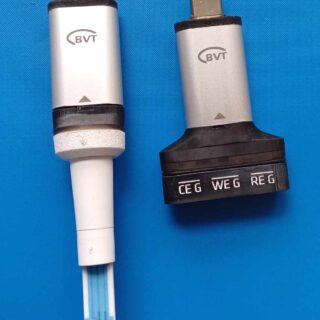
USB Potentiostat Galvanoplot
Read moreUSB Potentiostat Galvanoplot is a super small, low-cost and affordable device suitable for dedicated volume applications, which is optimized for screen-printed sensor and biosensor applications. It can be used in many other research areas and with other electrochemical sensors, for corrosion measurement, battery and super-capacitors or fuel cells.
It is capable of performing all common Amperometric and Voltammetric electrochemistry protocols (CA, LSV, CV, DPV, NPV, SVW, GAL) and can be used with three electrode (WE/RE/CE) and two electrode (WE/RE-CE) setups. Plug the device directly into an Android mobile device through OTG port for a true on-site analysis experience. It is possible to choose from two types of interfaces allowing direct insertion of the BVT SPE sensors or the use of 3 classical electrodes with 2 mm banana plugs (WE, RE, CE).
- Dimensions: 39x17x8 mm
- Weight: 5 g without sensor interface
- Voltage scan range: +-3V @1mV resolution
- Max current: 2000 nA (*at the request of the customer, it is possible to change the range, but this will change the resolution, noise and other parameters)
- Current resolution: 300pA@1KSPS/ 100pA@100SPS/ 30pA/10 SPS resolution
- Noise around: 50nA@1KSPS/ 7nA@100SPS/ 400pA/10 SPS
- Protocols: CA, LSV, CV, DPV, NPV, SVW, GAL
- Cell type: WE/RE/CE and WE/RE-CE
Connectivity: USB-C (Plug the device directly into an Android mobile device through OTG port for a true on-site analysis experience)
- Operating system compatibility: Windows 8, 10+
- Advanced analysis – filtering and auto peaks
Device Usage
- Electrochemical measurements
- Measurements with biosensors and electrochemical sensors
- Measurement of biochemical activity of a sample
- Corrosion measurement