

Battery Test System (32 channel battery cycler) – WBCS3000Le32
- Low current model
- 32 channel battery cycler
(expandable up to 128 channels) - No. of minimum channel : 16 channels
- max. voltage range : ±5V
- max. current range : 100mA@5V
Application
- For low current application
- Micro battery application
- Sensor application
- Electroanalytical application
Features
- low current type
- channel power limit : max. 500mWatt per channel
- number of minimum channels : 16 channels
- extra channels can be added by the unit of 16 channels
- voltage range : ±5V
- current range : 4 ranges, max. ±100mA
- voltage/current accuracy : ±0.01% f.s.
- Sampling time : 10msec (20msec with option)
- potentiostat/galvanostat circuit
– no switching time (charging to discharging, discharging to charging)
– analog feedback control to keep constant voltage & current
– capability of electrochemical experiments by controlling voltage versus
reference electrode for positive voltage polarity only. - high precision
– 16bit(0.0015% full scale) ADC, DAC
– MOSFET type linear power supply circuit.
– shield cell cable to prevent EMI noise - safety
– unique “fail check” function: to protect the system and cell, the system
will automatically stop when measured value is different from control
value by battery failure or wrong cell connection etc.
– system safety parameter: if the measured value is over system specification,
the running channelwill stop automatically.
– user defined safety condition setting: user can input safety level following
test cell’s chemistry.
– automatic cell connection check: before experiment, if the cell voltage value
is near 0Volt, program gives the warning message for the operator to check
the cell connection.
– if the operator did press stop function button by mistake, confirmation message
box appears.
– to prevent over current, poly-switch is located in each channel.
– watchdog function: stop “running channel(s)” on communication failure.
– while any channel is running, operator could not close the server program.
– if main program was down by unstable operating system, independent server
program keeps the experiment (control & data acquisition) without dead time. - maintenance & system expansion
– plug-in type channels
– power supply per 32 channel
– easy expansion up to 128 channels by adding 16ch substation
– each channel has Poly switch instead of fuse. - LAN communication
- User friendly software
- Compatible with IVMANTM DC data analysis software without purchasing license code
- Customized specification available
Experimental Techniques
Energy Test
- CC/CV (Lithium battery) test menu
- CC/CC (NiCd(NiMH) battery) test menu
- Steady state CV
- Pstat IV curve
- Gstat IV curve
- EVS (Electrochemical voltage spectroscopy) test
- GITT (Galvanostatic intemittent titration technique) test
- PITT (Potentiostatic intermittent titration technique) test
Electroanalytical techniques
- Cyclic voltammetry
- Linear sweep voltammetry
- Chrono-amperometry
- Chrono-coulometry
- Chrono-potentiometry
Corrosion measurement
- Tafel plot
- Potentiodynamic
- Potentiostatic
- Galvanostatic
- Cyclic polarization
- Ecorr vs. time
- Linear polarization resistance
Options
- Auxiliary voltage & temperature measurement
- Rack mount system available
- Multiple control board configuration available
- Battery jig
| Hardware | |
| Control voltage range | ±5V(standard) |
| Control current range | 4 ranges |
| LED | Run: 1ea |
| Input impedance | 1012 Ohm |
| Cell connection | 4 probe type, alligator clip cables |
| Max. channel no. | 128 |
| Voltage accuracy | ±0.02% f.s. |
| Current accuracy | ±0.02% f.s. |
| Voltage Control/Measurement | |
| Full scale ranges | ±5V(standard) |
| Resolution(16 bits) | 0.15mV(standard) @±5V |
| Current Control/Measurement | |
| Full scale ranges | Max. 100mA@5V |
| Resolution | 16 bit(0.0015% f.s) |
| Communication | TCP/IP |
| Sampling time | 10msec (20msec with option) |
| Size | W541xD454.6xH253.8mm |
All specifications are subject to change without notice.
You may also like…
-

Battery Test System (8 channel battery cycler) – WBCS3000Ls / WBCS3000Le
Read more- Low current model
- 8 channel battery cycler (expandable up to 128 channels)
- max. voltage range : ±5V
- max. current range :
– Model WBCS3000Ls : ±10mA
– Model WBCS3000Le : ±100mA - Customized specification is available.
Application - For low current application
- Micro battery application
- Sensor application
- Electroanalytical application
Features
- low current type
- voltage range : ±5V
- current range : 4 ranges
– Model WBCS3000Ls : max. 10mA
– Model WBCS3000Le : max. 100mA - voltage/current accuracy : ±0.02% f.s.
- sampling time
* Without option
– 1~32 channels system: 10msec
– 33~40 channels system: 20msec
– 41~64 channels system: 50msec
– 65~128 channels system: 50msec
* With option
– 1~16 channels system: 10msec
– 17~40 channels system: 20msec
– 41~64 channels system: 50msec
– 65~128 channels system: 50msec option) - max. 300,000 data point memory on control board
- potentiostat/galvanostat circuit
– no switching time (charging to discharging, discharging to charging)
– analog feedback control to keep constant voltage & current
– capability of electrochemical experiments by controlling voltage versus
reference electrode for positive voltage polarity only. - high precision
– 16bit(0.0015% full scale) ADC, DAC
– MOSFET type linear power supply circuit.
– shield cell cable to prevent EMI noise - safety
– unique “fail check” function: to protect the system and cell, the system
will automatically stop when measured value is different from control
value by battery failure or wrong cell connection etc.
– system safety parameter: if the measured value is over system specification,
the running channel will stop automatically.
– user defined safety condition setting: user can input safety level following
test cell’s chemistry.
– automatic cell connection check: before experiment, if the cell voltage value
is near 0Volt, program gives the warning message for the operator to check
the cell connection.
– if the operator did press stop function button by mistake, confirmation message
box appears.
– to prevent over current, poly-switch is located in each channel.
– watchdog function: stop “running channel(s)” on communication failure.
– while any channel is running, operator could not close the server program.
– if main program was down by unstable operating system, independent server
program keeps the experiment (control & data acquisition) without dead time. - maintenance & system expansion
– plug-in type channels
– power supply per 8 channel
– easy expansion up to 128 channels by adding plug in channel or by adding 8ch
substation
– each channel has Poly switch instead of fuse. - LAN communication
- User friendly software
- Compatible with IVMANTM DC data analysis software without purchasing license code
- Customized specification available
Experimental Techniques
Energy Test
- CC/CV (lithium battery) test menu
- CC/CC (NiCd(NiMH) battery) test menu
- Steady state CV
- Pstat IV curve
- Gstat IV curve
- EVS (Electrochemical voltage spectroscopy) test
- GITT (Galvanostatic intemittent titration technique) test
- PITT (Potentiostatic intermittent titration technique) test
Electroanalytical techniques
- Cyclic voltammetry
- linear sweep voltammetry
- Chrono-amperometry
- Chrono-coulometry
- Chrono-potentiometry
Corrosion measurement
- Tafel plot
- Potentiodynamic
- Potentiostatic
- Galvanostatic
- Cyclic polarization
- Ecorr vs. time
- linear polarization resistance
Options
- Auxiliary voltage & temperature measurement
- Rack mount system available
- Multiple control board configuration available
- Battery jig
-

Three Electrode Battery Test Cell – compression controlled (redox.me)
Read moreThis cell is designed as high-quality alternative to Swagelok-type constructions for reproducible electrochemical measurements of battery and supercapacitor materials.
The cell consists of two main elements:
(i) the cell base with micrometre screw and compression spring, which allows precise control of pressure applied to the electrode sandwich; and
(ii) electrode cartridge where the anode, cathode and reference electrode are located.
The (default) electrode cartridge and plungers are designed for planar electrodes with diameter of 18 mm and total sandwich thickness of 2.5 mm. The diameter of separator shall be at least 2 mm larger than electrode diameter (max. 22 mm). The lock ring secures the separator in the electrode cartridge allowing easy and safe electrodes insertion, while ensuring accurate alignment. The upper and lower electrode plungers are available in various materials: 316L Stainless Steel (default), copper, aluminum, nickel etc. The pin-type reference electrode is installed from the side of the electrode cartridge. Thanks to sharp edged hole at the end of the pin the reference electrode (Li/Na/K etc.) can be easily punched from the metal foil and directly loaded into cell. The magnetic mount facilitates rapid assembly of the cartridge in the cell base. The force applied to the electrodes can reach up to 90N and is adjusted with the micrometer control knob. For 2-electrode measurements, the reference electrode feedthrough hole can be closed with the reference electrode punch.
The cell elements are constructed with materials that are inert to the sample (Stainless steel and PEEK). It well fits aqueous (FKM and EPDM O-Rings) and organic solvent (FFKM O-Rings) electrolyte requirements. Good electrical contact is ensured by gold plated pins. The construction is gas-tight and can be effortlessly assembled in the glove box, reducing possible human error to minimum.
Application note:
This cell can be used for all common battery measurements, such as galvanostatic cycling, cyclic voltammetry or electrochemical impedance spectroscopy. Both liquid and solid-state or gel-polymer electrolytes can be studied. Additionally, properties and performance of supercapacitor materials can be investigated. Various materials can be examined, including typical Li-ion electrodes (graphite, NMC, LTO etc.) and other chemistries – sodium, magnesium, potassium etc. It can also be applied to measure the ionic conductivity of separators and electrolytes. Owing to the micrometer control knob, the relationship between the initial pressure applied to the cell and the performance of solid-state electrolytes or metal plating process (anode-free systems) can be studied.The above graph shows relation of pressure applied to electrode stack and distance travelled from the point of contact. The point of contact can be determined by checking OCV (see manual video) or by calculation. To calculate the point of contact, subtract electrode stack thickness from 4 mm. For example, for the 0.9 mm stack, the point of contact (i.e. reading on micrometer screw) will be 4 mm – 0.9 mm = 3.1 mm. Therefore, you should set micrometer screw to 3.1 mm and measure distance/pressure relation from this point.
Specification:
recommended electrode diameter: 18 mm (other options: 12 mm, 15 mm, 16 mm)
recommended minimum separator diameter: electrode diameter + 2 mm (max. 22 mm)
maximum electrode sandwich thickness: 2.5 mm
spring rate: 10.86 N/mm
maximum spring load: 90 N
operating temperature: -40°C – 80°C (default)Intrastat data:
HS Code: 90309000
Country of Origin: Sweden
NET weight: 400gProduct includes:
1 x cell base
1 x compression control unit
1 x Three-Electrode Cartridge
1 x reference electrode punch
1 x upper plunger (Stainless Steel)
1 x lower plunger (Stainless Steel)
1 x separator locking ring
1 x gold plated piston
1 x compression spring
2 x gold plated pin contact
1 x set of O-rings
1 x set of 3 cable adapters 1mm to 4mm banana plug
1 x electrode plunger removal tool
Related products
-
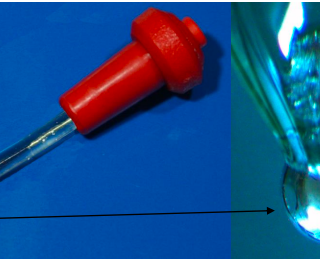
Hanging Platinum Drop Electrode
Read moreThe Hanging Platinum Drop Electrode (HPDE) is solid phase alanogy of HMDE.
The drop of liquid Pt at 2000 °C forms a drop of Pt. The surface of HPDE has nearly ideal surface which is impossible to obtain using polishing. HPDE has also spherical symmetry which enables mathematical treatment of its response.
The material is not toxic and it is chemically stable. The only disadvantage is HPDE cleaning, which can be, however, in some cases solved by carefull insertion of the electrode tip to the flame of an alcohol burner.
Thus HPDE can be used as reference electrode for complicated electrochemical studies, where it is necessary to distinguish the analytical signal from the signal generated by surface inhomogenities.Hanging platinum drop electrode (HPDE) is designed for measurements with thermostated cell TC4, TC5, TC6 and TC9.
-
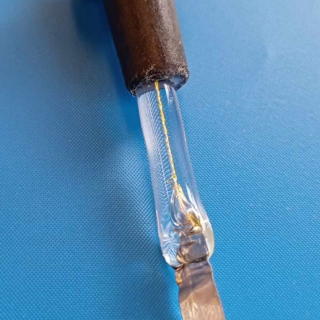
ACEc.Pt plate Auxiliary Classic Electrode Conic with platinum plate
Read moreACEc.Pt plate is a glass tube with platinum plate of guaranteed purity 99.99 %. Standard connection is with a 2 mm banana plug. Auxiliary classic electrode with platinum plate (ACEc.Pt plate) is designed for electrochemical measurements.
Dimensions of Pt plate: 15 x 5 mm Pt
(Pt thickness approx. 0.21 mm)The size of the platinum sheet can be adjusted at the customer’s request.
-

Platinum Coated Titanium Mesh Electrode with Holder – set of 10 pcs (redox.me)
Read moreThe metal counter (auxiliary) electrode is provided in electrochemical cell as a current sink to shunt excess current away from the reference electrode. Platinum Coated Titanium Mesh Electrode is a cheap alternative to pure Platinum Electrodes like Platinum Gauze Electrode or Metal Wire Auxiliary Electrode. Platinum coating makes this counter electrode inert under the reaction conditions and provides catalytic properties. The electrode is installed in the Basic Sample Holder (1 pcs included in the set), which allows full immersion of the electrode in the electrolyte (wet Tantalum contact). It well fits aqueous and organic solvent electrolyte requirements. Electrode size is customizable.
Application note
The Platinum Coated Titanium Mesh Electrode is fully immersed in the ion-conducting solution as a counter electrode. An electric current is passed between the working electrode and the Platinum Coated Titanium Mesh Electrode for a certain amount of time. After the process, the electrode should be washed several times with ethanol and dried under the nitrogen flow. Store the electrode in a dedicated compartment to avoid scratching. Discoloration may indicate the degradation (dissolution) of the Platinum layer and oxidation of Titanium mesh.
This electrode is used mainly in systems where there is a high risk of its contamination by organic or inorganic deposit during the electrochemical reaction. It is also a cheap replacement for pure Platinum electrode in electrodeposition processes.Specification
Titanium grade: GR1
working current: <5000 A/m2
Platinum content: >15 g/m2
Platinum coating thickness: 760 – 1500 nm
mesh hole size: 3 mm x 2 mm
mesh thickness: 0.5 mm
electrode size: 25x25mm2, 50x50mm2, 100x100mm2, custom
pH range: 1-12Intrastat data
HS Code: 71151000
Country of Origin: Sweden
NET weight: 100 gProduct includes
10 x Platinum Coated Titanium Mesh Electrode of selected size
1 x Basic Sample Holder (if selected) -

Sample Holder 25 mm x 25 mm (redox.me)
Read moreThe sample holder (known also as flat specimen holder) is used for holding flat, circular or square/rectangular samples. It enables contacting the sample from the front (e.g. ITO/FTO glass, Monolayer Graphene on SiC, or Boron-Doped Diamond thin film on various substrates) and from the back (e.g. metal specimen, Glassy Carbon plate, Boron-Doped Diamond plate). The default nominal aperture is 1cm2, but other value can be provided on request. The large electrical contact with Tantalum (formerly Copper) foil surface (not being in contact with an electrolyte) ensures optimal current collection by minimizing electrical resistance and unifying current distribution. The rod with electrical connection has a diameter of 6 mm, which makes the sample holder compatible with our voltammetry cells and jacketed cells, as long as it fits in. We may also provide an adapter to install this sample holder in openings larger than 6 mm dia.
The sample holder elements are constructed with materials that are inert to the electrochemical system (PEEK, Fluorocarbons). It well fits aqueous (FKM/EPDM O-Rings) and organic solvent (FFKM O-Rings) electrolyte requirements. The construction is well sealed which prevents the electrolyte to leak inside.
Application note
The sample holder is used largely for corrosion studies. It can be installed in a beaker type cell as well as in testing environments such as open water reservoirs, cans, tanks etc. It can also be used wherever it is necessary to make an electrode using a thin layer of an active material deposited on a flat substrate (conducting or insulating).Specification
nominal aperture range: 0.008 cm2 (1 mm dia.) – 4.155 cm2 (23 mm dia.)
minimum aperture: 0.008 cm2 (1 mm dia.)
maximum aperture: 4.9 cm2 (23 mm dia.)
electrical connection diameter (rod): 6 mm
minimum substrate size:nominal aperture minimum substrate size 0.008 cm2 (1 mm dia.) 10 x 10 mm2 (square) or 12 mm dia. (circular). 0.196 cm2 (5 mm dia.) 7 x 7 mm2 (square) or 10 mm dia. (circular). 0.283 cm2 (6 mm dia.) 8 x 8 mm2 (square) or 11 mm dia. (circular). 0.385 cm2 (7 mm dia.) 9 x 9 mm2 (square) or 12 mm dia. (circular). 1 cm2 (11.3 mm dia.) 13 x 13 mm2 (square) or 16 mm dia. (circular). 1.76 cm2 (15 mm dia.) 17 x 17 mm2 (square) or 20 mm dia. (circular). 3 cm2 (19.5 mm dia.) 22 x 22 mm2 (square) or 24 mm dia. (circular). 3.5 cm2 (21 mm dia.) 23 x 23 mm2 (square) or 25 mm dia. (circular). 4.155 cm2 (23 mm dia.) 25 x 25 mm2 (square only) maximum substrate size: 25 x 25 mm2
maximum sample thickness: 4 mm
contact type: front or backIntrastat data
HS Code: 90309000
Country of Origin: Sweden
NET weight: 100 gProduct includes
1 x chamber
1 x lid
1 x contact (Tantalum foil)
1 x rod with electrical connection