


ZIVE SP3 – potentiostat/galvanostat/impedance analyzer
- Research grade potentiostat/galvanostat/impedance analyzer
- Control voltage range: ±10V, ±1V, ±100mV
- Control current range: 2nA ~ 2A (2nA with gain, 10 ranges)
Application
- Battery/Super capacitor
- Fuel cell
- Coating
- Corrosion
- Sensor
- Solar cell
- Other Echem experiments
Features
- high compliance voltage potentiostat/galvanostat/impedance analyzer
- ±10V@2Amp control range
- current range (10 ranges)
– 2A to 20nA
– 2nA with gain - frequency range : 10uHz ~ 1MHz
- 14 EIS techniques capability including multisine
- Electrical isolation floating potentiostat can be used with autoclaves, mechanical stress apparatus, or pipeline probes.
- suitable for typical corrosion applications
– pitting, crevice corrosion, and passivation behavior
– corrosion rate (Tafel Plot) determination
– active/passive characteristics
– passivation rates
– anodic and cathodic protection - high speed data sampling time
– 2usec or 3usec depending on data point number - fast sweep mode (5000V/sec with 10mV data sampling)
- iR compensation & measurement
- 3 measurement/control voltage ranges &
10 measurement/control current ranges - internal 542,000 data point storage & continuing experiment regardless of PC failure
- LCD display
- software package
– Corrosion software package(COR3)
– EIS software package
– Electrochemical analysis software package
– Energy software package - multichannel configuration available by connecting multiple SP3 or other ZIVE products
- included basic software, Energy(battery)/Impedance/Corrosion/Echem analysis software packages
- free software upgrade
Experimental Techniques
Basic techniques
- Potentiostatic
- Galvanostatic
- Double step potentiostatic
- Double step galvanostatic
- OCP measurement
- Potential sweep
- Current sweep
- Cyclic voltammetry
- Fast potential sweep
- Potentiostatic Ru measurement
- Galvanostatic Ru measurement
Advanced software techniques (Included)
Options
- Power booster
| Power amplifier (CE) | |
| Power | 40Watt(20V@2A) |
| Compliance voltage | ±20V |
| Max. current | ±2A |
| Control speed selection | 4ea |
| Bandwidth | 1MHz |
| Slew rate | 8V/usec |
| Potentiostat mode(voltage control) | |
| Voltage control | |
| – Control voltage range | ±10, ±1V, ±100mV |
| – Voltage resolution | 16 bit per each range |
| – Voltage accuracy | ±0.02% fs (gain x1) |
| – Max. scan range | ±10V vs. ref. E |
| Current measurements | |
| – Current range | 10 ranges (auto/manual setting) 2nA~2A (2nA with gain) |
| – Current resolution | 16 bit 60uA, 6uA, 600nA, 60nA, 6nA, 600pA 60pA, 6pA, 600fA, 60fA |
| – Current accuracy | ±0.03% f.s.(gain x1)>200nA |
| Galvanostat mode(current control) | |
| Current control | |
| – Control current range | max. ±2A ± full sacle depending on selected range |
| – Current resolution | 16 bit 60uA, 6uA, 600nA, 60nA, 6nA, 600pA 60pA, 6pA, 600fA, 60fA |
| – Current accuracy | ±0.03% f.s.(gain x1)>200nA |
| Voltage measurements | |
| – Voltage range | ±10V, ±1V, ±100mV |
| – Voltage resolution | 16 bit; 0.3mV, 30uV, 3uV |
| – Voltage accuracy | ±0.02% fs(gain x1) |
| Electrometer | |
| Max. input voltage | ±10V |
| Input impedance | >2×10¹³Ω||4.5pF |
| Bandwidth | >22MHz |
| CMRR | >114dB |
| EIS Measurement for system | |
| Frequency range | 10uHz ~ 1MHz |
| Frequency accuracy | <0.01%> |
| Frequency resolution | 5000/decade |
| Amplitude | 0.5mV ~ 5Vrms(potentiostatic) 0.1 ~ 70% f.s.(galvanostatic) |
| Mode | Static EIS: potentiostatic, galvanostatic, pseudo-galvanostatic, OCP Dynamic EIS: potentiodynamic, galvanodynamic Fixed frequency impedance: potentiostatic, galvanostatic, potentiodynamic, galvanodynamic Multisine EIS: potentiostatic, galvanostatic Intermittent PEIS/GEIS |
| Main system | |
| PC communication | USB2.0 high speed |
| Line voltage | 100~240VAC, 50/60Hz |
| Size/weight | 195x313x105mm(WxDxH) |
| LED indicator | Run, Comm |
| Max. output power | 40Watt |
| Software | |
| Max. steps per experiments | 1,000 |
| Shutdown safety limits | voltage, current, temperature etc. |
| Max. sampling rate | 2usec or 3usec depending on data point number |
| Min. sampling time | unlimited |
| Sampling condition | time, dv/dt, dI/dt, temp. etc. |
| Interface for system | |
| Auxiliary port | |
| – Digital output | 3 (open collector) |
| – Digital input | 1 (photo coupler) |
| – Auxiliary voltage inputs | 3 analog input: ±10V for measurement of WE vs. CE CE vs. RE or other signal |
| – Analog output | 1 analog output : ±10V for stirrer, MFC, RDE etc. |
| Misc.port | |
| – Peripheralcommunication | I2C to control exte al devices |
| – Temperature measurement | 1 K-type thermocouple input |
| – Zero resistance ammeter | 20nA ~ 2A ranges |
| System | |
| Cell cable | 1 meter shielded type (standard) working, reference, counter, working sense |
| Calibration | Automatic |
| Control DAC |
DSP with FPGA 2x16bit DAC(50MHz) for bias & scan 1x16bit DAC(1MHz) for analog output |
| Dataacquisition ADC |
2x16bit ADCs(500kHz) for voltage & current 4x16bit ADCs(250kHz) for auxiliary voltage and temperature reading |
| Calibration | Automatic |
| Filter selection | 4ea(5Hz, 1kHz, 500kHz, 5MHz) |
| Scan rate | 0 ~ 200V/sec in common mode 0 ~ 5000V/sec in fast mode |
| Inte al data memory | 542,000 points |
| LCD display | DC & EIS mode automatically |
| PC requirement | |
| Operating system | Windows 7/8/10(32bit/64bit OS) |
| PC specification(minimum) | Pentium4, RAM 1GB or higher |
| Display | 1600×900 high color or higher |
| USB | high speed 2.0 |
| General | |
| Dummy cell | One exte al dummy cell included |
| Thermocouple | 1.5meter K-type (option) |
| Auxiliary cable | Option |
| Misc. cable | Option |
| Impedance data analysis software | ZMANTM software |
| DC data analysis software | IVMANTM software |
The specifications are subject to change without notice.
Related products
-

Working Disk Electrode – PEEK body 6 mm dia., 70 mm long (redox.me)
Read moreThis is a Standard Working Electrode in which a disk of electrode material (glassy carbon, gold, platinum, silver, boron-doped diamond, palladium, titanium, and copper) is embedded into the PEEK body by a compressed PTFE or PEEK sleeve. It well fits aqueous and organic solvent electrolyte requirements. If you need a different disk material, please contact us.
Application note
The disk electrode is immersed in the ion-conducting solution as a working electrode. An electric current is passed between the working electrode and the counter electrode for a certain amount of time. After the experiment, the electrode should be washed several times with ethanol or isopropanol. If the disk electrode was used as a current collector with other electrode material, or when there are visible traces of material absorption, it should be polished down to the mirror surface after the experiment is completed. Store the working disk electrode in the glass tube sealed with an O-ring (all included in the package). Instruction on maintenance is provided on the Electrode Polishing Kit product page.Specification
disk diameter: 2, 3, 4 or 5 mm
disk length: 1.5 mm for BDD, 3 mm for the rest
body material: PEEK with PTFE or PEEK sleeve
body diameter: 6 mm
body length: 70 mmIntrastat data
HS Code: 85451900
Country of Origin: Sweden
NET weight: 100 gProduct includes
1x working disk electrode
1x O-ring
1x glass tube -
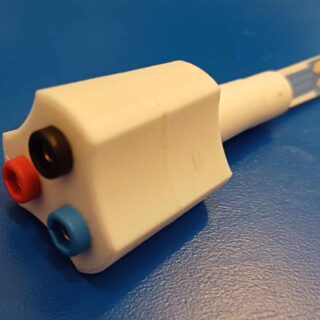
SPE Connector.GC.1 for measurements in glass
Read moreThe connector enables the use of the biosensor or electrochemical sensor based on the substrates AC1, AC4 and TS1 in glass cell TC4, TC5, TC6 or TC7.
The connector enables measurement with screen printed electrodes with width 7.26 mm and standard contact pads pitch (2.54 mm).
It is compatible with other SPE´s that use the same distance between the contact pads (2.54 mm). The cone at the connector sensor side is NJ 8/10 which enables to use the connector with any standard chemical vessels.Termination: 2 mm Banana plugs
-
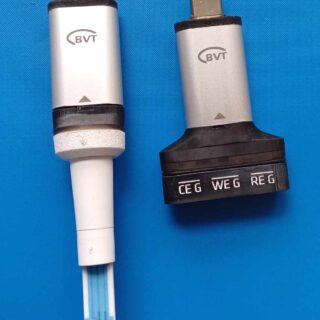
USB Potentiostat Galvanoplot
Read moreUSB Potentiostat Galvanoplot is a super small, low-cost and affordable device suitable for dedicated volume applications, which is optimized for screen-printed sensor and biosensor applications. It can be used in many other research areas and with other electrochemical sensors, for corrosion measurement, battery and super-capacitors or fuel cells.
It is capable of performing all common Amperometric and Voltammetric electrochemistry protocols (CA, LSV, CV, DPV, NPV, SVW, GAL) and can be used with three electrode (WE/RE/CE) and two electrode (WE/RE-CE) setups. Plug the device directly into an Android mobile device through OTG port for a true on-site analysis experience. It is possible to choose from two types of interfaces allowing direct insertion of the BVT SPE sensors or the use of 3 classical electrodes with 2 mm banana plugs (WE, RE, CE).
- Dimensions: 39x17x8 mm
- Weight: 5 g without sensor interface
- Voltage scan range: +-3V @1mV resolution
- Max current: 2000 nA (*at the request of the customer, it is possible to change the range, but this will change the resolution, noise and other parameters)
- Current resolution: 300pA@1KSPS/ 100pA@100SPS/ 30pA/10 SPS resolution
- Noise around: 50nA@1KSPS/ 7nA@100SPS/ 400pA/10 SPS
- Protocols: CA, LSV, CV, DPV, NPV, SVW, GAL
- Cell type: WE/RE/CE and WE/RE-CE
Connectivity: USB-C (Plug the device directly into an Android mobile device through OTG port for a true on-site analysis experience)
- Operating system compatibility: Windows 8, 10+
- Advanced analysis – filtering and auto peaks
Device Usage
- Electrochemical measurements
- Measurements with biosensors and electrochemical sensors
- Measurement of biochemical activity of a sample
- Corrosion measurement
-
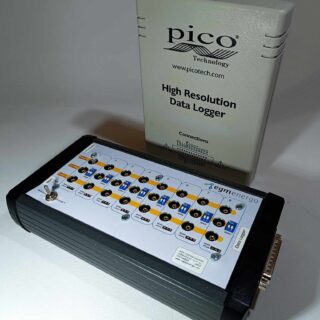
8/16-Channel Potentiostat for High Resolution Data Logger
Read moreThe device consists of a combination of an multi-channel potentiostat/converter (BVT Technologies) and an external USB Pico ADC high resolution data logger (Pico Technology).
The data logger can be supplied in two versions: ADC-20 (20 bits, 8 channels) or ADC-24 (24 bits, 16 channels). For detailed specifications, see the attachment at the end of the document. The device allows measurements from up to 8 or from up to 16 independent channels. The basic output signal is a voltage in the range of -2.5 to 2.5 V. All channels are programmable (the output can be concentration, temperature, pressure…).
After connecting the device to a PC with Pico Technology’s Picolog 6 measurement program installed, the voltage [V] can be processed using math channels and directly recorded in real time as temperature, current, resistance, frequency, % and pressure, see measurement example at the end of the document.
For temperature measurement, the device is compatible with resistance thermometers (Ni 1000, Ni 5000, Pt 1000. Power is provided via USB-B, the maximum electrical consumption of the device is 500 mA.
Device Usage
- Temperature measurement with different temperature sensor (resistance thermometers Ni 1000, ni 5000, Pt 1000)
- Voltage measurement
- Conductivity and resistance measurement
- Amperometry measurement
* For this product, we recommend our customers use the Training Service from BVT.
(https://bvt.cz/produkt/offer-of-long-term-automated-measurements-on-bvt-apparatus/)