

STK-C Customer Starting kit
Starting Kit STK.S-C
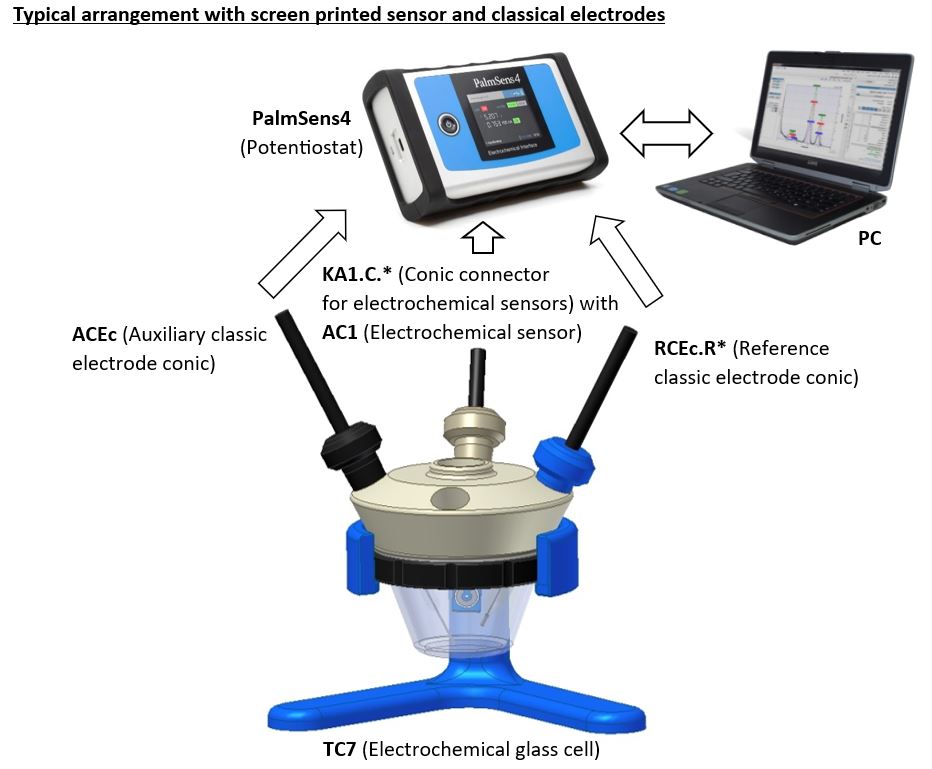
The customer starter kit is a set of twenty different electrochemical sensors to find the best one that suits your application.
The starter set contains at least 5 pcs of sensors type AC1.W*.R* from the given type of sensors with a working electrode diameter (Dw) 1 or 2 mm stored in a box with numbered positions and silica gel.
The exact choice of the given types of sensors in the kit is at the request of the customer.
You may also like…
-
STK Starting kit
Read moreStarting kit STK.S
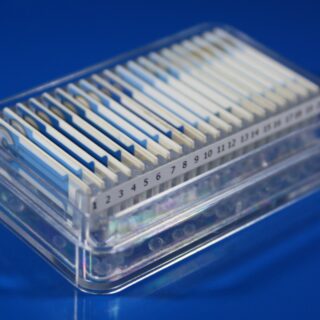
Set of twenty electrochemical sensors with a simple connector to find the best one to fit your application.
Starting kit is the set of twenty different electrochemical sensors to find the best one to fit your application. Starting kit contains 10 types of electrochemical sensors (2 sensors of each type), simple sensors connector and sensors box with numbered positions and silica gel.
-
PalmSens4
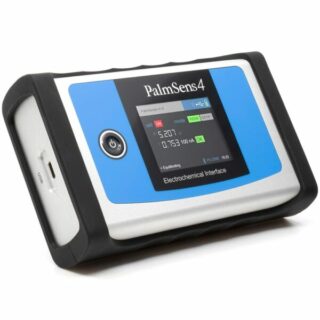
Read moreThe PalmSens4, is a USB and battery powered Potentiostat, Galvanostat, and optional a Frequency Response Analyser (FRA) for Electrochemical Impedance Spectroscopy (EIS).
Compact, versatile and powerful
- (Bi)Potentiostat / Galvanostat / Impedance Analyzer
- FRA / EIS: 10 μHz up to 1 MHz
- 9 current ranges: 100 pA to 10 mA
- 18-bit resolution
- Bluetooth or USB connection
The PalmSens4 has a large potential range (-5V to 5V or -10V to 10V) and current range (100 pA to 10 mA) with a high resolution and low noise. The economical PalmSens4 is a complete laboratory instrument but its compact and rugged design makes it also ideal for field work.
Connecting via Bluetooth guarantees a perfectly floating measurement.
More information can be found through the link: https://www.palmsens.com/product/palmsens4/
Configurable
PalmSens4 comes in different configurations:
- ±5 V or ±10 V potential range
- EIS/FRA with maximum frequency of 100 kHz or 1 MHz
- optional BiPotentiostat module for second WE
- optional iR-Compensation
Standard included
- Rugged carrying case
- High quality, double shielded cell cable with
2 mm banana connectors for Working, Counter, Reference electrode and Ground - Crocodile clips
- Dummy cell
- USB cable
- Manual and Quick Start document
- PSTrace software for Windows
Related products
-
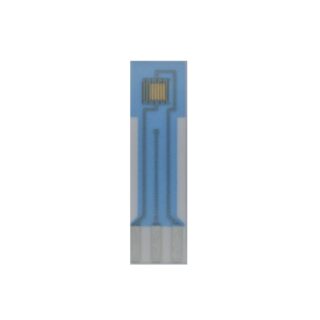
CC1 Electrochemical sensor
Read moreA conductivity sensor made by thick film technology with interdigitated structure of electrodes
Dimensions: 25.4 x 7.26 x 0.63 mm
WE material: Au/Pt, Au, Pt, Ag, C
The sensor is formed on a corundum ceramic base. Onto this surface two interdigitated structures of electrodes are applied. The electrodes are made of Platinum-Gold alloy in standard product CC1.WS. At the end of the sensor there is a contact which is connected with the active part by the silver conducting path which is covered by a dielectric protection layer. A bio-chemically active substance can be immobilised on the working electrode of the sensor.
-
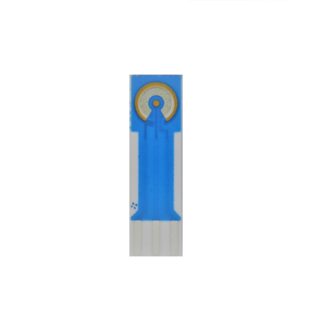
AC1 Dwe= 1mm, 2 mm Electrochemical sensor
Read moreBasic amperometric low cost three-electrode sensor with patented structure made by thick film technology.
Dimensions: 25.4 x 7.26 x 0.63 mm
WE material: Au/Pt, Au, Pt, Ag, C
The sensor is formed on a corundum ceramic base. On to this surface the working, the reference and the auxiliary electrodes are applied. The working and the auxiliary electrodes are made of variety of materials. At the end of the sensor there is a contacting field which is connected with the active part by the silver conducting paths which are covered by a dielectric protection layer.
A bio-chemically active substance can be immobilised on the working electrode of the sensor to create a biosensor. All sensors can be equipped with heating and temperature sensing elements. Thermistor (must be calibrated) or Pt 1000 (the response corresponds to the ISO standard) is used as the temperature sensor.
We also offer:
- working electrode made of polished gold (WE diameter 1 or 2 mm) – sensor type: AC1P.W*.R*, with homogenous surface with roughness less than 1 µm
- working electrode made of a material of guaranteed purity of up to 99.99 % (WE diameter 2 mm) – sensor type: AC1.GP
We also offer activated graphite sensors on customer request.
See activation example below:
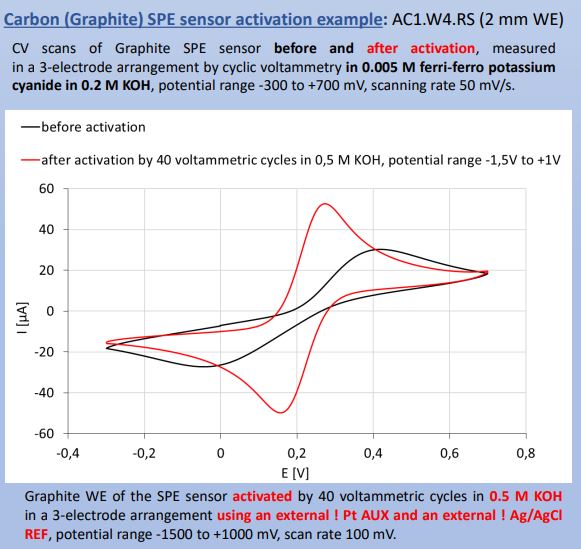
* Have a look at product cathegory Discounted SPEs – which include offer of Screen Printed Electrodes (SPEs) at a reduced Price from our AC1 line of Sensors. They are fully functional, but with visual defects or inconsistancies.
– ideal for use by students to gain handling experience and knowledge on SPEs and their uses
– ideal for initial experiments in research -
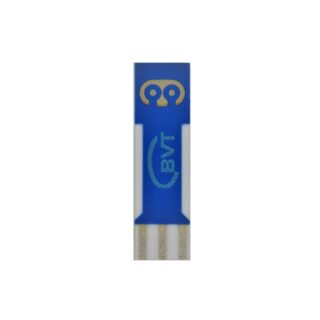
AC2 Electrochemical sensor
Read moreAmperometric two-electrode sensor with two working electrodes made by thick film technology.
Dimensions: 25.4 x 7.26 x 0.63 mm
WE material: Au/Pt, Au, Pt, Ag, C
The sensor is formed on a corundum ceramic base. On to this surface two working electrodes, and one reference electrode are applied. The working and the reference electrodes can be made of variety of materials. At the end of the sensor there is a contacting field which is connected with the active part by the silver conducting paths which are covered by a dielectric protection layer. Different bio-chemically active substance can be immobilised on the working electrode to create a biosensor.
-

Bottom mount front contact electrochemical cell setup (redox.me)
Read moreThis is a static voltammetry cell with variants for different sample dimensions. The sample is loaded from the bottom via magnetic or screw mount, while counter or/and reference electrodes are mounted in the lid as either 2-, or 3-electrode configuration. The cell is constructed with materials that are inert to the sample environment (glass and PEEK), and it can be used with FKM/EPDM O-rings or FFKM O-rings for aqueous or organic electrolyte requirements, respectively. The construction is gas-tight and inert gas can be bubbled through the electrolyte to remove and exclude contaminants such as air or water.
Application note:
The reference electrode tip should be placed close to the sample surface to ensure a negligible potential drop throughout the electrolyte solution during low-current experiments. In the magnetic variant of the cell, the strength with which the magnets hold the sample is adjusted by adding or removing the washers under the magnets. Thanks to this procedure, the distance between the magnets changes, with it, the force of their attraction. Various auxiliary electrodes are suitable for this cell, including metal wire and metal plate electrodes as well as carbon-based electrodes (graphite or Glassy Carbon). If a purge gas is used, stop the flow during experiments for better results.Specification:
nominal exposure area: 0.07 cm2 for 5x5mm2, 0.2 cm2 for 7x7mm2, 0.5 cm2 for 10x10mm2, and 1.33 cm2 for 15x15mm2
minimum electrolyte volume: 2.5 mL
maximum electrolyte volume: 15 mL
electrode plug diameter: 6 mm
substrate size: 5x5mm2, 7x7mm2, 10x10mm2, and 15x15mm2, other sizes available on request
minimum substrate thickness: 0.4 mm**lower thicknesses are also feasible when using a pad below the sample
Intrastat data:
HS Code: 90309000
Country of Origin: Sweden
NET weight: 200 gSetup includes:
1 x BM FC EC 15mL – Bottom Mount Front Contact Electrochemical Cell, 15mL (or BMM FC EC 15mL – Bottom Magnetic Mount Front Contact Electrochemical Cell, 15mL)
1 x lid
1 x glass chamber
1 x bottom casing
1 x sample mount
1 x tantalum contact
1 x plug
1 x set of Nylon screws (screw variant only)
1 x Reference electrode (Ag/AgCl, or Ag/Ag+), 70mm, 4 mm female banana socket
1 x Metal Wire Auxiliary Electrode – 50HX15 0.6/250 mm, platinum 99.9%, 4 mm female banana socket