
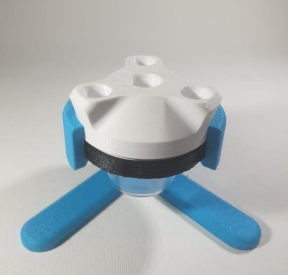
TC7 Electrochemical Glass Cell
The TC7 is a low cost Glass Cell that is ideal for students and basic lab measurements.
The TC7 comes with a stand, specially designed for it, and the stand provides more stability and ease of use.
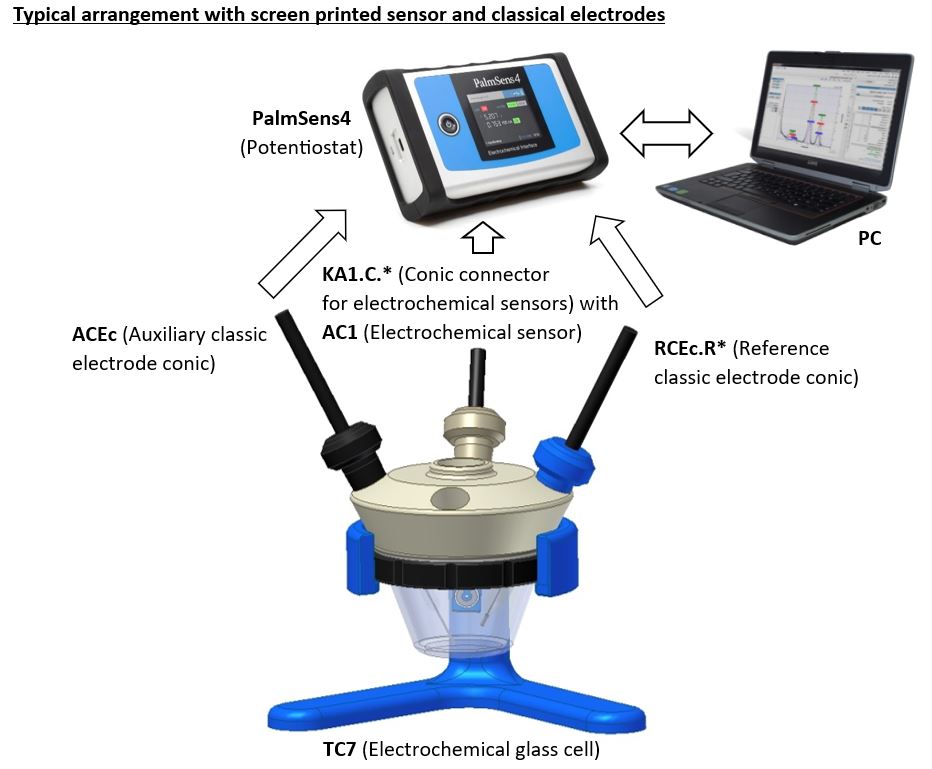
The Borosilicate glass cell serves for electrochemical measurements. Cell openings are designed for the SPE Electrochemical Sensors Connector KA1.C,Classical Electrodes WCEc, ACEc, RCEc, STP1.*
Stoppers for Cells, and Stirrer’s ST1 and ST3 separately.
The device enables the measurement with inserted samples.
You may also like…
-
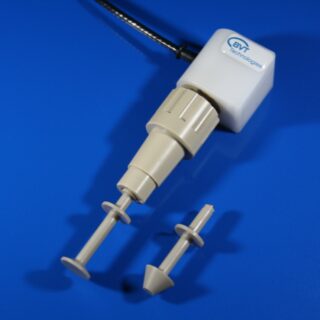
ST1.* Universal Stirrer for screen printed and classical electrodes
View products- The universal stirrer ST1 uses a common micro DC motor
- ST1 allows the solution to be mixed and the particles to be optimally transferred to the surface of the printed or conventional electrodes.
- The construction of stirrer assures the optimum mass transport with the minimum hydrodynamic noise.
- The supply voltage 0 – 5 V and the maximum current of 450 mA mean that it can be used as a USB device.
- The stirrer is manufactured from quality materials and suitable chemical measurements.
- Revolutions range: 120 – 12 000 rpm
-
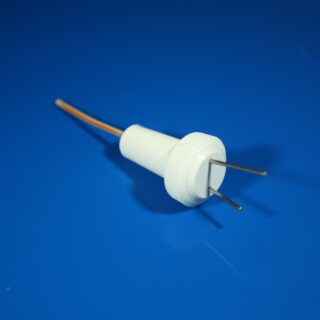
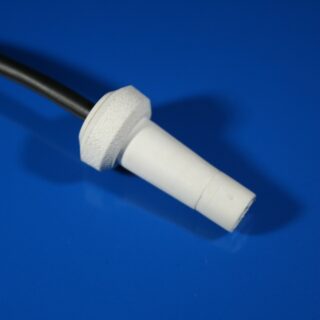
STP1.* Stoppers for Cells
Read moreStoppers are formed from white PBTP (Polybutylenterephtalate). They are used for covering of the glass cells produced by BVT.
The system with the stopper is closed and space is prevent from solution evaporation.
Model Recommended Vessel Termination STP1.S TC4, TC5, TC6 Stopper for TC4, TC5, TC6 STP1.1 TC4, TC5, TC6 Stopper with bubbling STP1.2 TC4, TC5, TC6 Stopper with tubing STP1.3 TC4, TC5, TC6 Middle stopper -
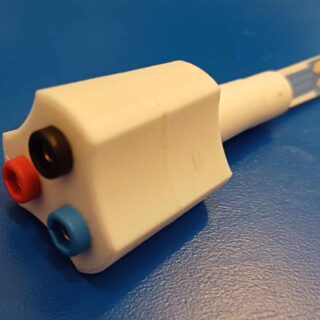
SPE Connector.GC.1 for measurements in glass
Read moreThe connector enables the use of the biosensor or electrochemical sensor based on the substrates AC1, AC4 and TS1 in glass cell TC4, TC5, TC6 or TC7.
The connector enables measurement with screen printed electrodes with width 7.26 mm and standard contact pads pitch (2.54 mm).
It is compatible with other SPE´s that use the same distance between the contact pads (2.54 mm). The cone at the connector sensor side is NJ 8/10 which enables to use the connector with any standard chemical vessels.Termination: 2 mm Banana plugs
Related products
-

AC1.GP. Electrochemical sensor with a working electrode of guaranteed purity
Read moreBasic amperometric three-electrode sensor with patented structure made by thick film technology.
Dimensions: 25.40 mm x 7.26 mm x 0.63 mm
WE material: gold, platinum, silver, copper, iron, nickel, cobalt, chromium, tantalum, irridium, rhenium, magnesium, palladium, zirconium and others
*Selection of sensor electrode materials other than those listed above is possible upon agreement with the customer.
The sensor is made on a corundum ceramic base. Working, reference and auxiliary electrodes are applied to this surface. Working, reference and auxiliary electrodes are made of different materials. At the end of the sensor there is a contact field that is connected to the active part by silver conductive paths that are covered with a dielectric protective layer. The working electrode of the sensor with a diameter of 2 mm is made of a material of guaranteed purity of up to 99.99 % depending on the selected material– standard layer thickness 0.0125 mm.
We also offer a working electrode made of polished gold AC1P.W*.R*, with homogenous surface with roughness less than 1 µm.
We also offer activated graphite sensors on customer request.
-

Modular PEM Electrolyzer Test Station up to 3 kW (redox.me)
Read moreThe Modular PEM Electrolyzer Test Station is a versatile and flexible solution designed for the testing and evaluation of proton exchange membrane (PEM) electrolyzers. Unlike fully automated, integrated systems, this platform features modular components that can be easily swapped by the end user, allowing for customized setups and adaptability to different testing needs. The platform is engineered to provide precise control and measurement of electrochemical performance while offering the convenience of easily replaceable parts.
This design enables users to test various configurations, integrate new modules, and adapt the system to specific research or development objectives without the need for specialized equipment or extensive downtime. Ideal for research labs and development environments, this platform supports the advancement of PEM electrolyzer technology through hands-on, flexible experimentation.
Application note:
Ideal for researchers investigating new PEM materials, flow field designs, and cell configurations. The system is an excellent tool for academic institutions and training centers, providing students and researchers with a hands-on understanding of PEM electrolysis processes and system operation. PEM Electrolyzer Test Station with power up to 3 kW is suitable for testing lab-scale or small to medium-scale electrolyzers, typically up to 60 cm². If the power requirements for a given electrolyzer are less than 2 A/cm², larger electrolyzers up to 100 cm² or more can also be tested.
The entire system, as well as its component parts, are CE certified, which signifies that a product meets European Union (EU) health, safety, and environmental protection standards. Other certificates are available upon request.The Modular PEM Electrolyzer Test Station is continuously being improved, so the photos may not fully represent the current version of the device.
Specification:
weight: 150 kg
height: 129 cm (25U)
width: 135 cm (85 cm with folded monitors)
depth: 90 cm
maximum input power: 3 kW
maximum input current: 120 A
maximum input volatge: 60 V
power connection: 230V, 3 kW, single phaseIntrastat data:
HS Code: 85433000
Country of Origin: Sweden
NET weight: 150 kgSetup includes:
1 x Modular PEM Electrolyzer Test Station or selected module(s) -

Basic electrochemical cell setup (redox.me)
Read moreThis is a stationary solution basic electrochemical cell for measurements of electrodes in a form of:
a) rod/disc (6 mm dia.),
b) thin film deposited on a flat substrate (using a wire clip) and
c) membrane (using a wire clip).
The working, counter, and reference electrodes are mounted in a top casing either in 2-, or 3-electrode setup. The cell elements are constructed with materials that are inert to the sample (glass and PEEK). It well fits aqueous (FKM/EPDM O-Rings) and organic solvent (FFKM O-Rings) electrolyte requirements. The construction is gas-tight and can be used when the removal and exclusion of contaminants such as oxygen and water is required by bubbling of an inert gas through the electrolyte. The cell chamber is available in several material variants here (glass, PTFE, PEEK)
Application note:
The reference electrode tip should be placed at the level of working electrode center. This will ensure a low potential drop throughout the electrolyte solution for low-current experiment. Various auxiliary electrodes are suitable for this cell including metal wire and metal foil electrodes as well as graphite rod. The bubbling of gas through the solution must be stopped prior to experiment.Specification:
maximum electrolyte volume: 50 mL
electrode plug diameter: 6 mm
number of electrode slots: 3Intrastat data:
HS Code: 90309000
Country of Origin: Sweden
NET weight: 200 gSetup includes:
Item Qty B-A-BEC-50 B-O-BEC-50 BEC 50 mL – Basic Electrochemical Cell 1 C-A-BEC-50 C-O-BEC-50 Metal wire auxiliary electrode – 50HX15 0.6/250 mm, platinum (99,9%), 1 mm dia. gold plated pin 1 E-A-50HX15_Pt-1mm E-O-50HX15_Pt-1mm Silver / Silver Chloride Reference Electrode – Ag/AgCl 70 mm 1 E-Ag/AgCl_70 Non-aqueous Silver / Silver Ion Reference Electrode – Ag/Ag+ 70 mm 1 E-Ag/Ag+_70 Working disk electrode – 2 mm dia., PEEK BODY 6 mm dia. – 70 mm, glassy carbon 1 E-A-DISK_GC-70 E-O-DISK_GC-70 10 pcs of Tantalum wire clip with septum plug 0.6 mm dia., 60 mm long 1 E-A-Ta_CLIP-0.6/60-10p E-O-Ta_CLIP-0.6/60-10p -
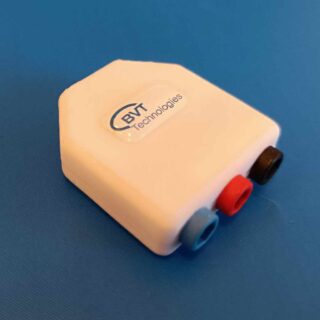
SPE Connector.1 for electrochemical sensors
Read moreThe connector enables the use of the biosensor or electrochemical sensor based on the substrates AC1, AC4, AC13 and TS1 1 in classical electrochemical arrangement.
The connector enables measurement with screen printed electrodes with width 7.26 mm and standard contact pads pitch (2.54 mm).
It is compatible with other SPE´s that use the same distance between the contact pads (2.54 mm).Termination: 2 mm Banana plugs