Archives: Products
Showing 81–96 of 141 results
-
LP Linear pump
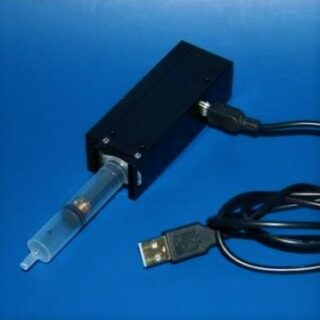
Read moreThe linear pump LP.* consists of miniature motor with digital encoder and planetary gear, which is in aluminium body of pump.
The motor drives the screw which moves the piston in syringe in both directions. The pump is designed for extremely small applications such as medical or military applications. It can be used in hand-held devices. The main advantage is no pulsation and easy connection with syringe piston. The pump can supply liquid through flow cells FC2, FC3 or FC4. Linear pump is delivered with optional Hamilton syringe holder.
-
MAC Microreactor
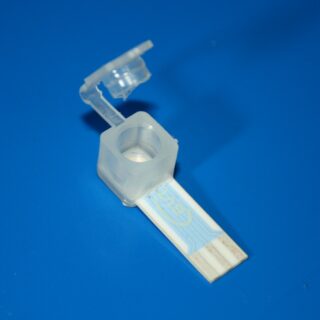
Read moreMicroreactor for sensor used for measurement of small volume (20 µl) in closed system.
Dimensions: 7.26 (width) x 0.63 mm (thickness)
The MAC Microreactor is attached to the Sensor/s that the customer would like to use, and allows the customer to place a solution (20µl) for carrying out measurements directly above the WE in a contained area. The lid of the MAC Microreactor can be closed sealing the solution and helps avoid contaminants from affecting the test.
-

Membrane Capacitive Deionization configurable cell (redox.me)
Read moreMembrane Capacitive Deionization (MCDI) configurable cell has been designed to conduct research on removal of charged ionic species from aqueous or organic solutions (i.e., Desalination/Demineralization) via electrostatic (i.e., non-Faradaic) or electrochemical (redox) interactions. The MCDI cell contains two graphite current collectors that can serve as polarization electrodes. However, if the electrode material is the subject of research, it should be applied to an additional current collector, such as graphite paper or metal felt (not included in the product). Different electrode materials can be installed on both sides of the cell. If the thickness of these electrodes exceeds 250 micrometers, different gaskets are required. In such a case, please contact us for a solution.
The cell is designed in such a way that replacing the electrodes does not require removing the membranes or flow fields. It is enough to unscrew the plungers on both sides and replace the electrodes. In the standard configuration, the liquid in the main channel and side channels flows through the flow field cut from PEEK. However, these can be replaced with a porous material such as felt or a battery spacer, which will allow fluid flow. If work with materials of dimensions different from those listed in the specification is required, we can supply seals of different thicknesses or customize the cell. The cell allows for the installation of one or two ion-exchange membranes (not included in the setup). Their thickness is not critical, and it is not necessary to adjust the thickness of the membrane gaskets pressing them. The cell elements are constructed with inert materials to the sample (PEEK). It well fits aqueous (FKM gaskets and O-rings) and organic solvent (FFKM gaskets and O-rings) electrolyte requirements. The construction of the cell is gas-tight.
Application note:
MCDI cell can be configured to allow the following cell architectures:- Flow-by CDI consisting of: (i) two porous carbon or metal based current collectors coated with capacitive (e. non-Faradaic) material, and (ii) a main flow field enabling the feed water to be transported between electrodes. In this configuration, side flow fields and membranes are not installed.
- Membrane CDI consisting of: (i) two porous carbon or metal based current collectors coated with capacitive (e. non-Faradaic) material, (ii) two ion-exchange membranes (cation exchange membrane and anion exchange membrane) separating electrodes from the main flow field, and (iii) a main flow field enabling the feed water to be transported between electrodes. In this configuration, side flow fields are typically not installed. However, there are cases where installing both side flow fields is justified. All the graphics included in the product page refer to that configuration.
- Inverted CDI consisting of: (i) two porous carbon or metal based current collectors coated with capacitive (e. non-Faradaic) material where anode is treated for net negative surface charge and a cathode is treated for net positive surface charge, and (ii) a main flow field enabling the feed water to be transported between electrodes. In this configuration, side flow fields and membranes are not installed.
- Flow-electrode CDI consisting of: (i) two porous carbon or metal based current collectors with flowing electrodes made of capacitive (e. non-Faradaic) carbon suspension, (ii) two ion-exchange membranes (cation exchange membrane and anion exchange membrane) separating electrodes from the flow chamber, (iii) a main flow field enabling the feed water to be transported between electrodes, and (iv) two side flow fields for liquid electrodes. All the graphics included in the product page refer to that configuration.
- Hybrid CDI consisting of: (i) a Faradaic (e. battery) electrode for cation adsorption/desorption, (ii) a capacitive (i.e. non-Faradaic) electrode for anion adsorption/desorption, (iii) an anion exchange membrane placed adjacent to the capacitive electrode, and (iv) a main flow field enabling the feed water to be transported between electrodes. In this configuration, side flow fields and a cation-exchange membrane are not installed.
- Cation intercalation desalination consisting of: (i) two porous carbon or metal based current collectors coated with Faradaic cation intercalation materials, (ii) an anion exchange membrane separating electrodes, and (iii) a main flow field enabling the feed water to be transported between electrodes. In this configuration, one side flow field and cation-exchange membrane are not installed.
- Desalination battery consisting of: (i) two porous carbon or metal based current collectors coated with redox (e. Faradaic) material (one for cation adsorption/desorption and the other for anion adsorption/desorption), and (ii) a main flow field enabling the feed water to be transported between electrodes. In this configuration, side flow fields and membranes are not installed.
Specification:
tubing size: 4 mm OD
fitting type: push-in, M5 male
electrode size: 60 mm x 60 mm (36 cm2)
recommended total electrode thickness: 200-250 µm
membrane size: 70 mm x 85 mm
maximum operating pressure: 20 bar
maximum operating temperature 150 ºCIntrastat data:
HS Code: 90278080
Country of Origin: Sweden
NET weight: 1300 gProduct includes:
2 x stand, anodized aluminum
2 x plunger holder, SS 316L
2 x PEEK plunger
2 x tantalum current collector
2 x graphite current collector
1 x threaded end plate, SS 316L
1 x unthreaded end plate, SS 316L
1 x PEEK outer cell body
1 x PEEK inner cell body
1 x set of fittings
2 x female banana connectors, 4 mm dia.
1 x PEEK main flow field, 0.5 mm thick
2 x PEEK side flow field, 0.5 mm thick
1 x set of gaskets (FKM or FFKM) including:1 x main flow gasket, 0.5 mm thick
2 x membrane gasket, 0.25 mm thick
2 x side flow gasket, 0.5 mm thick
2 x electrode gasket, 0.25 mm thick -

Metal Wire Auxiliary Electrode – 50HX15 0.6/250 mm (redox.me)
Read moreThe metal wire counter (auxiliary) electrode is provided in the electrochemical cell as a current sink to shunt excess current away from the reference electrode. The counter electrode is generally chosen to be inert under reaction conditions, typically platinum, rhodium, palladium, or gold wire. It well fits aqueous (FKM O-Ring) and organic solvent (FFKM O-Ring) electrolyte requirements.
Application note
The metal wire electrode is immersed in the ion-conducting solution as a counter electrode. An electric current is passed between the working electrode and the counter electrode for a certain amount of time. After the process, the electrode should be washed several times with isopropanol or ethanol and dried under the nitrogen flow. Store the metal wire electrode in the glass vial sealed with O-rings (all included in the package).Specification
helix inner diameter: 4.8 mm
helix outer diameter: 6 mm
number of turns: 12
wire diameter: 0.6 mm
total wire length: 250 mm (215 mm long helix, 35 mm long straight wire)Intrastat data
HS Code: 71101910 (platinum), 71081310 (gold),
Country of Origin: Sweden
NET weight: 100 gProduct includes
1 metal wire electrode with PEEK plug and selected electrical connector
1 O-Ring
1 glass vial -
Mini *-ISE-L60.C* Miniature ion selective elecrodes
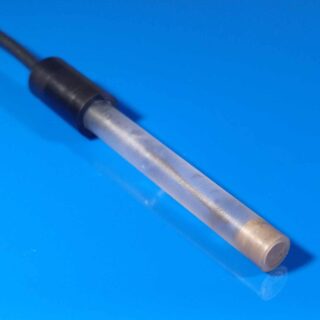
Read moreMiniature ion selective electrodes for potentiometric measurements of Chloride ions, Sodium ions, Calcium and Potassium ions concentration in aqueous solutions when used together with a reference electrode (following prior calibration) with a diameter of 6 mm and a length of 60 mm.
Specifically, these applications may include analyses for agricultural purposes, online monitoring of the representation of selected ions in water management, certain industrial areas or agriculture (hydroponic cultivation of plants) etc.
Electrodes are applicable to all commonly used measuring apparatus, with input resistance of at least 1012 Ω. The work with ion selective electrodes is time effective, requires an only small amount of chemicals, and a friendly price of measuring equipment (potentiostat with measuring method potentiometry).
Possibility of integration with a FC.1ISE.1REF Flow cell for single ion selective electrode with integrated stirring – possible automation and continuous measurement.
* For this product, we recommend our customers use the Training Service from BVT.
(https://bvt.cz/produkt/offer-of-long-term-automated-measurements-on-bvt-apparatus/)
-
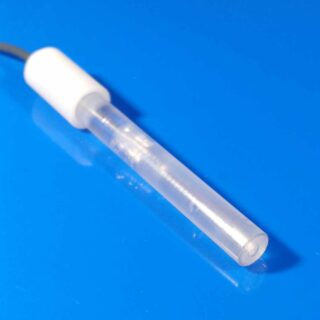
Mini RCE.GEL.L60.C1 Miniature reference argentochloride gel electrode
Read moreMiniature reference argentochloride gel electrode is designed for potentiometric measurements in connection with Miniature ion selective electrodes for potentiometric measurements of Chloride ions, Sodium ions, Calcium and Potassium ions concentration in aqueous solutions following prior calibration.
The conductive connection of the internal electrolyte (KCl gel) enclosed in a plastic tube is mediated by a porous frit.
Maintenance-free electrode – no need to top up the internal electrolyte (KCl gel).
Electrodes are applicable to all commonly used measuring apparatus, with input resistance of at least 1012 Ω.
Possibility of integration with a FC.1ISE.1REF Flow cell for single ion selective electrode with integrated stirring – possible automation and continuous measurement.
-
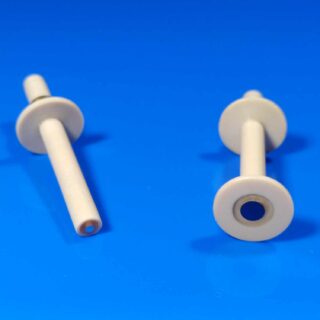
Mini RDE tips
Read moreMini rotating disc electrode tips
BVT provides a wide range of RDE tips, composed from different materials from gold, platinum and copper to glassy carbon and working electrode diameters from 2 to 5 mm.
The electrode material is inserted into a body of the Rotating disk electrode (RDE) to ensure excellent chemical compatibility and mechanical integrity.
-
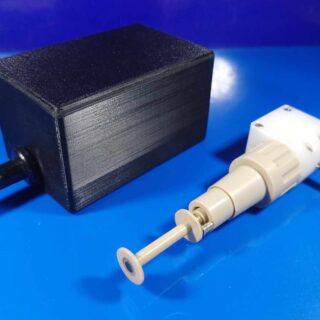
Mini Rotating Disk Electrode
Read moreThe Mini Rotating disk electrode (Mini RDE) in general enables defined mass transfer towards electrode surface.
The Mini RDE consists of the body of the RDE (motor) with 6 pcs of interchangeable electrode tips.
The device is equipped by control electronics and SW and powered by USB connection with PC.
Rotational speed of Mini RDE is 10 – 1300 rpm.RDE is suitable for measurements in glass cells of type TC4, TC5, TC6 and TC7. During measuring with RDE
in a classic three-electrode connection, it is advisable to use a classic reference RCEc.R* and auxiliary electrode ACEc.* For this product, we recommend our customers use the Training Service from BVT.
(https://bvt.cz/produkt/offer-of-long-term-automated-measurements-on-bvt-apparatus/)
-

Modular PEM Electrolyzer Test Station up to 3 kW (redox.me)
Read moreThe Modular PEM Electrolyzer Test Station is a versatile and flexible solution designed for the testing and evaluation of proton exchange membrane (PEM) electrolyzers. Unlike fully automated, integrated systems, this platform features modular components that can be easily swapped by the end user, allowing for customized setups and adaptability to different testing needs. The platform is engineered to provide precise control and measurement of electrochemical performance while offering the convenience of easily replaceable parts.
This design enables users to test various configurations, integrate new modules, and adapt the system to specific research or development objectives without the need for specialized equipment or extensive downtime. Ideal for research labs and development environments, this platform supports the advancement of PEM electrolyzer technology through hands-on, flexible experimentation.
Application note:
Ideal for researchers investigating new PEM materials, flow field designs, and cell configurations. The system is an excellent tool for academic institutions and training centers, providing students and researchers with a hands-on understanding of PEM electrolysis processes and system operation. PEM Electrolyzer Test Station with power up to 3 kW is suitable for testing lab-scale or small to medium-scale electrolyzers, typically up to 60 cm². If the power requirements for a given electrolyzer are less than 2 A/cm², larger electrolyzers up to 100 cm² or more can also be tested.
The entire system, as well as its component parts, are CE certified, which signifies that a product meets European Union (EU) health, safety, and environmental protection standards. Other certificates are available upon request.The Modular PEM Electrolyzer Test Station is continuously being improved, so the photos may not fully represent the current version of the device.
Specification:
weight: 150 kg
height: 129 cm (25U)
width: 135 cm (85 cm with folded monitors)
depth: 90 cm
maximum input power: 3 kW
maximum input current: 120 A
maximum input volatge: 60 V
power connection: 230V, 3 kW, single phaseIntrastat data:
HS Code: 85433000
Country of Origin: Sweden
NET weight: 150 kgSetup includes:
1 x Modular PEM Electrolyzer Test Station or selected module(s) -
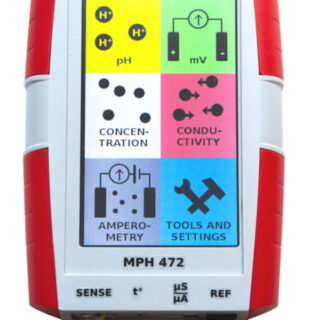
MPH 472 Universal Potentiostat
Read moreThe instrument enables measurement of amperometry, potentiometry and conductometry. Communication with the computer is provided via USB or Bluetooth. This hand-held device is equipped with GPS navigation so the measured data may be enhanced by the exact coordinates of the location where the measurement was made.
Measured data can be stored and later processed in a PC because of the SD card slot incorporation. The ability to record a waveforms or integrate the measure values is enabled. Basic evaluation methods are also implemented – linear and non-linear calibration and standard addition method is available. The influence of the type of oxygen electrode membrane, temperature or gas solubility can be compensated for the measured values.
The measured data are automatically recalculated and displayed in units of current, voltage, concentration (g∙L-1 or mol∙L-1) or saturation. Potentiometric measurement allows connection of pH electrodes and ISE.
Key Properties
- Up to 200 hours of battery life depending on the operating mode.
- Excellent analytical tools (graphs, unit conversions, internal standard method for potentiometry, coulometric titration, 10 Henry’s constants for various redox active gases).
- Power supply and data communication via USB, possibility of connection via Bluetooth.
- Data logging to memory card.
- Up to 5-point calibration for ISE and pH electrodes.
- Up to 4-point calibration of the conductivity cell makes it possible to compensate the non-linearity of the measurement.
- GPS equipment enables measurements in the field with location storage.
- Calibration stored separately in the device (possibility of changing the memory card without having to recalibrate the device).
- Possibility of separate calibration for 4 probes for amperometry and potentiometry.
- The possibility of using different temperature sensors (PT100, PT1000, Ni1000, ATC Monocrystals).
- Advanced power management (display sleep and automatic device shutdown can be set according to the user’s preferences
- Vector voltmeter for accurate conductivity measurement.
- Powerful thirty-two-bit microprocessor for accurate measurement calculations.
Improvements:
- Faster battery charging via USB charger.
- Vector voltmeter for precise conductometric measurement.
- A more sensitive GPS module.
- More robust input circuits for ametrometric measurement – less susceptible to noise.
More information can be found through the link: https://www.monokrystaly.cz/cs/ph-mv-ion-metry.html?fbclid=IwAR3ieir-mH-D10LZ-SZkrx74OHZYvOHjZPnOX8nfi9WdcwostsUgTAVaZPM#MPH471
-
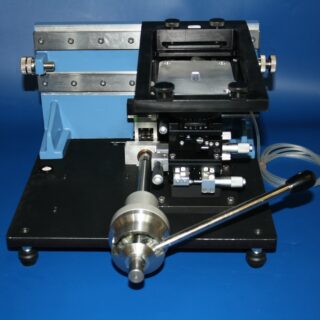
MSP Manual Screen Printer
Read moreThe manual screen printer is useful for applying of biochemical paste on electrochemical sensors. It may be used for preparing customer design electrochemical sensors also.
It uses extremely small quantities of printing material. With the adjustment of the distance between the screen and the substrate the thickness of the printed elements can be varied. Under optimal conditions printing of lines with 200 µm can be achieved.
* For this product, we recommend our customers use the Training Service from BVT.
(https://bvt.cz/produkt/offer-of-long-term-automated-measurements-on-bvt-apparatus/)
-
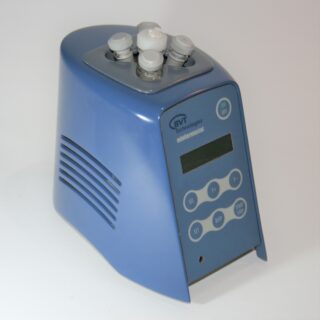
MT-1 Minithermostat
Read moreTechnical Parameters
- Supply: 12 V
- Min temperature: -9.9°C
- Max temperature: 59.9 °C
- For TC4, TC6 or Eppendorf microvials
Device Usage
- Cooling/heating of solution of temperature sensitive chemicals during experiments
- Maintaining of chemicals at exact temperature
- The electrochemical measurement with thermodiffusion
- Heated electrodes technology
The option with Eppendorf microvials 0.2 ml, 0.5 ml, 1.5 ml is possible
Minithermostat device is designed for tempering an electrolytic bath for electrochemical measurements. The temperature is stabilized and the Peltier thermal element, which allows cool or warm the measured electrolytic samples.
-
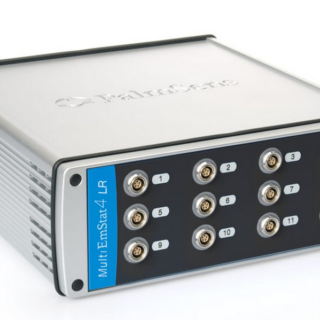
MultiEmStat4
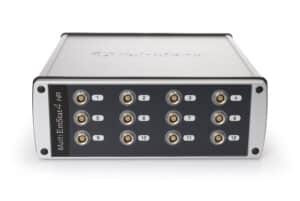
Read moreThe MultiEmStat4 is a compact Potentiostat, Galvanostat, and optional Frequency Response Analyser (FRA) for Electrochemical Impedance Spectroscopy (EIS) with 8 or 12 channels. The MultiEmStat4 comes in two versions; the Low Range version is great for applications that require a low current range down to 1 nA, whereas the High Range version is very suitable for applications that need a maximum current of 200 mA.
The MultiEmStat4 is controlled with MultiTrace for Windows, or you can write your own MethodSCRIPT and control it from any platform or operating system.
- Available with 8 or 12 channels
- FRA / EIS: 10 μHz up to 200 kHz
- Potential range: ±3 V (LR) or ±6 V (HR)
- Max. current: ±30 mA (LR) or ±200 mA (HR)
More information can be found through the link: https://www.palmsens.com/product/multi-emstat4/
Always a backup
The MultiEmStat4 is equipped with 500 MB internal storage memory on each channel for storing your measurements as a backup. All internally stored measurements can be browsed and transferred back to the PC easily using the MultiTrace software. Your data is always with your instrument wherever you take it.
Synchronizing channels in Synched mode
By enabling synchronization of channels and adjusting the setup of your cables, you can use the MultiEmStat4 as a polypotentiostat. This means you can use multiple working electrodes, one counter and one reference electrode in the same cell at the same time. Your working electrodes all perform the same measurement.
Specifications
The MultiEmStat4M is available in two versions: the LR (Low Range) and HR (High Range) version.
Main differences between the MultiEmStat4 Low and High Range 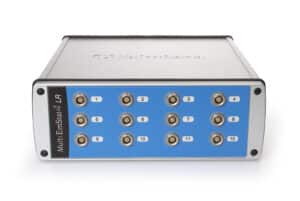


Potential range ±3 V ±6 V Max. compliance voltage ±5 V ±8 V Current ranges 1 nA to 10 mA (8 ranges) 100 nA to 100 mA (7 ranges) Max. current ±30 mA ±200 mA Electrode connections WE, RE, CE and ground,
2 mm banana plugsWE, RE, CE, Sense, and ground,
2 mm banana plugsHardware options - EIS up to 200 kHz
- Galvanic Isolation
- EIS up to 200 kHz
- Galvanic Isolation
-
MultiPalmSens4
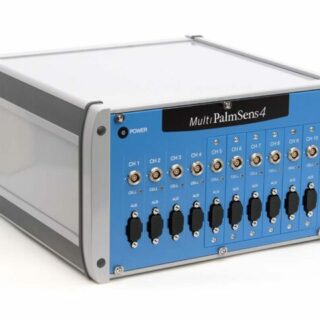
Read moreMulti-channel Potentiostat / Galvanostat / Impedance Analyzer
- 4 to 10 channels available in different configurations
- FRA / EIS: 10 μHz up to 1 MHz
- 9 current ranges: 100 pA to 10 mA
- potential range: ±5 V or ±10 V
The MultiPalmSens4 is a flexible multi-channel potentiostat, galvanostat and impedance analyzer which you can fully tailor to your requirements and budget. The MultiTrace software allows for using each channel individually or simultaneously or running a sequence of automated tasks on each channel. Each channel provides an additional auxiliary port for controlling peripherals or monitoring temperature or other analog signals.
More information can be found through the link: https://www.palmsens.com/product/multipalmsens4/
Configure your ideal multi-channel potentiostat
Each channel can be configured with:
- ±5 V or ±10 V maximum potential range
- EIS/FRA with maximum frequency of 100 kHz or 1 MHz
- Bipotentiostat module for second WE
- iR-Compensation
- Galvanic isolation
Always a backup
Every channel of the MultiPalmSens4 is equipped with 8 GB storage space. This means all your measurements* can automatically be saved on-board as backup.
Measurements can be browsed and transferred to the PC easily using the MultiTrace software for Windows.Synchronizing channels in Synched mode
By enabling synchronization of channels and adjusting the setup of your cables, you can use the MultiPalmSens4 as a polypotentiostat. This means you can use multiple working electrodes, one counter and one reference electrode in the same cell at the same time. Your working electrodes all perform the same measurement.
-
MUX8-R2 Multiplexer
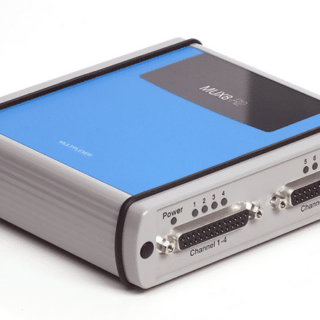
Read moreMultiplexer for 8 up to 128 cells
- Automatically switch between electrochemical cells
- Easy stacking with magnetic feet and top
- 4 different electrode or sensor configurations
- Daisy chain multiplexers, up to 128 channels!
The PalmSens series and the EmStat4X can be used to work with multiple working electrodes or a sensor array by means of a multiplexer.
The multiplexer switches between the working electrodes in the range of milliseconds.
- each MUX8-R2 multiplexer enables to work with up to eight 2- or 3- electrode systems.
- daisy chaining multiple MUX8-R2 boards (expansion up to 128 channels)
- all hardware settings are controlled by the software making it unnecessary to flick a physical switch
- LEDs to show which channel is selected
- allows to connect auxiliary input (like temperature sensor)
More information can be found through the link: https://www.palmsens.com/product/mux8-r2/
Connection options
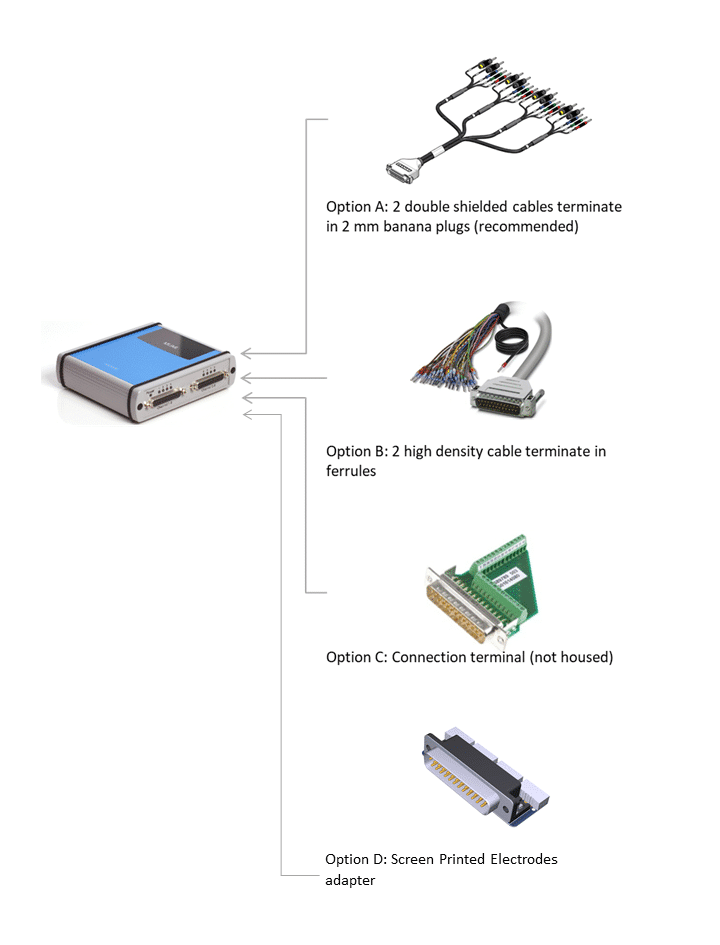
The most selected connection option uses two double shielded D-Sub cables ending in 2 mm banana plugs. As alternatives we can provide a PCB with screw terminals, D-Sub cable ending in ferrules or Screen Printed Electrode Adapter. Each of these cables can be connected to 4 channels, if all 8 channels are used, two cables are needed.
Specifications
System number of channels 8 (up to 128 when daisy chained) multiplexer switches 8 x (WE, S, RE and CE) on resistance for WE 1.5 ohm typical charge injection on WE 20 pC typical leakage current < 55 pA (30 pA typical) at 25 ºC switching time 2 ms compliance voltage
± 10 V Other housing aluminium: 138 mm x 121 mm x 37 mm weight +/- 500 g temperature range 0 ºC to + 50 ºC power supply USB The MUX8-R2 has the following connectors:
Connector Function Input Y-cable connects to both potentiostat sensor connector and (digital) AUX AUX Can be used to measure auxiliary input like temperature or pH, and to switch external hardware using two digital control lines that can be set in PSTrace Link Connects to Input of next multiplexer, for daisy-chaining multiple multiplexers USB-C Input for extra power when
≥3 multiplexers are daisy-chainedChannel 1-4 Connects to sensor cables 1-4 Channel 5-8 Connects to sensor cables 5-8