Archives: Products
Showing 97–112 of 141 results
-

Nexus
Read moreBuilding on PalmSens’ legacy of providing top-tier solutions for accurate low-current measurements, Nexus delivers an ultra-low-noise performance that exceeds even our existing portable devices, while also supporting measurements up to 1 Ampere.
More information could be found trough link:
https://www.palmsens.com/product/nexus/
- Bi)Potentiostat/ Galvanostat/ Impedance analyzer
- FRA / EIS: 10 μHz up to 1 MHz
- 11 current ranges: 100 pA to 1 A
- Dual EIS with second sense electrode
- Script your experiments using MethodSCRIPT
- Use with PSTrace software for Windows
Versatile
Our high-end instrument, the Nexus, is a Potentiostat, Galvanostat, and optional a Frequency Response Analyser (FRA) for Electrochemical Impedance Spectroscopy (EIS). The Nexus has a large potential range (-12V to +12V) and current range (100 pA to 1 A) with a high resolution and low noise.
The research software PSTrace makes using the Nexus a breeze. The scripting language MethodSCRIPT gives a user full control when needed. Looking for a multi-channel instrument? Just stack multiple instruments on top of each other.
Configurable
Nexus comes in different configurations:
- optional EIS/FRA module with maximum frequency of 1 MHz
- optional BiPotentiostat module for second WE
Standard included
Carrying padded bag containing:
- High quality, double shielded cell cable with
2 mm banana connectors for Working, Sense, Counter, Reference electrode and Ground - Chassis ground cable with croc clip (4 mm)
- Hardware Sync Link cable
- Crocodile clips
- Calibration report
- Dummy cell
- USB cable and Ethernet cable
- Manual and Quick Start document
- PSTrace software for Windows
- iR-compensation (ohmic drop compensation) module
- Second Sense lead cable
S2 and BiPot
Nexus includes a Second Sense lead (S2) and an optional BiPotentiostat (BiPot) module.
S2 – Additional voltage (potential) measurement point
BiPot – Independent second working electrode for simultaneous current measurement
These two features are independent and serve distinct purposes:
- S2 (Second Sense Lead)
S2 acts as an additional voltage-sensing input, with the same specifications as the main reference electrode. It measures the potential at a specific point in the cell and, because the current at that point is known, it can also be used to calculate impedance. - BiPot (BiPotentiostat Module)
The BiPot module introduces a second working electrode (WE2), operating versus the same reference and counter electrodes as the main channel. In BiPotentiostat mode, both working electrodes (WE1 and WE2) are recorded simultaneously. WE2 operates in potentiostatic mode, meaning it can independently control its potential and measure its current.
Why choose the Nexus?

-

NREL High-Pressure Low-Temperature Electrolysis Cell (redox.me)
Read moreDeveloped by National Renewable Energy Laboratory (NREL) High-Pressure Low-Temperature Electrolysis (LTE) Cell is on open-source cell hardware designed for repeated reassembly. This work was planned and funded by the U.S. Department of Energy’s H2NEW consortium.
Redox.me offers a 25 cm² PEM variant produced based on the technical documentation from NREL, as well as other variants developed by redox.me according to NREL guidelines. In the former, the flow field pattern is directly translated from 25 cm² PEM variant. The dissemination of these products aims to facilitate easy access to this equipment for a wide range of users. However, if you have the capability to produce the 25 cm² PEM variant on your own, we encourage you to use the open-source files. It may turn out that if you have access to your own technical resources, this will be a more cost-effective option. 3D CAD models and 2D technical drawings for variant 25 cm² PEM are available for download.
High pressure LTE operation can reduce operating costs, as it is more efficient to produce electrochemically pressurized hydrogen compared to using downstream mechanical compressors. However, the cell is also compatible with ambient pressure LTE.
The cell can accommodate porous transport layers of varying thicknesses. To achieve this, the number of gaskets on each side of the cell can be increased, providing a larger volume for the porous transport layer.
One benefit of the smaller surface area variants (1 cm² and 4 cm²) is their compatibility for testing with a potentiostat and booster. In these cases, the current levels are typically within the acceptable range for most boosters. However, for larger active surfaces with current densities up to 6 A/cm², a high-power programmable DC power supply may be required.Application note:
The documents and drawings linked below outline the design of low-temperature electrolysis hardware that is intended to meet leak testing standards as per ASME B31.1. They also provide comprehensive cell assembly instructions and a procedure for performance benchmarking. The responsibility for safe operation at both ambient and elevated pressures lies solely with the end user, and each individual cell should be assessed on a case-by-case basis. The sealing effectiveness may be influenced by factors such as machining quality, components used in cell assembly, operating conditions, and the operational history. Pressure operations should only be conducted on qualified test stands by trained operators.Specification:
- cell
active area: 25 cm², 4 cm² or 1 cm² (other on request)
maximum verified working pressure: 30 bar
flow field design: triple serpentine (other on request) - temperature sensor
sensor type: Pt100 x2 (100 W at 0 ºC)
construction: Wire-Wound, 10 mm tails
fundamental interval: 38.5 W (nominal)
self-heating: 0.02 to 0.3 ºC/mW
thermal response: <0.4 s
measuring current: 1 mA
diameter: 1.5 mm
length: 15 mm
tolerance class (IEC 60751): Class A
temperature range: -200 ºC to +650 ºC
body material: alumina - adhesive-backed pad heater
power source: electric
voltage: max 60 V
power: max 59 W
resistance: 61 W
material: polyimide
maximum temperature: 250 ºC
wire type: silicone braided wire
insulating resistance: >5 MW
size: 50 mm x 50 mm
thickness: <0.2666 mm
adhesive: 3M
wire length: 60 mm - fittings
body material: Stainless Steel 316
connection 1 size: 1/4 in. tube OD (6.35 mm)
connection 1 type: Swagelok® Tube Fitting
connection 2 size: 7/16-20 in.
connection 2 type: male SAE/MS straight thread
reference: Swagelok® part #: SS-400-5-4ST
Intrastat data:
HS Code: 90278080
Country of Origin: Sweden
NET weight: 2000 gList of Materials:
anode flow field (PEM): platinum coated titanium (grade II)
cathode flow field (PEM): gold coated titanium (grade II)
anode flow field (AEM): pure nickel
cathode flow field (AEM): pure nickel
threaded end plate: anodized aluminium
unthreaded end plate: anodized aluminium
current collectors: gold coated (nickel interlayer) copper (101)
fittings: Stainless Steel 316
bolts: zinc yellow-chromate plated steel grade 8
gaskets: skived PTFE and FKM
washers: Stainless Steel18/8
Belleville washers: Stainless Steel 302
insulating tape: PEEK
alignment pins: PFA
temperature sensor body: alumina
adhesive backed pad heater: polyimide with 3M adhesiveSetup includes:
1 x anode flow field
1 x cathode flow field
1 x threaded end plate
1 x unthreaded end plate
2 x current collector
4 x Swagelok® part #: SS-400-5-4ST fitting
8 x bolt
10 x FKM gasket
10 x skived PTFE gasket
16 x washer
64 x Belleville washer
2 x insulating PEEK tape
4 x alignment pin 11 mm long, 3 mm OD
2 x alignment pin 8 mm long, 3 mm OD
2 x dual Pt100 temperature sensor
2 x adhesive backed pad heater - cell
-
OE.D*.E** Oxygen Electrode
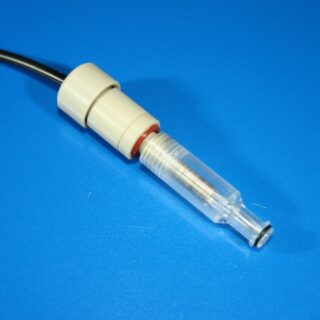
Read moreThe Oxygen electrode consists of a PEEK body, platinum electrode, silver reference electrode and membrane holder.
The platinum electrode is melted in glass. The membrane holder with electrolyte is attached by thread. Oxygen electrode (OE) is designed for measurements with thermostated cell TC4, TC5, TC6.
-
Offer of long-term automated measurements on BVT apparatus
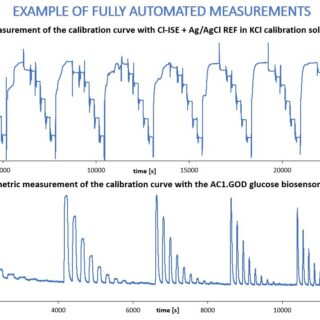
Read moreSPE sensors work best in flow mode. For these purposes, the BVT laboratory is equipped with potentiostats, high-pressure pumps, peristaltic pumps, linear pumps, liquid switches and flow cells.
Measurement by FIA and DIA (Flow injection and Diffusion injection analysis) methods in connection with a microdialysis catheter.
We have a unique AUTOSAMPLER device (x-y-z robot) with a movable arm, allowing the movement of the measuring probe between up to 50 samples.Example of use:
- semi-continuous measurement by classic immersion of electrodes in samples
- continuous measurement in flow mode using the DIA and FIA methods
-
PalmSens4
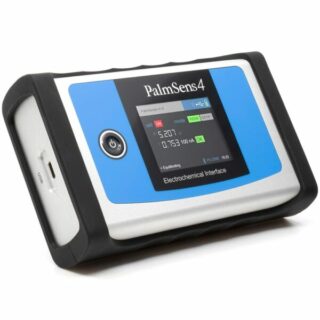
Read moreThe PalmSens4, is a USB and battery powered Potentiostat, Galvanostat, and optional a Frequency Response Analyser (FRA) for Electrochemical Impedance Spectroscopy (EIS).
Compact, versatile and powerful
- (Bi)Potentiostat / Galvanostat / Impedance Analyzer
- FRA / EIS: 10 μHz up to 1 MHz
- 9 current ranges: 100 pA to 10 mA
- 18-bit resolution
- Bluetooth or USB connection
The PalmSens4 has a large potential range (-5V to 5V or -10V to 10V) and current range (100 pA to 10 mA) with a high resolution and low noise. The economical PalmSens4 is a complete laboratory instrument but its compact and rugged design makes it also ideal for field work.
Connecting via Bluetooth guarantees a perfectly floating measurement.
More information can be found through the link: https://www.palmsens.com/product/palmsens4/
Configurable
PalmSens4 comes in different configurations:
- ±5 V or ±10 V potential range
- EIS/FRA with maximum frequency of 100 kHz or 1 MHz
- optional BiPotentiostat module for second WE
- optional iR-Compensation
Standard included
- Rugged carrying case
- High quality, double shielded cell cable with
2 mm banana connectors for Working, Counter, Reference electrode and Ground - Crocodile clips
- Dummy cell
- USB cable
- Manual and Quick Start document
- PSTrace software for Windows
-
PE Paste Electrode
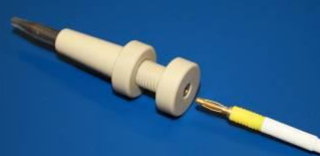
Read moreThe PEc consists of a PEEK body containing screw and piston with contact. The electrode itself is polyethylene tip profiled with paste.
The graphite paste is delivered as a standard electrode. Standard connection is with a 2 mm banana plug. Paste electrode (PEc) is designed for measurements with TC4, TC5 and TC6 glass cell. PEc is used for measurement of cyclic voltammetry and stripping voltammetry. The tip with paste is exchangeable.
-

Platinum Coated Titanium Mesh Electrode with Holder – set of 10 pcs (redox.me)
Read moreThe metal counter (auxiliary) electrode is provided in electrochemical cell as a current sink to shunt excess current away from the reference electrode. Platinum Coated Titanium Mesh Electrode is a cheap alternative to pure Platinum Electrodes like Platinum Gauze Electrode or Metal Wire Auxiliary Electrode. Platinum coating makes this counter electrode inert under the reaction conditions and provides catalytic properties. The electrode is installed in the Basic Sample Holder (1 pcs included in the set), which allows full immersion of the electrode in the electrolyte (wet Tantalum contact). It well fits aqueous and organic solvent electrolyte requirements. Electrode size is customizable.
Application note
The Platinum Coated Titanium Mesh Electrode is fully immersed in the ion-conducting solution as a counter electrode. An electric current is passed between the working electrode and the Platinum Coated Titanium Mesh Electrode for a certain amount of time. After the process, the electrode should be washed several times with ethanol and dried under the nitrogen flow. Store the electrode in a dedicated compartment to avoid scratching. Discoloration may indicate the degradation (dissolution) of the Platinum layer and oxidation of Titanium mesh.
This electrode is used mainly in systems where there is a high risk of its contamination by organic or inorganic deposit during the electrochemical reaction. It is also a cheap replacement for pure Platinum electrode in electrodeposition processes.Specification
Titanium grade: GR1
working current: <5000 A/m2
Platinum content: >15 g/m2
Platinum coating thickness: 760 – 1500 nm
mesh hole size: 3 mm x 2 mm
mesh thickness: 0.5 mm
electrode size: 25x25mm2, 50x50mm2, 100x100mm2, custom
pH range: 1-12Intrastat data
HS Code: 71151000
Country of Origin: Sweden
NET weight: 100 gProduct includes
10 x Platinum Coated Titanium Mesh Electrode of selected size
1 x Basic Sample Holder (if selected) -
PME011 Microdialysis Catheter Microeye
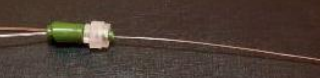
Read moreMicrodialysis catheter is provided with a special membrane which produces a “plasma-like” sample without the need for blood centrifugation.
It enables “plasma-like” samples taking and continuous monitoring of low-molecular substances in circulating blood without withdrawing blood from the patient. It offers virtually real-time information. Samples can be collected for off-line analysis if required. This catheter is easy to use and reduces risks of contact with blood borne pathogens. The MicroEye is intended for intravenous use for periods up to 48 hours and is inserted via 18G blood catheter.
The range of substances that can be monitored using this catheter
- Electrolytes (such as potassium, magnesium etc.)
- Energy metabolites (glucose, lactate, pyruvate, etc.)
- Amino acids (glutamate, GABA, etc.)
- Hormones and neurotransmitters (dopamine, serotonin, etc.)
- Inflammatory mediators and growth factors (cytokines, etc.)
- Drugs and their metabolites (unbound “free fractions and /or total
-
PP10.M*.T* Peristaltic pump
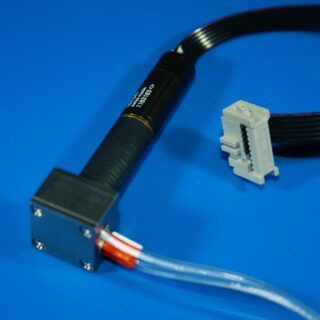
Read moreThe peristaltic pump PP.M10/*.T* consists of miniature motor with planetary gear and stainless body of peristaltic pump.
Optionally the motor is equipped with encoder. The pump has one channel. The flow is in one direction. The pump is designed for extremely small applications such as medical or military applications. It can be used in hand-held devices. The lifetime of tubing is optimized to maximal value. The pulsation is minimized for flow cell FC2. The device is supplied by USB connection with PC.
-
Project Support and Consultancy
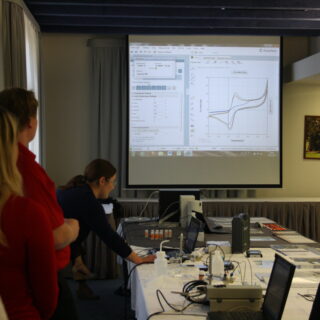
Read moreBVT has a lot of experience from participating in International Projects and developments of technology such as Sensors/Electrodes and Lab Equipment, which allows us the ability to provide support and consultancy services for multiple types of projects and also as a 3rd party expert for help or consultancy on projects. With our 30+ Years of experience in a range of areas, we can provide expert and reliable advice.
We have experts in the field of Chemistry, Biochemistry, Thick Film Technology and Engineering and Design, who are on hand with their knowledge to assist partners and customers alike. Some examples of Projects that we have worked on include HydroSense (No. 7D19007), InFuLOC (No. 230749) and BioMedNano (No. 017350), these projects show a range of what BVT has to offer in other projects and as consultants.
-

Raman Electrochemical Flow Cell, active area: 3.5 cm2, volume: 4.5 mL (redox.me)
Read moreThis cell combines two classical analytical techniques such as electrochemistry and Raman spectroscopy, to obtain in-situ chemical information about the reactions taking place during an electrochemical experiment. It consists mainly of three elements: (i) sample holder with Tantalum (formerly Copper) foil serving as an electric contact to working electrode surface, (ii) chamber in which reference and counter electrodes are installed together with electrolyte inlet and outlet and (iii) lid which seals the cell and holds the Sapphire window. The sample consisting of a thin film of electrochemically active material deposited on a rigid or flexible substrate (working electrode) is loaded from the bottom via magnetic or screw mount. The counter or/and reference electrodes are mounted in a top casing (either 2-, or 3-electrode setup. The oval counter electrode made of e.g. Platinum wire assures uniform distribution of the field lines along the path to working electrode. During an experiment Raman laser is focused onto the surface of a thin film working electrode through a transparent Sapphire window and thin layer of electrolyte (total optical path of 3.25 mm). The electrolyte thickness of 2.25 mm ensures free diffusion of ions (e.g. protons) and its counter ions.
The electrode adapter for installing 6 mm dia. electrodes inside Raman ECFC is available here. It enables using disk electrode, plug with clip or any other rod-shape electrode (e.g. graphite rod) or current collector (e.g. metal mesh, graphite coated metal mesh, metal foil, graphite coated metal foil, metal foam, carbon woven and non-woven fabrics, carbon paper, etc.) as working electrode instead of a flat electrode in default Raman ECFC configuration.
The screw mount variant of Raman ECFC can be converted into GDE Raman ECFC by using Gas Compartment. This conversion allows installation of Gas Diffusion Electrodes as working electrode.
The cell elements are constructed with materials that are inert to the sample (PEEK, Fluorocarbons). It well fits aqueous (FKM O-Rings) and organic solvent (FFKM O-Rings) electrolyte requirements. The construction is gas-tight and can be used when the removal and exclusion of contaminants such as oxygen and water is required by bubbling of an inert gas through the electrolyte (in an external reservoir).
Application note:
This cell can be used to track kinetic phenomena such as the near-surface proton concentration changes during oxidation and reduction reaction at working electrode. It can be also used to identify materials such as carbon, metal oxides, polymers and electrolytes, and to determine their structure and distribution. Various metals are suitable for this cell as auxiliary electrode including Platinum, Gold and Silver.Specification:
nominal exposure area: 3.5 cm2
electrolyte volume: 4.5 mL
optical path (including Sapphire window): 3.25 mm
electrode plug diameter: 6 mmIntrastat data:
HS Code: 90275000
Country of Origin: Sweden
NET weight: 200 gProduct includes:
1 x chamber
1 x Reference electrode (Ag/AgCl, or Ag/Ag+), 30mm
1 x Metal wire auxiliary electrode – ST 0.6/150 mm, Platinum
1 x Sapphire window – 0054PSPCM
1 x lid
1 x WE Tantalum contact
1 x sample holder
1 x plug – 0005CPEMA -
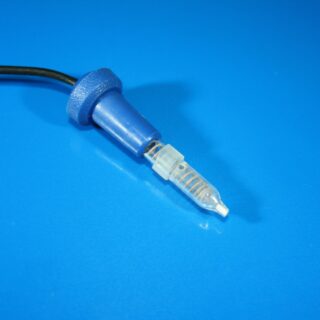
RCEc.R* Reference Classic Electrode Conic
Read moreRCEc is a glass hollow tube with silver or silver covered by silver chloride wire inside. The tube is hollow with the hole in the wall for inserting KCl solution.
Hole is covered by a rubber band. Reference classic electrode (RCEc) is designed for measurements with glass cell TC4, TC5, TC6, TC9.
Standard connection is with a 2 mm banana connector.
Connector or banana plug colour is blue.
-

Sample Holder 25 mm x 25 mm (redox.me)
Read moreThe sample holder (known also as flat specimen holder) is used for holding flat, circular or square/rectangular samples. It enables contacting the sample from the front (e.g. ITO/FTO glass, Monolayer Graphene on SiC, or Boron-Doped Diamond thin film on various substrates) and from the back (e.g. metal specimen, Glassy Carbon plate, Boron-Doped Diamond plate). The default nominal aperture is 1cm2, but other value can be provided on request. The large electrical contact with Tantalum (formerly Copper) foil surface (not being in contact with an electrolyte) ensures optimal current collection by minimizing electrical resistance and unifying current distribution. The rod with electrical connection has a diameter of 6 mm, which makes the sample holder compatible with our voltammetry cells and jacketed cells, as long as it fits in. We may also provide an adapter to install this sample holder in openings larger than 6 mm dia.
The sample holder elements are constructed with materials that are inert to the electrochemical system (PEEK, Fluorocarbons). It well fits aqueous (FKM/EPDM O-Rings) and organic solvent (FFKM O-Rings) electrolyte requirements. The construction is well sealed which prevents the electrolyte to leak inside.
Application note
The sample holder is used largely for corrosion studies. It can be installed in a beaker type cell as well as in testing environments such as open water reservoirs, cans, tanks etc. It can also be used wherever it is necessary to make an electrode using a thin layer of an active material deposited on a flat substrate (conducting or insulating).Specification
nominal aperture range: 0.008 cm2 (1 mm dia.) – 4.155 cm2 (23 mm dia.)
minimum aperture: 0.008 cm2 (1 mm dia.)
maximum aperture: 4.9 cm2 (23 mm dia.)
electrical connection diameter (rod): 6 mm
minimum substrate size:nominal aperture minimum substrate size 0.008 cm2 (1 mm dia.) 10 x 10 mm2 (square) or 12 mm dia. (circular). 0.196 cm2 (5 mm dia.) 7 x 7 mm2 (square) or 10 mm dia. (circular). 0.283 cm2 (6 mm dia.) 8 x 8 mm2 (square) or 11 mm dia. (circular). 0.385 cm2 (7 mm dia.) 9 x 9 mm2 (square) or 12 mm dia. (circular). 1 cm2 (11.3 mm dia.) 13 x 13 mm2 (square) or 16 mm dia. (circular). 1.76 cm2 (15 mm dia.) 17 x 17 mm2 (square) or 20 mm dia. (circular). 3 cm2 (19.5 mm dia.) 22 x 22 mm2 (square) or 24 mm dia. (circular). 3.5 cm2 (21 mm dia.) 23 x 23 mm2 (square) or 25 mm dia. (circular). 4.155 cm2 (23 mm dia.) 25 x 25 mm2 (square only) maximum substrate size: 25 x 25 mm2
maximum sample thickness: 4 mm
contact type: front or backIntrastat data
HS Code: 90309000
Country of Origin: Sweden
NET weight: 100 gProduct includes
1 x chamber
1 x lid
1 x contact (Tantalum foil)
1 x rod with electrical connection -
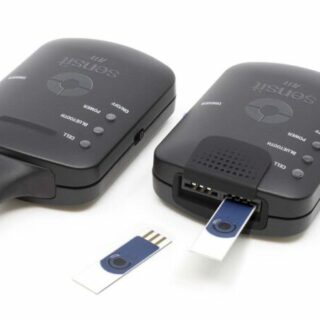
Sensit BT
Read moreHandheld and wireless dual-channel potentiostat
- Capable of EIS up to 200 kHz
- Built around the EmStat Pico module
- Potential range -1.7 to +2 V
- Current ranges 100 nA – 5 mA (max ±3 mA)
- Can be used without PC or smartphone connection
The Sensit BT is ideal for electrochemical sensor applications. The Sensit BT connects via Bluetooth to your smartphone or tablet and controlled via the Android app PStouch. You can use the USB-C port to charge the Sensit BT or connect to a classic USB port on your PC and control the Sensit BT via our PC software PSTrace.
The Sensit BT supports most common electrochemical techniques, including Cyclic Voltammetry, Square Wave Voltammetry and Impedance Spectroscopy (FRA/EIS).
More information can be found through the link: https://www.palmsens.com/product/sensit-bt/
Two versions:
Sensit BT.SPE Sensit BT.SNS 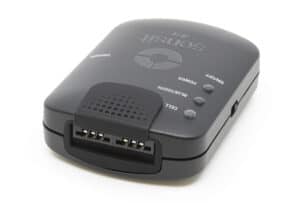

Sensor pitch 2.54 mm Cable length 40 cm Electrode connections RE, WE, CE Connectors 2 mm banana Allowed sensor thickness Between 0.1 mm and 0.8 mm Electrode connections RE, WE, WE2, CE Maximum sensor width 11 mm Dual-channel and Bipotentiostat
The Sensit BT.SPE can be used for running sequential measurements on two different Screen-Printed Electrodes (SPE’s) each with their own Reference, Counter and Working electrodes.
The second channel can also be used in Bipotentiostat mode, functioning as second Working Electrode versus the Reference and Counter electrode of channel 1. Both working electrodes are recorded simultaneously in the Bipotentiostat mode.
The Sensit BT.SNS has a lead connected to the WE of channel 2 and can be used out-of-the-box for BiPotentiostat measurements.
On-board data storage
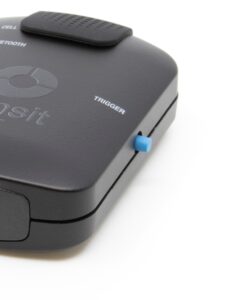
The Sensit BT is equipped with 500 MB internal storage memory.
Save measurements on-board as a backup. Or pre-program the device with a script and use the trigger button to run and store measurements: no need to connect a PC or smartphone. Browse and transfer all internally stored measurements back to the PC easily using PSTrace for Windows.
-
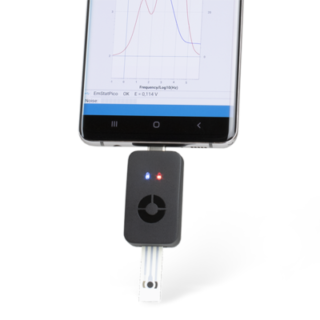
Sensit Smart
Read moreSmartphone potentiostat
- Capable of EIS up to 200 kHz
- Built around the EmStat Pico module
- Potential range -1.7 to +2 V
- Current ranges 100 nA – 5 mA (max ±3 mA)
The Sensit Smart can be directly inserted in a smartphone or tablet and controlled via the Android app PStouch. You can use the USB-C Female to USB-A cable to connect the Sensit Smart to a classic USB port on your PC and control the Sensit Smart via our PC software PSTrace.
The Sensit Smart supports most common electrochemical techniques, including Cyclic Voltammetry, Square Wave Voltammetry and Impedance Spectroscopy (FRA/EIS).
More information can be found through the link: https://www.palmsens.com/product/sensit-smart/
The Sensit Smart comes with:
- Dummy Cell (SPE version)
- SPE to screw-terminal adapter
- USB-C Female to USB-A cable
- USB-C Female to Micro USB adapter
- USB-C Extension cable
- USB-C port protector
- PSTrace software for Windows (activation code for my.palmsens.com)
- PStouch app for Android (find it in the Google Play Store)
Compatible with most common Screen Printed Electrodes / Sensors Sensor pitch: 2.54 mm Electrode connections: RE, WE, CE Allowed sensor thickness: Between 0.1 mm and 0.8 mm Maximum sensor width: 11 mm